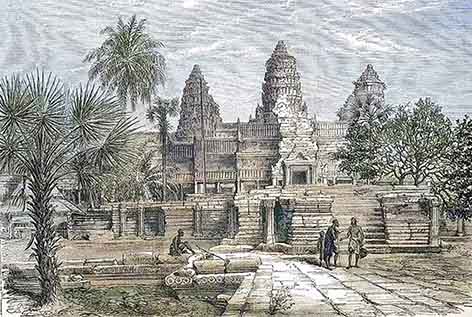
 The nineteenth century was a formative period in the European scholarly encounter with Asia’s historical depth. Travellers, administrators, antiquarians and scholars began to document the temples, inscriptions, languages and political traditions of a region that European geographical imagination had too often treated as an indistinct extension of the East. James Crawfurd’s writings on the Malay Archipelago, James Fergusson’s studies of architecture and Alfred Russel Wallace’s observations of the natural and cultural world of the East Indies belonged, in different ways, to this widening intellectual engagement. The more specialised historical and archaeological scholarship of the twentieth century would reveal the extraordinary extent to which the civilisations of Southeast Asia had been shaped by Indian religious, linguistic and cultural traditions.
The most consequential contributions include the work of the French historian and epigraphist George Coedès whose The Indianized States of Southeast Asia (1968) remains a landmark synthesis of the subject. First published in French in 1944, it traced the Indian imprint on the region’s political institutions, religious traditions and cultural life.
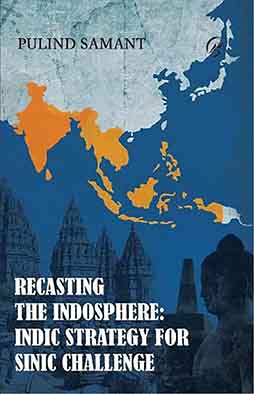
Pulind Samant’s Recasting the Indosphere: Indic Strategy for Sinic Challenge (Indus Scrolls Press, 2024) enters this intellectual territory with a purpose that is at once historical and contemporary.
In Samant’s reading, these connections constitute a strategic resource - an inheritance that India has insufficiently understood, inadequately cultivated and, in consequence, failed to deploy with the imagination it deserves.
The book’s ambition is considerable. It sweeps across Indonesia, Malaysia, Thailand, Vietnam, Cambodia, Laos, Singapore and Myanmar before drawing these individual histories into the larger conceptual framework of the Indosphere.
It trenchantly examines the relationship between the Indosphere and the Sinosphere, considers the nature and limitations of India’s soft power, and what the author describes as the civilisational contest between Indic and Sinic influence.
The result is a magisterial work that attempts to connect cultural history, political geography and contemporary international relations within a single interpretative framework.
Cultural Assimilation
The opening chapters demonstrate how deeply Indic traditions became embedded in the societies of Southeast Asia. Indonesia provides perhaps the most striking illustration. The Sanskrit-derived vocabulary of Bahasa Indonesia, the cultural endurance of the Ramayana and Mahabharata, and the extraordinary survival of the epics through Wayang Kulit shadow-puppet theatre are not incidental survivals of an exotic past. They are evidence of a long process of cultural assimilation through which Indic traditions acquired distinctly local forms.
The Indonesian national motto, Bhinneka Tunggal Ika - unity in diversity - and the term Pancasila, with its Sanskrit antecedents, offer further reminders of an inheritance that continues to inform the country's public vocabulary and national imagination.
Thailand’s relationship with the Ramayana, expressed through the Ramakien, and the adoption of Rama as a royal title provide another compelling example. In Vietnam, Samant examines the historical distinction between the Sinic influence of the north and the Indic inheritance of the Cham civilisation in the south. Cambodia and Laos reveal the depth of Hindu-Buddhist and Sanskritic traditions in mainland Southeast Asia, while Myanmar and Singapore offer further instances of the region’s complex cultural and historical connections with India.
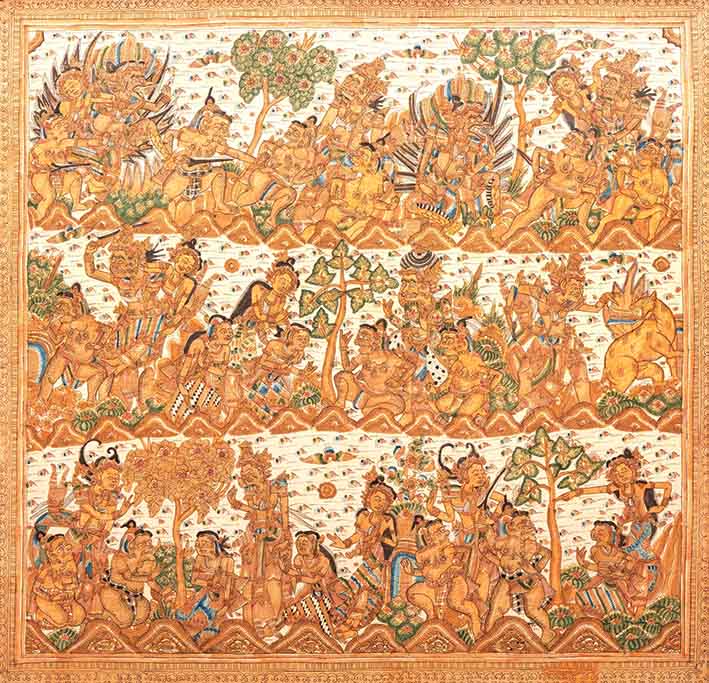
The spread of Indic civilisation across the region, maintains Samant, should not be confused with European colonial expansion. It was not principally the product of territorial conquest or the imposition of a centralised imperial authority.
Its transmission took place through maritime commerce, religious teachers, scholars, traders and cultural exchanges, with local societies adopting and reshaping the traditions they encountered. The resulting civilisations were not Indian replicas but distinctive creations in which Indic elements interacted with indigenous beliefs and institutions. This helps explain why the Indian inheritance could survive in forms that were recognisably local while retaining a deep connection with the subcontinent.
‘Indosphere’ itself was coined by the American linguist James Matisoff to describe areas of Indian linguistic and cultural influence in Southeast Asia. Samant takes the idea beyond its original linguistic application and develops it into a broader civilisational and strategic category. The Indosphere, in his formulation, is not simply a geographical zone or a collection of countries with historical links to India. It is a cultural continuum, sustained by shared traditions, religious ideas, languages, literary inheritances and historical memories.
In its geographical sweep and its attempt to understand Southeast Asia as an interconnected historical world, the book invites comparison with Anthony Reid’s Southeast Asia in the Age of Commerce, 1450–1680 and Victor Lieberman’s Strange Parallels. Reid’s work illuminates the commercial networks, social structures and cultural transformations that shaped the region, while Lieberman’s ambitious comparative history examines the longer patterns of state formation and political change in mainland Southeast Asia and their parallels across Eurasia.
Strategic Framework
Samant’s distinctive contribution is to bring this historical canvas into a contemporary strategic framework. He effortlessly moves across political history, religious traditions, linguistics, epigraphy, maritime trade and the evolution of statecraft, drawing together material dispersed across specialised disciplines.
His use of Friedrich Hirth’s observations on the Chinese tributary system is particularly germane. Hirth had questioned the assumption that every Chinese tributary mission represented a straightforward acknowledgement of political subordination, suggesting that many such exchanges also served the practical purposes of regulated trade. The distinction between the ceremonial language of imperial suzerainty and the realities of commercial and political interaction is vital to understanding the historical relationship between China and its neighbours.
Samant argues that India has not adequately recognised the strategic value of its cultural inheritance in Southeast Asia. Its engagement with the region, he suggests, has too often been framed through the immediate vocabulary of trade, diplomacy and maritime security without sufficient attention to the deeper connections that could lend these relationships greater substance.
The discussion of India’s soft power therefore goes beyond the familiar and asks how historical memory, shared religious traditions, language, literature, education and the preservation of cultural heritage might be organised into a more coherent instrument of public diplomacy.
Samant acknowledges that India has begun to address this deficit. The strengthening of ties with ASEAN, the establishment of a dedicated diplomatic mission at Jakarta, scholarships for Southeast Asian students at Nalanda University, the restoration of heritage sites and the symbolic significance of high-level visits to places of Hindu-Buddhist importance all figure in his assessment. Yet he regards these initiatives as insufficient in relation to the scale of the historical opportunity. His argument is that cultural diplomacy cannot be reduced to occasional gestures or ceremonial recognition but requires sustained academic engagement, country-specific understanding and a willingness to invest in the study of the region’s shared past.
Long Duel
Drawing on the decline of the Cham, Kambuja and Majapahit polities, the history of Chinese imperial power projection, the voyages of Zheng He and the subsequent transformation of the region’s political and religious landscape, Samant advances a reading of Southeast Asian history as a prolonged contest between Indic and Sinic influence. He also examines what he sees as a Sinic-Islamic dimension to this historical transformation, particularly in his interpretation of the decline of Majapahit and the rise of Malacca. These are among the book’s more provocative and fascinating propositions.
Samant has assembled a substantial body of material and fashioned it into a sustained argument about a dimension of India’s historical and strategic imagination that has received far less attention than it warrants. His achievement is to make the reader look eastwards and recognise a much older geography of cultural connections.
Recasting the Indosphere is a work of considerable learning, ambition and originality of perspective. It asks Indian readers to approach Southeast Asia not merely through the contemporary lenses of trade and diplomacy but through the longue durée of a shared civilisational history. Historians, scholars of international relations and students of Asian affairs will find much to engage with in its pages. This is a book that deserves to be read widely, discussed seriously and, above all, to stimulate further scholarship on a subject that has remained too long at the margins of India’s intellectual and strategic discourse.