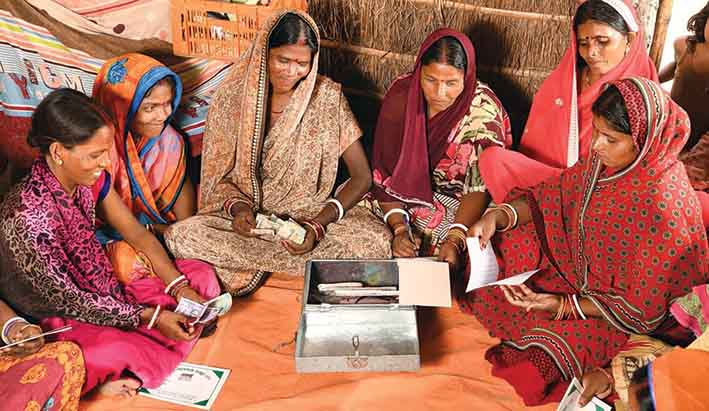
For millions of rural women in the country, a Self-Help Group (SHG) is often their first point of entry into the formal financial system. Through collective savings, access to bank credit and shared decision-making, these groups have enabled women to participate in economic activities that were previously beyond their reach. Over the years, the SHG movement has become an important instrument of rural development and financial inclusion. Yet its larger promise remains only partly realised: have these groups created sustainable economic opportunities, or do they still function primarily as networks for savings and microcredit?
The scale of the movement is considerable. Under the Deendayal Antyodaya Yojana–National Rural Livelihoods Mission (DAY-NRLM), approximately 92 lakh SHGs had been formed, covering more than 10 crore rural women as of July 2026. This represents a major achievement in community mobilisation and financial inclusion. By bringing women into organised groups, the programme has created platforms for collective action, financial discipline and greater participation in household and community decisions.
The significance of this achievement becomes clearer against the wider rural economic landscape, where women continue to face barriers to formal employment, productive assets and independent sources of income. SHGs have helped address the problem of financial exclusion, but the transition from access to finance to control over productive economic opportunities remains far more difficult.
Beyond Inclusion
The importance of this model extends beyond access to loans. For women with limited financial independence, SHGs provide opportunities to save regularly, obtain institutional credit and reduce dependence on informal moneylenders. They also strengthen confidence, social networks and participation in household financial decisions. In many rural communities, these groups have become important intermediaries between women, banks, government institutions and local markets.
However, financial inclusion and economic empowerment are not synonymous. Access to credit does not automatically translate into higher incomes or sustainable livelihoods. While loans can help women initiate small economic activities, building an enterprise requires considerably more than working capital. Women entrepreneurs often struggle to identify markets, maintain product quality, access modern equipment, develop brands and compete with established businesses. Activities such as tailoring, food processing, handicrafts and livestock rearing may generate supplementary income, but turning them into viable businesses requires sustained institutional and commercial support.
Market access remains one of the most significant missing links. Producing goods does not guarantee buyers. Many SHG products remain confined to local markets, exhibitions and occasional fairs. Limited knowledge of pricing, packaging, logistics and digital marketing further restricts their reach. Without reliable market connections, even enterprises that receive initial financial support may struggle to expand or survive.
There is also the problem of scale. Individual SHG members generally operate with limited resources, making it difficult to invest in machinery, standardise production or fulfil large orders. Consequently, many enterprises remain small and dependent on local demand. Without stronger connections to institutional buyers, retailers and larger supply chains, their ability to generate consistent incomes remains constrained.
The Lakhpati Didi
The government’s Lakhpati Didi initiative attempts to address this broader challenge by encouraging SHG members to earn an annual household income of at least Rs.1 lakh on a sustainable basis. It recognises that women's economic empowerment must extend beyond access to financial services. The initiative seeks to connect women with diversified livelihood opportunities, entrepreneurship training and institutional credit.
Other interventions are also intended to strengthen the rural enterprise ecosystem. The Start-up Village Entrepreneurship Programme (SVEP), under DAY-NRLM, supports rural entrepreneurs through training, financial assistance and business mentorship. Similarly, initiatives such as Saras Aajeevika and the e-Saras platform seek to connect SHG producers with wider consumer markets.
These programmes reflect an important shift in rural development policy: from treating women primarily as beneficiaries of financial inclusion to recognising them as potential producers, entrepreneurs and participants in the wider economy. Their effectiveness, however, will depend on whether commercial support and market access become permanent features of the SHG ecosystem rather than occasional interventions.
Entrepreneurship support cannot be confined to occasional training programmes or the provision of loans. Women need continuous assistance at different stages of enterprise development, from identifying viable opportunities to managing accounts, procuring raw materials and building customer relationships. Training must respond to local market demand rather than offer identical activities across regions with different economic conditions.
Another priority is to move beyond individual and group-level production towards collective enterprise development. SHG federations and producer groups can help women aggregate products, achieve economies of scale and negotiate better prices. These institutions can also support procurement, transportation, branding and marketing, reducing the burden on individual entrepreneurs.
Digital integration could further strengthen this transition. E-commerce platforms, digital payments and social media marketing can connect women-led enterprises with customers beyond local markets. But simply listing products online is insufficient. Digital literacy, product photography, packaging standards, inventory management and reliable delivery systems are equally important. Technology must be accompanied by the institutional support that makes it commercially useful.
Equally important is recognising that not every SHG member wants to become an entrepreneur. Some women may prefer wage employment, agricultural activities or part-time livelihood opportunities. The objective should be to expand economic choices rather than expect every member to run a business. SHGs can also connect women with skill development programmes, local employers and producer organisations.
Measuring Success
Ultimately, the success of India’s SHG movement should be measured by what happens after financial inclusion. Are women earning stable and adequate incomes? Are their enterprises surviving beyond initial government support? Are they gaining greater control over household finances and business decisions? Participation in an SHG does not automatically translate into economic independence.
India has demonstrated that collective mobilisation can bring millions of rural women into the financial system. The next challenge is to help them move further up the economic ladder through stronger market linkages, sustained enterprise support, better infrastructure and participation in larger value chains.
The rise of Self-Help Groups has indeed altered the social and political landscape of rural India. By bringing women together around a shared economic purpose, SHGs have created spaces for collective decision-making, mutual support and engagement with local institutions. For many women, participation has meant a first opportunity to handle money independently, interact with banks and government officials, and acquire a voice in matters extending beyond the household. In villages where caste, class and gender continue to shape access to resources, these networks can also challenge established hierarchies, although their impact varies considerably across regions.
SHGs have the potential to become much more than networks for savings and credit. They can evolve into profound institutions that nurture entrepreneurship, create local employment and strengthen women’s economic agency. Their larger significance lies not only in the credit they mobilise but also in the collective confidence and bargaining power they can build.
(The writer is an economics postgraduate from Jawaharlal Nehru University with research interests in economic policy, trade and global governance. Views personal.)