Jensen Huang, the man who helped turn artificial intelligence into Silicon Valley’s new religion, has discovered that even a four-trillion-dollar technological empire can be shaken by something considerably more primitive than a computer virus: human desire.
Last week, Huang resigned as chief executive of NVIDIA, the company he co-founded in 1993, bringing an extraordinary 33-year tenure to an abrupt end. His departure followed revelations of multiple extramarital relationships, including one with Alice Huang, a Chinese businesswoman suspected by American intelligence of having links to Beijing. The spectacle of an artificial intelligence colossus being rocked by the oldest of human vulnerabilities had an unmistakably cinematic ring about it.
The movies have long understood that the most sophisticated security apparatus can be undone by an ill-judged romance. The sinister honeytrap has supplied films with an enduring gallery of duplicitous lovers, compromised officials and professional seducers.
Old Playbook
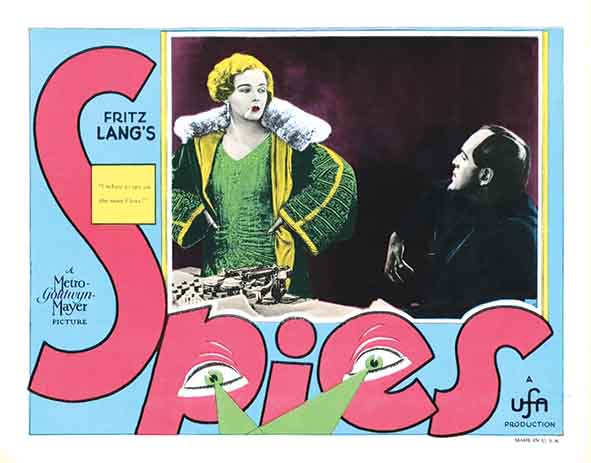
One of its earliest and most ingenious exponents was the Austrian auteur Fritz Lang. His 1928 classic Spione (‘Spies’) anticipated practically every ingredient of the modern espionage thriller. At its centre is Haghi, an apparently respectable banker who secretly commands an international spy network dealing in murder, sabotage, extortion and stolen government secrets. His operative Sonja is assigned to eliminate ‘Agent No. 326,’ but the mission becomes complicated when she falls in love with her intended victim.
Lang, fresh from the monumental visual experiments of Metropolis (1927), constructs a labyrinthine world of disguises and elaborate double-crosses. The film’s ingenuity lies in its understanding that the operative who sets out to manipulate another person may eventually become a victim of her own deception.
Three years later, Marlene Dietrich gave the female spy an altogether more glamorous incarnation in Josef von Sternberg’s Dishonored (1931). Playing X-27, a widowed Austrian woman recruited into the secret service during the First World War, Dietrich is instructed to employ her feminine charms in the service of the empire. Her assignment brings her into contact with a Russian officer, Colonel Kranau, played by Victor McLaglen. Their encounters develop into a dangerous game of attraction, suspicion and divided loyalties.
In a final, cruel irony, X-27, having served her country with distinction, is condemned to a firing squad. The state that has exploited her sexuality has little use for her once she becomes expendable.
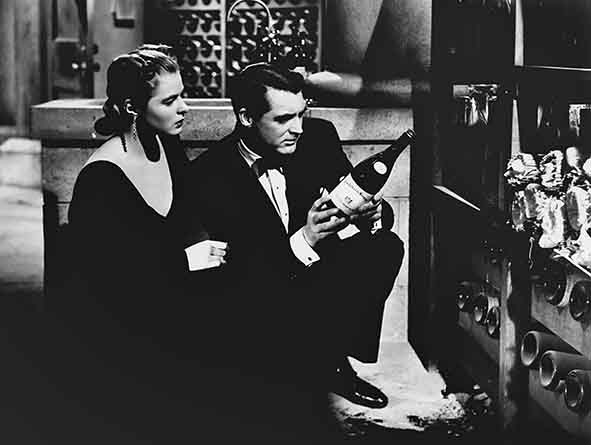
The moral squalor of this arrangement found perhaps its most sophisticated expression in Alfred Hitchcock’s Notorious (1946). Ingrid Bergman plays Alicia Huberman, the daughter of a convicted Nazi, recruited by American intelligence to infiltrate a circle of German expatriates in post-war Brazil. Her assignment is to cultivate the affections of Alexander Sebastian, played by Claude Rains, a former Nazi operative. Cary Grant’s Devlin, the intelligence officer who recruits her, is also the man who loves her. Nevertheless, he sends her into another man’s arms.
Seldom has the cruelty of espionage been explored cinematically with such psychological starkness. Alicia is expected to surrender her dignity and risk her life for a cause, while Devlin’s jealousy makes him almost as punishing as the enemy. The celebrated wine-cellar sequence, involving stolen uranium concealed in bottles of champagne, remains a masterclass in suspense. Hitchcock shows that the most ‘effective’ honeytrap is the one where those who deploy it deceive themselves about the price to be paid.
Cynical Tradition
By the 1960s, espionage cinema was beginning to split into two rather distinct traditions. The James Bond phenomenon, launched with Dr. No in 1962, had turned the secret agent into an international adventurer surrounded by exotic locations, ingenious gadgets and accommodating women. But the more disenchanted and ‘realistic’ tradition, associated with John le Carré and Len Deighton, was dismantling Bondian glamour.
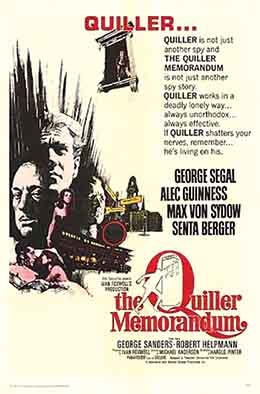 Michael Anderson’s The Quiller Memorandum (1966), scripted by Harold Pinter, is one of its finest and most neglected examples. Based on Adam Hall’s novel The Berlin Memorandum, it stars George Segal as Quiller, an American intelligence operative working for British intelligence in West Berlin. His assignment is to penetrate a neo-Nazi organisation known as Phoenix. He becomes involved with Inge Lindt, a schoolteacher played by Senta Berger, whose apparent innocence conceals a more troubling allegiance.
Pinter’s dialogue, with its pauses, evasions and seemingly inconsequential exchanges, lends the film an atmosphere of exquisite unease. The film’s chilling conclusion is a reminder that the most dangerous intelligence asset may be the person one has allowed oneself to trust.
Robert Tronson’s Ring of Spies (1964), a reconstruction of the Portland spy ring, was one of the most consequential British counter-intelligence cases of the Cold War and a spectacular honeytrap case.
Harry Houghton, a former Royal Navy serviceman, had been recruited by Polish intelligence while working in Warsaw in the early 1950s. His espionage activities subsequently passed under Soviet control. After returning to Britain in 1953, he worked at the Royal Navy’s Underwater Detection Establishment in Portland, Dorset, where he was joined by Ethel Gee, a colleague with access to highly classified material. Their relationship provided a convenient domestic cover for the movement of stolen documents.
The couple travelled regularly to London, posing as husband and wife, to meet their Soviet controller, Gordon Lonsdale, a seemingly unremarkable Canadian businessman whose real identity was Konon Molody, a KGB intelligence officer operating under an assumed name. The stolen material included sensitive naval intelligence, including information relating to British anti-submarine capabilities.
In January 1961, MI5 surveillance culminated in the arrest of Houghton, Gee and Lonsdale in London. Two other members of the network, Peter and Helen Kroger, were arrested at their home in Ruislip. They were subsequently exposed as Morris and Lona Cohen, American-born Soviet agents who had operated as deep-cover illegals.
The Portland operation was not a conventional honeytrap. It showed that intelligence agencies do not always need to manufacture romantic entanglements to trap someone from the other side. Existing relationships, financial inducements, personal grievances and the intimacies of domestic life can be equally effective instruments of recruitment and concealment.
The Profumo affair offered an even more extraordinary intersection of sex, politics and intelligence. In 1963, British War Secretary John Profumo's relationship with Christine Keeler, who was also acquainted with Soviet naval attaché Yevgeny Ivanov, precipitated a political scandal that shook Harold Macmillan’s Conservative government.
Keeler moved through a social circle that included the osteopath Stephen Ward, whose acquaintances extended into both political and diplomatic worlds. Her relationship with Profumo became a national scandal when the minister was forced to admit that he had misled the House of Commons about their association, causing him to resign from the cabinet.
Whether Keeler was deliberately deployed as a Soviet honeytrap has never been established. Ivanov’s presence in the story, however, gave the affair an intelligence dimension that made it considerably more serious than an ordinary political scandal of the flesh. Macmillan resigned later that year, although the affair was not the sole reason for his departure.
The scandal generated its own cinematic curiosities. The Keeler Affair (1963), a British-Danish production, was made in Copenhagen while the scandal was still fresh. The British Board of Film Censors refused it a certificate on December 18, 1963, describing it as an “almost continuous picture of sordid vice.” When the film was resubmitted in 1969, amid renewed interest generated by Keeler’s memoirs, it was rejected again in March 1970.
The film was, however, shown in several overseas markets, including the United States and parts of Europe, making its exclusion from Britain all the more remarkable.
It was not until Michael Caton-Jones’s Scandal (1989) – starring Joanne Whalley as Keeler, Ian McKellen as Profumo and John Hurt as Stephen Ward - that British cinemagoers received a substantial cinematic reconstruction of the affair.
The honeytrap is a reminder that the human being remains the least predictable component of even the most sophisticated security system. While a firewall can be upgraded, the human heart has no two-factor authentication.