There was a time when Pune’s appeal lay in a distinctive combination of education, culture, political consciousness and a relatively tranquil way of life. Students came from across India to study, professionals to build careers and families to settle down. Its old neighbourhoods, theatres and universities gave it an identity quite unlike Mumbai’s frenetic urban sprawl. That reputation lies in tatters today as Pune increasingly makes headlines for its gangs, firearms, public assaults and disturbing instances of institutional impunity.
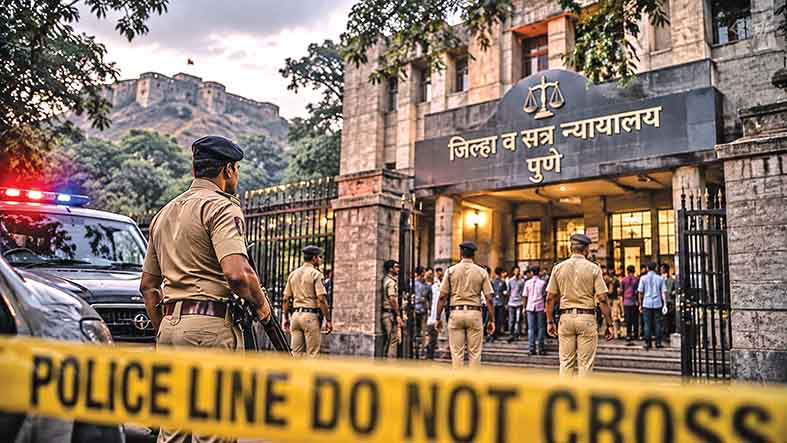
The latest reminder came in an extraordinary attack outside the Pune District and Sessions Court. Mandar Kiwale, 36, an accused in a murder case who had recently secured bail, was allegedly shot at by five assailants as he emerged from Gate No. 4. He attempted to flee towards the Civil Court Metro station, but his attackers pursued him and assaulted him with sickles, leaving him critically injured. A pistol was recovered from the scene.
Police have linked the assault to a murder in Katraj in April 2025, in which Kiwale was an accused. The attack was allegedly orchestrated by the brother of the man killed in that case. If the allegations are borne out, one murder has spawned another attempted killing, this time almost at the doorstep of the judiciary. That armed assailants could execute such an attack in broad daylight, in the vicinity of a major court complex, is as troubling as the crime itself. So, who is afraid of the law in Pune?
Unsettling Character
The city’s present predicament did not emerge overnight. In October 2008, the rape and murder of a young software engineer shocked its burgeoning IT community. The German Bakery bombing in February 2010, which killed 17 people and injured 56, exposed the vulnerability of a city rapidly acquiring national and international significance. That year, the murder of Sachin Kudle in Dattawadi, linked to gang rivalry, offered another reminder that organised criminal networks were hardly strangers to Pune.
In subsequent years, however, violence acquired a more visible and unsettling character. The emergence of so-called koyta gangs, whose members wield sickles to intimidate shopkeepers, motorists and residents, brought street-level criminality into everyday public consciousness. Videos of men vandalising vehicles and threatening people circulated widely. These were not necessarily sophisticated criminal enterprises; often they were local groups using intimidation and violence to settle scores or establish territorial dominance. But their brazenness suggested a growing willingness to challenge the authority of the state in public.
The Porsche tragedy in Kalyani Nagar in May 2024 exposed a different dimension of the problem. Two young IT professionals were killed when a Porsche allegedly driven by a 17-year-old under the influence of alcohol rammed into their motorcycle. The subsequent allegations of blood-sample manipulation, bribery and attempts to shield the accused transformed the accident into a national controversy. The issue was no longer merely reckless driving by a privileged teenager but whether wealth and influence could bend the machinery of justice even when two lives had been lost.
The murder of former corporator Vanraj Andekar in Nana Peth in September 2024, in which armed assailants used firearms and sharp weapons, brought gang rivalries and family feuds back into focus. The killing of businessman Satish Wagh in December 2024 and the Swargate bus stand sexual assault case in February 2025 added to public anxiety.
The statistics offer grounds for grave concern. NCRB figures for 2024 put reported violent crimes in Pune at 3,573, against 2,296 in 2023 and 2,417 in 2022. The category includes offences ranging from murder and attempted murder to grievous hurt, rioting, robbery and rape. Pune Police, meanwhile, have offered a more qualified assessment. Police Commissioner Amitesh Kumar said in January 2025 that registered criminal cases had risen from 11,974 in 2023 to 12,954 in 2024, but serious offences such as murder had declined from 101 to 93.
Political Duel
The incident has snowballed into a slanging match with NCP (Sharadchandra Pawar) working president Supriya Sule urging Chief Minister Devendra Fadnavis, who also holds the Home portfolio, to assume responsibility as Pune’s guardian minister. Congress state president Harshwardhan Sapkal and Shiv Sena (UBT) leader Sushma Andhare have also questioned the government’s handling of law and order.
There is a legitimate question of political accountability here. But changing the guardian minister’s nameplate is unlikely, by itself, to change the city's fortunes. The more consequential test is whether the government can translate its promises into sustained policing, intelligence-gathering and prosecution.
Pune’s rapid expansion makes the task more complicated. Hinjewadi, Wakad, Kharadi, Hadapsar and Baner have become major residential and commercial centres, while the IT, automobile, education and real-estate sectors have drawn people and investment on an enormous scale. Yet urban growth has placed mounting pressure on transport, housing, civic infrastructure and policing. A force once tasked with managing a considerably smaller city must now contend with sprawling suburbs, a mobile population and increasingly complex criminal networks. This is an administrative challenge, not an alibi for failure.
Illegal firearms must be traced to their sources, rather than merely recovered after an attack. The attack outside the court also demands a serious review of security arrangements around judicial institutions. An audit that produces another set of assurances but no demonstrable improvement is of little value.
The greatest danger is the gradual normalisation of violence. A modern metropolis cannot function on this cycle of shock and forgetfulness.
Pune’s future will not be secured by its IT parks or real-estate boom. A city that once advertised learning and civility cannot afford to acquire a reputation for gangs, guns and impunity. Pune is growing rapidly. The problem is whether the institutions responsible for governing it are growing fast enough.
(The writer is a political observer. Views personal.)