Is life, no less than the relationships between men and women, men and men, women and women, or parents and children, defined by pretensions? Are husbands and wives, bound by that supposedly sacred institution called marriage, ever entirely truthful to one another, even when adultery and other familiar social transgressions are absent? Or are we all prisoners of illusions of our own making, pretending to be what we are not for so long that the pretence itself begins to acquire the appearance of reality?
These questions lie at the heart of Edward Albee’s Who’s Afraid of Virginia Woolf? , a play that has retained its extraordinary psychological force across generations since its first premiere in the early 1960s. Its concerns extend well beyond marital discord. It examines the elaborate performances through which human beings negotiate identity, power, affection, disappointment and social respectability.
Theatrecians, Kolkata’s longest-active English theatre group, founded by Tathagata Chowdhury, recently brought Albee’s celebrated work to the city. Staging a play so closely associated with formidable performances on Broadway and in cinema is no small undertaking.
Chowdhury, however, took on the challenge of directing and acting in the production, presenting it to a packed Kolkata audience. The result is an energetic and absorbing theatrical experience that did justice to the play’s demanding emotional architecture.
The Absurd Condition
Albee (1928–2016) occupies an important place in modern American theatre. First staged in 1962, Who’s Afraid of Virginia Woolf? is a three-act drama that draws upon the sensibility of the Theatre of the Absurd, even though Albee resisted being confined to any single theatrical category. Its enduring appeal lies partly in its refusal to be tied to a particular period, geography or culture. The psychological territory it explores is universal.
‘The Theatre of the Absurd,’ a term popularised by critic Martin Esslin, describes a body of dramatic writing that emerged prominently in the 1950s and 1960s. Its philosophical antecedents can be traced to Albert Camus’s The Myth of Sisyphus (1942), in which the Greek mythological figure is condemned to push a boulder up a mountain, only to watch it roll back down, repeating the futile exercise for eternity.
Camus used this image to examine the absurdity of human existence: the conflict between humanity’s search for meaning and a universe that offers no reassuring answers. The devastation of the Second World War, the collapse of established certainties and the widespread disillusionment with inherited moral and social structures gave this sensibility particular urgency.
Writers such as Samuel Beckett, Eugène Ionesco, Jean Genet, Arthur Adamov and Harold Pinter, despite their considerable differences, repeatedly explored the predicament of individuals struggling to find purpose in an uncertain world.
Albee brings this philosophical unease into the apparently familiar territory of marriage and domestic life. His absurdity is not necessarily found in extraordinary events. It emerges from ordinary people behaving in extraordinary ways to protect themselves from truths they cannot bear to acknowledge.
Marriage as Theatre
The play revolves around two couples. George and Martha, an older married pair, return home after a university gathering and invite a younger couple, Nick and Honey, to join them in the early hours of the morning. Nick is a professor at the local university, while Honey is his seemingly innocent young wife.
What begins as an uncomfortable social visit soon becomes an extended exercise in psychological warfare. George and Martha appear incapable of speaking to each other without taunts, insults and provocations. Nick and Honey initially watch this spectacle with visible embarrassment, but they are gradually drawn into the older couple’s games.
The veneer of civility begins to peel away. Sexual jealousy, professional ambition, resentment, disappointment and concealed insecurities surface in increasingly unpredictable ways. Each character attempts to humiliate another, while simultaneously protecting a private vulnerability. The younger couple, who initially seem to represent a more conventional and respectable marriage, are themselves exposed as prisoners of their own evasions.
The boundaries between performance and reality become increasingly difficult to distinguish. The possibility of sexual betrayal becomes entangled in this theatre of manipulation.
At the centre of their marriage lies perhaps the most disturbing illusion of all: an imaginary son whom George and Martha have invented and nurtured as a substitute for the child they never had. This shared fiction has become an essential part of their relationship, a private world through which they have attempted to compensate for their disappointments. Its eventual destruction forces them to confront the emptiness beneath their carefully maintained domestic mythology.
The title itself is a stroke of theatrical ingenuity. It is a dark parody of the popular song “Who’s Afraid of the Big Bad Wolf?” from Walt Disney’s 1933 animated short Three Little Pigs. Albee replaces the threatening wolf with Virginia Woolf, the celebrated English modernist writer whose literary explorations often ventured into the complexities of consciousness, identity and human relationships.
To be afraid of Virginia Woolf is, in the context of Albee’s play, to be afraid of confronting life without the comforting illusions through which one has learnt to survive. As Tathagata Chowdhury observes, the play is about how afraid we are of living without our illusions. George and Martha have built an entire marriage around games, pretences and carefully constructed fictions.
Families, institutions and societies, too, construct narratives about themselves. We often prefer the reassuring fiction to the uncomfortable truth, not necessarily because we are incapable of recognising reality, but because acknowledging it might require us to change. The private theatre of George and Martha is a mirror held up to the larger theatre of human existence.
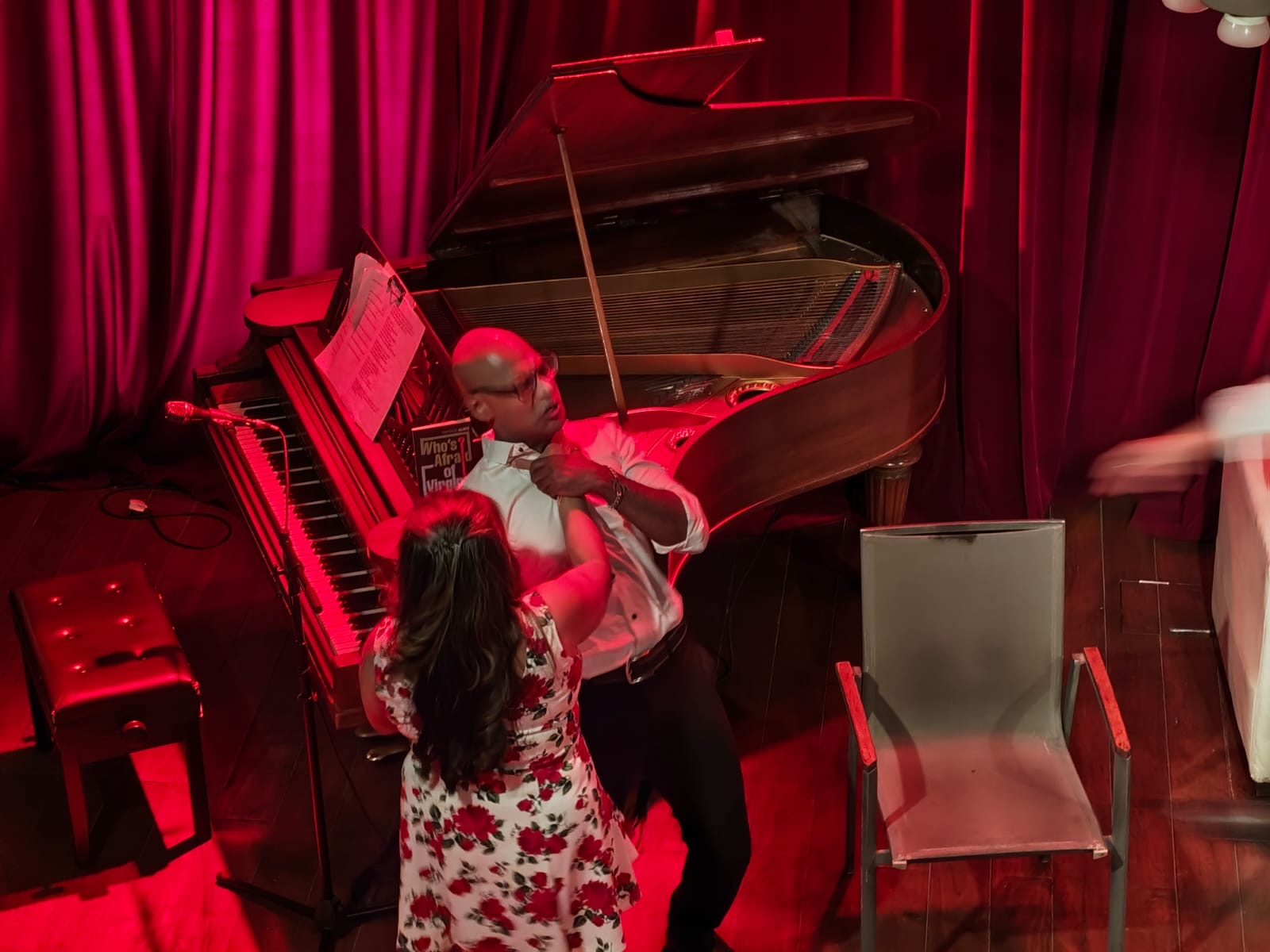
The Theatrecians’ production relies on a single set, but the arrangement is anything but static. The four actors — Kamalini Roy as Martha, Tathagata Chowdhury as George, Sulekha Nagpal as Honey and Yuvraj Surana as Nick — negotiate the crowded stage with considerable physical freedom.
Kamalini Roy brings an additional dimension to her performance through her piano playing and singing. The musical interludes are woven into the production rather than appearing as ornamental distractions. Chowdhury, meanwhile, makes full use of the stage, dancing, jumping, romping and moving about with an almost restless abandon that helps convey George’s shifting moods and unpredictable temperament.
The performances sustain the play’s difficult balance between comedy and cruelty. Its humour is frequently uncomfortable, its emotional confrontations often unsettling, and its moments of apparent levity rarely free from an undercurrent of menace. The four characters are continually testing one another’s limits, and the actors manage to keep this psychological contest alive without allowing the production to lose its momentum.
The lighting deserves particular mention. Its changing moods, especially the use of red, lend an added intensity to the proceedings, reflecting the volatility of the relationships and the emotional temperature of individual encounters. The music, movement and lighting combine to give the production a dynamic quality.
The play’s frank references to desire and marital dissatisfaction challenge conventional notions of propriety, exposing the contradictions between the moral codes people publicly endorse and the desires, frustrations and insecurities they privately conceal.
There is never a moment when the production appears to stand still or lose control. Its emotional turbulence carries the audience through successive layers of hostility, humour, vulnerability and revelation.
Theatre at its most compelling does not necessarily provide answers. It unsettles, provokes and compels audiences to look again at things they may have taken for granted. Albee’s play asks whether the institutions and relationships through which we define ourselves are built upon truth or upon mutually sustained fictions. The Theatrecians’ production admirably succeeds in bringing this disturbing question to the foreground.
(The writer is a noted film scholar, theatre critic and a double-winner for the National Award for Best Writing on Cinema)