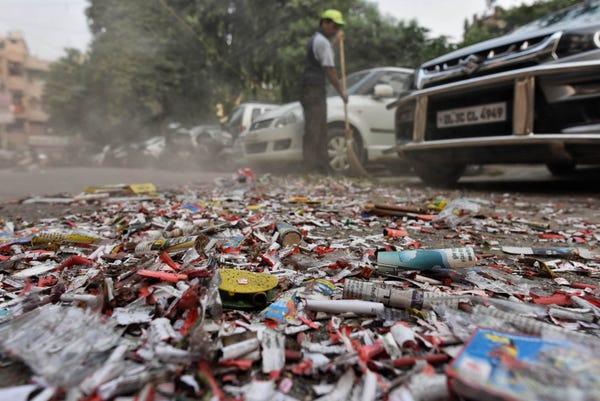
Diwali is meant to illuminate homes and bring communities together. Yet, every year, the festival leaves behind a less festive legacy of smoke-laden skies, deafening explosions, mountains of discarded material and an increasingly familiar struggle to breathe.
This year, the consequences have been particularly stark in Mumbai and Pune. A spate of firecracker-related fires has prompted Mumbai’s civic administration to prohibit rockets and other aerial fireworks, while Pune has emerged from the festivities with air quality approaching hazardous levels. The debate now is about the price that an entire city is expected to pay for a few hours of entertainment.
On November 9, the Brihanmumbai Municipal Corporation () prohibited rockets and other aerial firecrackers across Mumbai until November 25. The decision followed an alarming sequence of fires during Diwali. On November 8 alone, the Mumbai Fire Brigade received 142 fire calls, of which 137 were attributed to firecrackers.
In an order last month, the Bombay High Court had reiterated that the prohibition on bursting firecrackers on public roads, streets, lanes and footpaths applies throughout the year, not merely during particular festivals. It also directed the authorities to take measures against air and noise pollution and undertake public-awareness initiatives.
Unfortunately, this is where our environmental governance frequently falters.
Pune presents an equally worrying picture. Once celebrated for its greenery, pleasant weather and relatively comfortable living conditions, the city is increasingly struggling under the weight of its own expansion. On November 9, its Air Quality Index (AQI) touched 432 in the early hours, placing it in the severe category. The Central Pollution Control Board subsequently recorded an average AQI of 288 on Monday afternoon, while Pimpri-Chinchwad registered 301. Several localities reported readings above 300.
Firecrackers release fine particulate matter and other pollutants that penetrate deep into the respiratory system. Children, senior citizens and those already suffering from respiratory ailments are particularly vulnerable. Even otherwise healthy individuals can experience coughing, throat irritation and breathing discomfort.
Increasing vehicular traffic, construction dust, incessant road digging and rapid urbanisation have already placed considerable strain on Pune’s environment. Firecrackers add another burden to an atmosphere struggling to absorb accumulated pollutants. When emissions coincide with weather conditions that prevent smoke from dispersing, the consequences become particularly severe.
Noise pollution deserves urgent attention. The explosive soundtrack of Diwali cause babies to awake in a startled state while giving no respite to elderly residents. Hospital patients endure unnecessary distress and students preparing for examinations struggle to concentrate.
The more fundamental weakness is enforcement. Pune Municipal Corporation issued an order on November 6 prohibiting firecrackers on public roads, junctions, footpaths, gardens, terraces and other public spaces. Yet reports suggested that the civic body had not deployed dedicated teams to monitor violations and intended to act only when citizens lodged complaints. This raises an obvious question: if violations are foreseeable, why should enforcement depend on residents taking the initiative to report them? A prohibition without monitoring is little more than an announcement.
The promotion of green crackers has offered another ostensibly reassuring alternative. Designed to release fewer pollutants than conventional fireworks, they may reduce some environmental damage. But the adjective ‘green’ should not be mistaken for a certificate of harmlessness. Such crackers can still release harmful particles and gases capable of aggravating respiratory and cardiovascular conditions. Their availability cannot become a justification for unrestricted bursting.
Ultimately, the issue extends beyond municipal regulations to personal responsibility. Festivals are integral to India’s cultural life, and people have every right to celebrate them. But that right cannot come at the cost of another person’s health and safety. Those indiscriminately and relentlessly bursting crackers on a road must think of the elderly resident trying to sleep, the patient recovering in a nearby hospital and the child whose breathing is already compromised.
There are numerous alternatives that need not diminish the celebratory nature of the occasion. Traditional lamps, decorations, music, community gatherings and cultural programmes can preserve the warmth of Diwali without making smoke and noise its defining features. Housing societies can organise collective celebrations that place safety and consideration at their centre. These are not unreasonable demands or an assault on tradition. They are practical ways of preserving its spirit.
Mumbai’s restrictions and Pune’s deteriorating air quality should serve as a warning to the rest of Maharashtra. The answer cannot be an annual ritual in which authorities issue prohibitions after a crisis and forget them until the next festival. Firecracker sales need regular scrutiny, public-space restrictions require consistent enforcement, fire services must remain adequately prepared and pollution monitoring must extend beyond the festive calendar. Municipal corporations, police departments and pollution-control authorities must work together rather than pass responsibility from one office to another.
The argument, ultimately, is not about being for or against Diwali. It is about recognising that the freedom to celebrate carries an obligation not to endanger others. A festival should not leave firefighters battling preventable blazes, hospitals dealing with avoidable emergencies or children inhaling dangerous levels of particulate matter. The lights of Diwali should illuminate our cities, not expose the inadequacies of their administration. If the festivities leave such devastating pollution in their wake, it is time to reconsider what we have come to regard as celebration.
(The writer is a political observer. Views personal.)