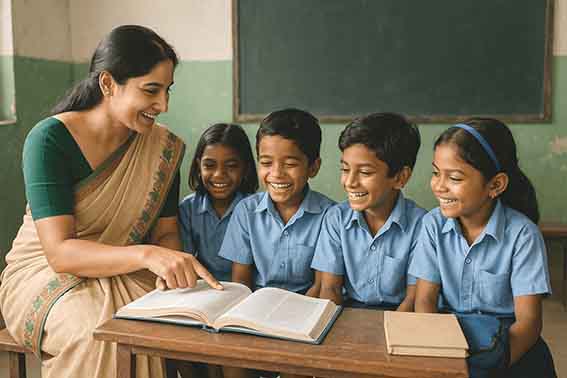
Imagine a teacher entering a classroom thinking more about the money they will receive than the lesson they will teach. Would we accept our children's teacher prioritising money over the lesson and students' understanding? As parents, we look for teachers who prepare well, care about learning and fulfil their responsibilities with sincerity, viewing payment as a return for their contribution.
Now, let us turn the question towards ourselves. Don't we sometimes become so occupied with salary packages, promotions and financial returns that we lose sight of the core purpose of our work? We expect commitment from others, but shouldn't we give the same importance to the process through which we earn?
When we look at life as a whole, we realise that for a few hours, we may be teachers, doctors, administrators, accountants, engineers or business owners. At other times, we are parents, children, partners, friends, neighbours and citizens. Beyond these roles, we are essentially human beings navigating life according to its needs and circumstances. Our profession is one part of life, not our reason for living.
When we understand these different roles, we become more conscious of our responsibilities and how we can contribute meaningfully to life. This is also an important part of what education prepares us for.
This brings us to an important question: Is education preparing us only for a job, a salary package or a professional identity, or for the fulfilling journey of life?
Education is not simply about preparing someone for a profession. We need to remind ourselves that its true purpose is to prepare us for life. Our profession is important, but it is not the whole of it. Education helps us understand our roles as individuals, family members, friends and responsible members of society. Our lives include relationships, health, purpose, and social responsibilities, and all these dimensions deserve our understanding and attention.
When we learn a skill and use it to contribute to an organisation or society, our work creates value for others. This value benefits people financially, emotionally, educationally, psychologically or physically. In return, people or organisations recognise our contribution and pay us for it. Earning, therefore, becomes a natural outcome of learning, developing abilities and contributing meaningfully.
However, we do not always see this relationship clearly. Sometimes, we treat completing our education as the ultimate achievement, pursuing it at any cost. We focus on qualifications, placements and impressive salary packages. Along the way, we forget to pause and ask ourselves: Am I happy with the person I am becoming, both personally and professionally? A qualification may make us eligible for a job, but the real education develops our understanding, abilities and sense of responsibility.
The difficulty becomes greater when salary packages and professional achievements become measures of social approval. We pursue a particular package not only for what it can provide but also for how it makes others perceive us. This may lead to a life that looks exciting and successful from the outside but lacks inner satisfaction. This is where pausing and reflecting become important.
At times, many of us run blindly from one task to another, chasing one target after another. We remain so caught up in moving forward that we rarely stop to ask where we are heading. It is like running on a treadmill: we keep moving, putting in effort and exhausting ourselves, yet reach nowhere. We keep chasing targets and bigger packages, rarely stopping to ask ourselves: Is this what I truly wanted when I began this journey?
A true understanding of education can help us pause, reflect and understand our roles. It can develop professional competence while also encouraging values, empathy, cooperation and thoughtful choices. We begin to realise that earning helps us have a house, but values, understanding and relationships turn that house into a home.
This is not an argument against ambition, financial security or professional success. They do matter, and people deserve fair returns for their work. However, education should help us evaluate their place in life, recognise our responsibilities and find fulfilment in what we do, rather than focusing merely on earning.
Perhaps it is time to reflect on what education is truly preparing us for. A life with financial fearlessness, meaningful relationships, purpose and inner fulfilment is waiting for us. Let us embrace that life with understanding, confidence, compassion, a strong sense of purpose and a commitment to contributing meaningfully to others.
(The writer is an educational entrepreneur. Views personal)