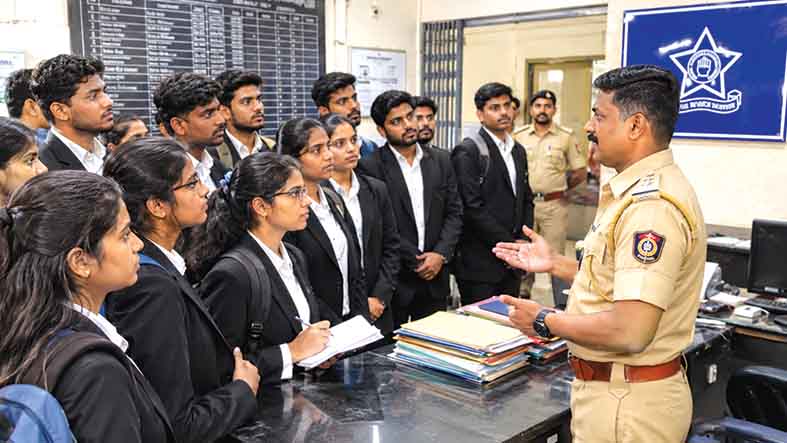
Moving beyond classroom learning, students of Devji Bhai Hariya Law College, Shahad, gained first-hand exposure to police administration during an educational visit to Bazaar Peth Police Station in Kalyan. Organised as part of Shahu Shikshan Sanstha’s academic approach, the visit provided insights into police procedures, including registering complaints, recording Non-Cognisable (NC) offences, filing First Information Reports (FIRs), maintaining station diaries and handling administrative responsibilities. The interaction helped aspiring legal professionals understand how statutory provisions studied in classrooms are implemented in practice.
Legal education is not limited to studying statutory provisions, judicial decisions and different sections of law. It also involves understanding how laws are implemented, how institutions within the justice delivery system function and their responsibilities in ensuring access to justice for ordinary citizens. Practical exposure alongside theoretical knowledge is an essential part of academic development.
The educational visit aimed to connect classroom learning with the practical functioning of the criminal justice system. Students were introduced to the day-to-day activities of a police station and the procedures followed when a complainant approaches the police. They were briefed on documentation, administrative responsibilities and the stages involved in recording complaints and initiating legal proceedings.
During the interaction, students learnt about maintaining station diaries and recording daily entries. They were also briefed on registering Non-Cognisable (NC) offences and filing First Information Reports (FIRs). In addition, they were introduced to the complaint-handling system, administrative operations within the police station and the weapons used by the police force.
The distinction between an NC complaint and an FIR, the nature of offences and the legal provisions applicable to different situations are important components of criminal law studies. However, studying these concepts in textbooks differs from observing how procedures are carried out in practice. The visit helped students connect their theoretical knowledge with the processes followed by police personnel.
For aspiring advocates, knowledge of the law alone is not sufficient to represent a client effectively. A lawyer must understand the background of a case, examine the sequence of events, study the police complaint, scrutinise the FIR and analyse available documents. Understanding the procedural journey of a criminal case is equally important when preparing legal arguments and assessing its merits.
When a person approaches an advocate in connection with a criminal case, the lawyer must understand the circumstances of the incident, the complaint lodged with the police and the subsequent action taken by the authorities. Familiarity with police procedures helps in examining relevant documents and interpreting legal aspects more effectively. The practical exposure gained during the visit is expected to benefit students in their future professional careers.
Police administration and the judicial system play important roles in delivering justice. From registering an offence and conducting investigations to completing documentation and initiating judicial proceedings, every stage requires adherence to established legal procedures. Understanding police administration is therefore as important for law students as gaining familiarity with courtroom proceedings.
Interacting directly with police personnel also allowed students to ask questions and gain a clearer understanding of the challenges and responsibilities associated with police administration. They learnt about routine duties, how citizens' complaints are handled and the importance of administrative procedures in running a police station.
In today's evolving legal environment, aspiring legal professionals need more than academic qualifications. They must also be able to apply their legal knowledge in practical situations. Exposure to police stations, courts and other institutions involved in implementing the law helps students understand the realities of the profession.
Such educational initiatives also help develop observation skills, analytical thinking, communication abilities and the capacity to assess legal matters from a practical perspective. Direct interaction with professionals in the justice system provides insights that classroom instruction alone cannot fully offer.
The initiative by Devji Bhai Hariya Law College, Shahad, highlights the importance of experiential learning in legal education. By taking students beyond the classroom and introducing them to how police administration functions, the institution has given them an opportunity to understand the practical dimensions of law.
Preparing competent advocates and legal professionals requires a combination of academic knowledge and practical understanding. Legal education must enable students not only to understand what the law states but also how it operates within society. Bridging the gap between textbook learning and practical experience can help develop a more informed, realistic and responsible approach to the legal profession.