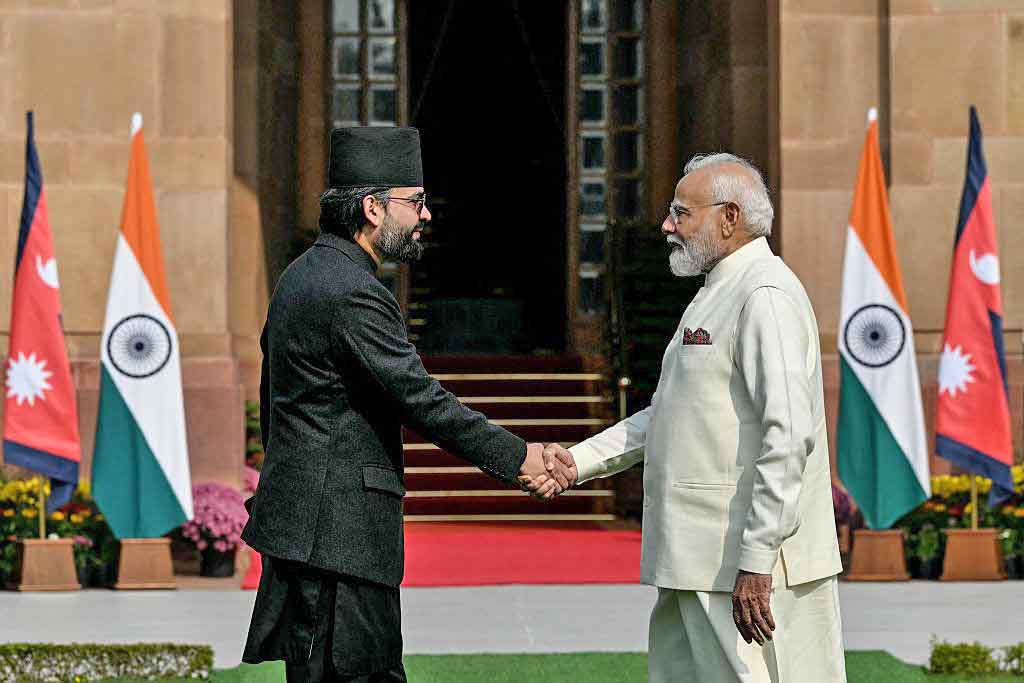
For all the poetry that surrounds India–Nepal relations, geography has often been a less forgiving arbiter. Bound by an open border, intertwined by religion, language, trade and family connections, the two countries have enjoyed an intimacy that few neighbouring states can claim. Yet their relationship has also been punctuated by diplomatic mistrust, political misunderstandings and competing strategic calculations. The recent state visit of Nepal’s Prime Minister Balendra Shah to India offers an opportunity to move beyond the familiar rhetoric of civilisational friendship towards a more consequential partnership.
The joint vision of a “Viksit Bharat and Samunnat Nepal” (Developed India and Prosperous Nepal) adopted during the visit is significant precisely because it attempts to give institutional and economic substance to an unusually close relationship. Its ambition is to transform historical affinities into practical cooperation, spanning trade, infrastructure, energy, education, technology and tourism. The challenge now is to ensure that the language of a new beginning is followed by measurable progress.
Distinctive Place
Nepal has traditionally occupied a distinctive place in India’s strategic imagination. Often described as a buffer between India and China, it is increasingly better understood as a potential bridge between South Asia and the wider Himalayan region. But a durable relationship cannot rest on geographical inevitability or historical sentiment alone; it must be sustained by mutual respect and tangible benefits.
Shah’s visit has provided an encouraging framework. India announced development assistance worth Rs. 15,000 crore, comprising Rs. 3,500 crore in grants for post-disaster reconstruction and new infrastructure, alongside a concessional, rupee-denominated line of credit of Rs. 11,500 crore for energy-sector projects. The commitment follows the devastating floods and debris flows that struck Nepal in August this year.
It is a substantial expression of India’s willingness to support its neighbour's reconstruction and development.
Connectivity is another important pillar. The inauguration of the motorable bridge across the Mahakali River, linking Dharchula in Uttarakhand with Darchula in Nepal, will strengthen access across the western border. The inauguration of the second phase of the Motihari–Amlekhgunj petroleum pipeline and the foundation stone for a new petroleum terminal at Jhapa further demonstrate how cross-border infrastructure can reduce logistical costs and improve the reliability of essential supplies.
Perhaps the most evocative initiative is the Sarayu-Kamala Express connecting Ayodhya with Janakpur, the city associated with Sita. The two destinations occupy a special place in the Ramayana tradition, and a direct railway connection gives their shared religious and cultural inheritance a practical expression. The journey, covering approximately 604 kilometres, is expected to take around 19 hours. Such a connection could also stimulate hospitality, local commerce and employment across the regions through which the train passes.
Ambitious Agenda
The wider railway agenda is more ambitious. The completion of the final location survey for the proposed Raxaul–Kathmandu electrified broad-gauge railway is an important step towards linking Nepal’s capital more directly with India's railway network. Cooperation on Nepal’s East–West Railway could also improve domestic connectivity within the Himalayan republic. In maritime access, India has offered Nepal a new transit route through Kandla, with access to Paradip to follow once the necessary infrastructure is in place. For a landlocked country, diversification of transit options is an important element of economic security.
Energy cooperation may ultimately prove the most consequential component of the partnership. Nepal possesses considerable hydropower potential, while India’s expanding economy offers a large and proximate market for electricity. The two leaders laid the foundation stone for the 669 MW Lower Arun hydroelectric project and called for progress on the Pancheshwar, Saptakoshi and Sunkoshi multipurpose projects. These undertakings could create a mutually beneficial relationship in which Nepal earns revenue from its natural resources while India secures a cleaner and more diversified energy supply. But water-sharing, environmental safeguards, financing and the equitable distribution of benefits will require sustained negotiation.
The agreements extend well beyond conventional infrastructure. Eight memoranda of understanding were exchanged, covering forensic science, police training, civil-service capacity building, traditional medicine, satellite communications, sustainable urban development, healthcare, and livestock and fisheries. India also agreed to explore the establishment of an offshore IIT campus in Nepal. Cooperation in space technology, digital services, start-ups and artificial intelligence could give the relationship a distinctly contemporary dimension. These initiatives are especially relevant to Nepal’s younger generation, whose aspirations increasingly extend beyond traditional sectors of employment.
There is, however, a larger diplomatic consideration. Relations between New Delhi and Kathmandu have not always been easy. China’s growing economic and strategic presence in Nepal has added another layer to this relationship. The willingness to review existing bilateral arrangements, including the 1950 Treaty of Peace and Friendship, through mutual consent is equally important. A relationship that has endured for generations must be capable of adapting to changing political and economic realities. Prime Minister Shah’s invitation to Prime Minister Narendra Modi to visit Nepal, which the latter has accepted, provides an opportunity to maintain this diplomatic momentum.
India and Nepal do not need to invent a friendship; history has already supplied one. What they need is to modernise it. The Himalayas may define their geography, but connectivity, economic interdependence and mutual confidence will determine their future.
(The writer is a foreign affairs expert. Views personal.)