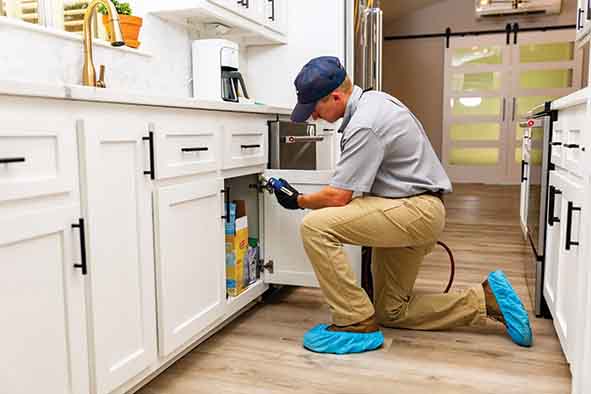
Most people encounter pest management personnel when cockroaches invade the kitchen, a rat enters the storeroom or mosquitoes plague the housing society. Someone arrives to tackle the problem, and all we see is the spraying.
But whether pests return depends on what happens before treatment: where the technician looks, what they find and what they ask the customer to fix. The same skills protect homes, offices, schools, hospitals, hotels and warehouses. The person matters as much as the product.
Picture a family calling about cockroaches in the kitchen. Before reaching for a spray, the technician uses a torch to check their hiding places: under the sink, inside cabinet hinges, below the kitchen platform, behind the refrigerator and around the drainpipe. He finds droppings behind the refrigerator, where the motor keeps the space warm, and cardboard boxes stacked under the counter.
Following the product label, he places gel bait in cracks and crevices. He also points out gaps in the masonry and a leaking pipe, asking the family to fix these and clear the cardboard before his next visit.
Every step involves a judgement call. A pest management plan is only as good as the person making those calls.
Current Rules
Commercial pest control in India is a licensed activity. Under the Insecticides Rules, 1971, applicants must hold a degree in agriculture or a science degree with chemistry, and complete at least 15 days of training at a recognised institute.
For technicians working in homes and businesses, India has a separate, voluntary skills framework. The National Institute of Rural Development and Panchayati Raj (NIRDPR), working with the industry, has defined eight pest management job roles listed on the National Qualification Register. These range from General Pest Management Technician to Supervisor and Manager, including specialised roles in fumigation and vector control. Those who pass the assessment receive a national qualification certificate from NIRDPR. The qualification has also been endorsed by the National Council for Vocational Education and Training (NCVET), India's apex body for regulating vocational education and training.
Professional standards are also gaining ground in the food industry. FSSAI's checklist for food manufacturing units treats pest control as a critical item, requiring trained and experienced personnel. For termite control, the Bureau of Indian Standards specifies building treatment procedures under IS 6313, revised in 2022. Applying these standards correctly requires training.
Prevention First
Integrated Pest Management (IPM) asks why pests are present and uses chemicals only when necessary. This is especially important as pests develop insecticide resistance. A 2019 Purdue University study found that German cockroaches have developed resistance to every class of insecticide introduced since the early 1950s. Addressing the conditions that attract pests helps prevent repeat infestations and keeps insecticides effective for longer.
Whether you live in a flat or manage a housing society, school, office or restaurant, choose a pest control firm carefully. Check its licence, and ask who will do the job and what training they have. A good firm will inspect the premises, provide a written report of its findings and recommend corrective measures. It should also disclose the products used and necessary safety precautions.
These measures are part of the treatment. Cracks, poor sanitation, uncovered dustbins and leaking pipes may need the customer's attention. Assign each corrective action a person and deadline, and check its completion during the next visit.
The Industry's Role
For firms, the opportunity is to make skills visible. Get technicians and supervisors nationally qualified, starting with those serving demanding clients. Include their names and qualifications in service reports, making certification visible to customers and giving technicians a clear career path.
Industry partnerships are widening access to training. Since October 2025, Envu has partnered with NIRDPR through a memorandum of understanding to promote structured, industry-orientated pest management training for both new and experienced technicians.
Professional pest management is essential to safe, healthy living. A technician who inspects premises, uses a torch to locate pests, asks questions and understands their behaviour is doing skilled work. When customers value that skill and firms invest in it, pest management earns its place as a profession. This is how the industry helps create healthier environments for everyone, everywhere.
(The writer is a senior technical service manager at Envu. View personal.)