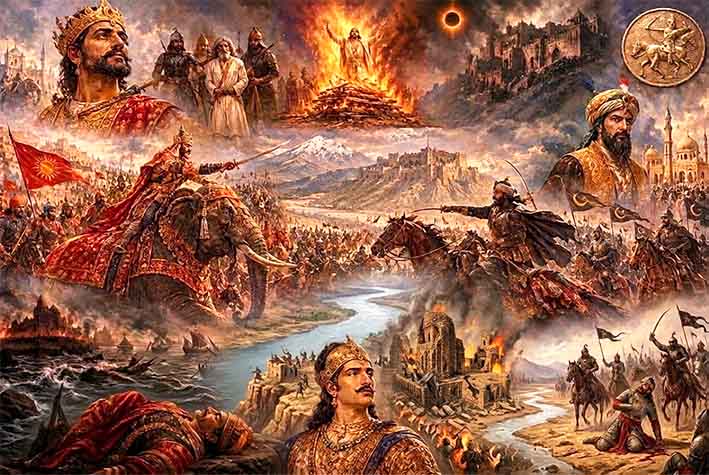
Autumn 1001. Exactly a millennium and a quarter century ago, on November 27, 1001 CE, the plains near Peshawar in present-day Pakistan - where the mountain passes descend towards the Indus and the ancient routes into the Indian subcontinent converge - became the theatre of a momentous encounter.
The fate of the Hindu Shahi (or Brahmin Shahi) kingdom, whose dominions had once extended from Kabul to the Punjab, hung in the balance.
Facing one another were two rulers at the end of a long and bitter frontier struggle. On one side stood Jayapala (called Jaipal in the Persian chronicles), the ageing sovereign whose kingdom had once commanded the approaches from Kabul into the Punjab. On the other was Mahmud of Ghazni, the relentlessly ambitious 30-year-old son of Amir Sabuktigin, inheriting his father’s campaigns and preparing to turn a protracted border conflict into an enterprise of conquest.
As Mahmud’s court chronicler Abu Nasr al-Utbi records in his Tarikh-i-Yamini, Jayapala assembled a formidable army of cavalry, infantry and war elephants to confront the advancing Sultan. But the battle ended disastrously for the Shahis and Jayapala, members of his family and several leading nobles were captured and brought before Mahmud, bound and humiliated.
Al-Utbi’s account, steeped in the floridly triumphal rhetoric of the Ghaznavid court, goes on to say: “The enemy of God, Jaipal, and his children and grandchildren, and nephews, and the chief men of his tribe, and his relatives, were taken prisoners, and being strongly bound with ropes, were carried before the Sultan, like as evildoers, on whose faces the fumes of infidelity are evident, who are covered with the vapours of misfortune, will be bound and carried to Hell. Some had their arms forcibly tied behind their backs, some were seized by the cheek, some were driven by blows on the neck. The necklace was taken off the neck of Jaipal - composed of large pearls and shining gems and rubies set in gold, of which the value was two hundred thousand dinars; and twice that value was obtained from the necks of those of his relatives who were taken prisoners, or slain, and had become the food of the mouths of hyenas and vultures. God also bestowed upon his friends such an amount of booty as was beyond all bounds and all calculation, including five hundred thousand slaves, beautiful men and women.”
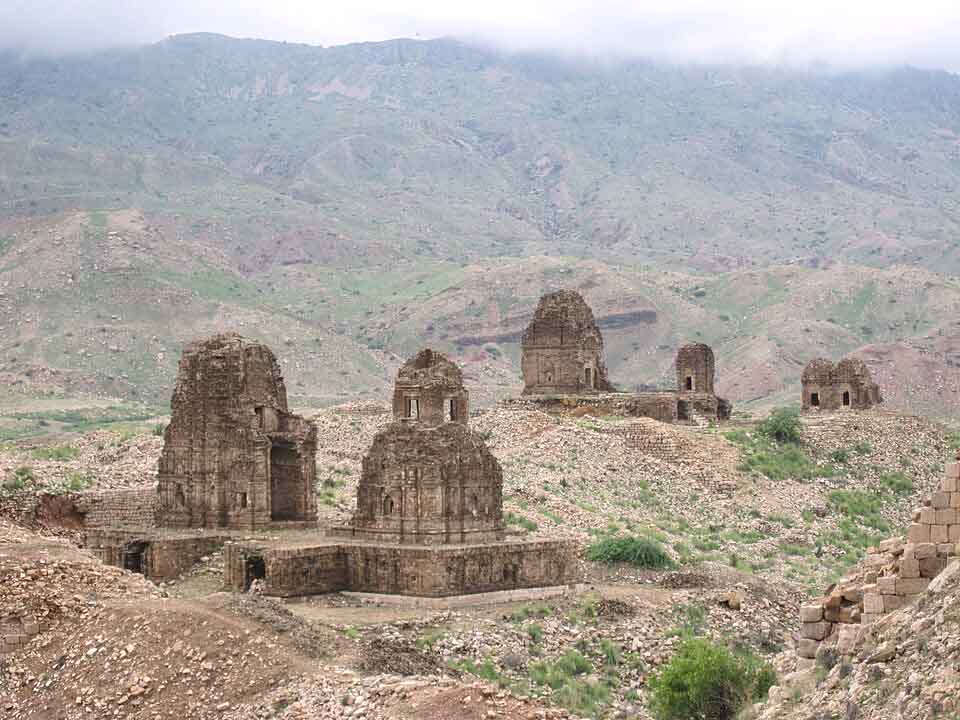
Al-Utbi continues: “The infidel returned to his own country and remained there, and wrote to his son, Andandpal, whose territory, on which he prided himself, was on the other side of the Sihun (Indus), explaining the dreadful calamity which had befallen him, and beseeching him with many entreaties to send the elephant which were according to agreement to be given to the Sultan. Upon this Anandpal sent the elephants to Jaipal, after dismissing the courier who had brought the letter, and the elephants were sent on to the Sultan. The Sultan, therefore, ordered the release of the hostages, and his myrmidons gave them a smack on the buttocks, telling them to return to their country.” (quoted in Volume II of The History of India, as Told by Its Own Historians edited by H.M Elliot and John Dowson, originally published in 1869)
Mahmud released Jayapala after demanding fifty elephants and taking some of his family as hostages. The Hindu Shahi ruler’s humiliation, however, proved harder to ransom.
Jayapala, whose kingdom who had once commanded the approaches from the Paropamisus mountains in Afghanistan (today known as the Silsila-yi Safed Koh or ‘White Mountain range’) to the Indus, now returned to a realm shorn of territory and prestige.
The relentless advance of the Ghaznavites had already pushed the centre of Shahi power eastwards, from its ancestral seat in Kabul to Waihind near Peshawar. Now, even that diminished inheritance stood gravely imperilled.
Jayapala placed the crown upon his son’s head and relinquished the throne. He then immolated himself on a funeral pyre, unable to endure the dishonour of defeat, as related by later accounts.
Who was Jayapala, and what was the enigma of the Hindu kingdom that once stretched from the better part of today’s Afghanistan, Pakistan and the Punjab? What kind of state had the Hindu Shahis fashioned in the rugged corridor linking Kabul, Gandhara and the Punjab? And what did its final struggle signify, as the shock-troops of Islam massed the frontier, bringing not merely a change of sovereignty but a new and coercive religious order in its wake.
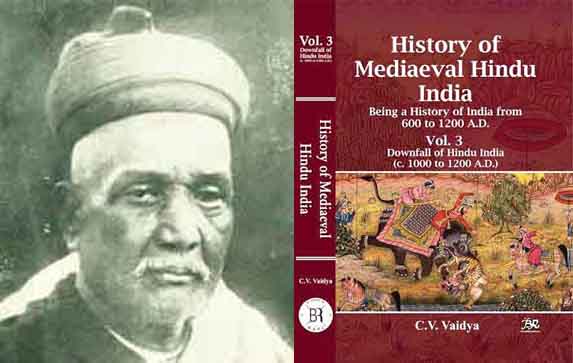
It was these knotty questions that Chintaman Vinayak Vaidya sought to untangle in his three-volume opus History of Mediaeval Hindu India, published between 1921-26.
The Breach on the Indus
For generations, Jayapala’s defeat at Peshawar has been regarded as a decisive moment in the history of the north-west. Vaidya described it as the battle that ended Hindu dominion west of the Indus. The defeat opened the way for Mahmud to seize the Shahi capital at Waihind and consolidate his hold over the frontier. Yet it would be misleading to mistake this encounter for the opening scene of an immediate and inevitable collapse of Indian political power.
The two centuries that followed were no unbroken procession of defeats as powerful dynasties still continued to rule across the subcontinent and resisted external incursions.
The harder question that Vaidya sought to confront was why a civilisation of formidable warrior houses and considerable material resources eventually proved unable to prevent the establishment of Turkish power across much of the north.
His three-volume opus traced the political fortunes of the subcontinent from the age after Harshavardhana to the Islamic conquests that transformed northern India.
Vaidya drew upon Arabic and Persian chronicles, Sanskrit court poetry, copperplate grants, inscriptions, coins, geographical treatises and the work of European and Indian antiquarians. Far more than a mere account of dynasties and battles, Vaidya wanted to recover, on a Gibbonian scale, the political and social forces that had shaped the rise and downfall of medieval Hindu power.
Gibbon’s Shadow
Born in 1861, Vaidya belonged to a remarkable generation of western Indian intellectuals who made the recovery of India’s past part of a wider cultural and intellectual awakening. Trained in law, prominent in public life and later Chief Justice of the Gwalior State, his writings ranged across the Mahabharata, the Ramayana, Sanskrit literature and the history of Chhatrapati Shivaji Maharaj and the Maratha state.
His intellectual world was shaped by the ferment of late nineteenth- and early twentieth-century Maharashtra, when the study of India’s past was acquiring new scholarly foundations. Ramakrishna Gopal Bhandarkar and John Faithfull Fleet, among others, were using inscriptions, coins and textual evidence to illuminate dynasties that had long remained obscure.
Vaidya wrote about the disappearance of a historical world at a moment when India was attempting to recover its political independence. His account was informed by a desire to understand how a civilisation could lose the political institutions that had once sustained it.
As Vaidya acknowledged, the intellectual lodestar for this gargantuan undertaking was Edward Gibbon’s The History of the Decline and Fall of the Roman Empire (1776-88).
He saw a striking parallel between the collapse of Roman power (both Western Rome and Byzantium) before successive invaders and the decline of the medieval Hindu political order.
Vaidya saw the fall of Kanauj and Jayachandra’s death on the Yamuna battling Ghurid forces as resembling the fall of Constantinople on the Bosphorus to the Turks in 1453 CE. The latter became the seat of the Turkish empire in Europe while Delhi, he observed, became the seat of the Turco-Afghan empire in India.
For Vaidya, Kanauj occupies a position comparable to Constantinople in Gibbon’s narrative. The conquest marks the close of an epoch.
But the analogy has its limitations. Unlike the Eastern Roman Empire, the political world of India was not a single imperial structure whose capture could be equated with the extinction of an entire civilisation. Hindu kingdoms continued to flourish in the south, and new political formations would emerge in the centuries that followed.
Vaidya himself acknowledges this. His final preface looks beyond the period covered by the book to the destruction of the Yadava, Kakatiya and Hoysala kingdoms under Alauddin Khalji and Malik Kafur, the subsequent rise of Vijayanagara, and the defeat of the latter at Talikota in 1565.
While some of Vaidya’s social theories inevitably bear the imprint of his age, the breathtaking scale of his ambition and the sheer amplitude of his learning remain astonishing - qualities conspicuously scarce among historians today.
One must also remember that this monumental enterprise was undertaken in 1921, a time when the centuries before the Sultanate were still too often dismissed as an obscure interlude in the country’s history.
The Last Frontier
Drawing upon al-Biruni and the Sanskrit geographical tradition, including the writings of Rajashekhara, Vaidya reconstructs a lost frontier between Afghanistan and India – a fiercely contested political landscape (as is today) through which armies, merchants, religious traditions and rival dynasties had traversed for centuries.
At its centre stood the Hindu Shahis. Once rulers of Kabul, they had gradually been pushed eastwards towards the Indus, where their authority became concentrated around Udabhandapura, identified with Waihind or Hund.
Vaidya traces the rise of Ghazni to Yaqub-i-Lais, the Saffarid adventurer whose campaigns carried Muslim power into Zabul and Kabul. Yaqub’s incursions weakened the older political order and helped prepare the ground for subsequent expansion. The decisive transformation came later, under Alptigin, a former Turkish commander in the service of the Samanids, who established himself at Ghazni around 962. His successor Sabuktigin, who ruled from 977 to 997, converted this foothold into a formidable military power.
Mahmud thus inherited not merely a throne but an expanding frontier state and an unfinished struggle with the Hindu Shahis.
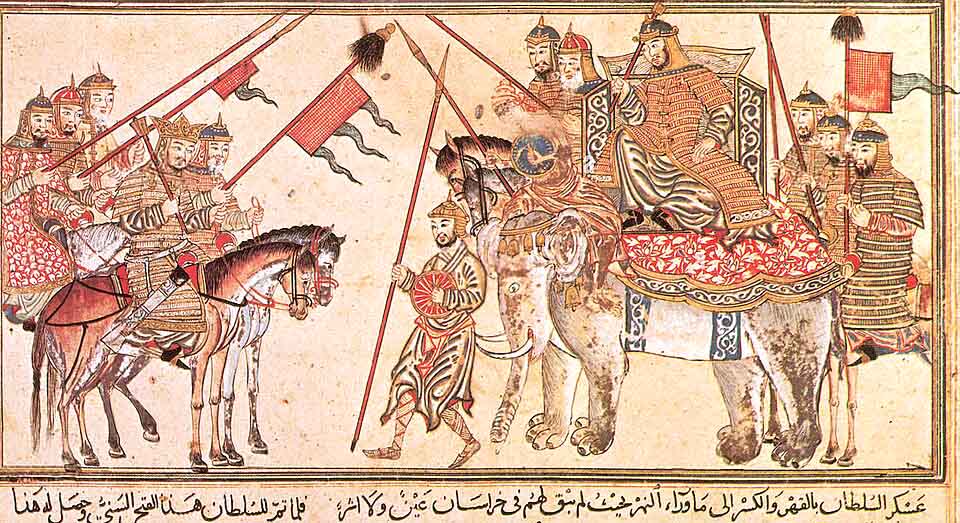
In one of his more arresting historical analogies, Vaidya compares the succession of Alptigin, Sabuktigin and Mahmud with that of Maloji, Shahaji and Shivaji.
The conflict between Jayapala and Sabuktigin is crucial to understanding what followed. Drawing upon al-Utbi, Vaidya describes a Shahi ruler watching his frontier steadily contract. Jayapala initially attempted to check Sabuktigin through military action. An uneasy settlement followed, but disagreements over the surrender of frontier forts reopened hostilities.
Sabuktigin returned, ravaged Shahi territory and drove the conflict further towards the Indus. By the time Mahmud succeeded his father, the Shahis were facing a power that had spent years learning their weaknesses and military habits of their kingdom.
Complex Portrait
Mahmud’s accession transformed the scale of the conflict. Recognised by the Abbasid Caliph and increasingly secure in his authority, he adopted the title of Sultan and turned his attention eastwards.
But Vaidya’s portrait of Mahmud is more discriminating than the familiar image of a marauding conqueror.
He acknowledges the Sultan’s exceptional military and administrative abilities in striking terms. Assessing the judgments of Gibbon and Stanley Lane-Poole, he adds his own tribute: Mahmud was a great soldier, a consummate commander, a just ruler and an administrator of unusual capacity. Vaidya praises his patronage of learning, his support for scholars and poets, his protection of commerce and his concern for the administration of justice.
He places Mahmud among the exceptional figures who alter the destinies of nations, comparing his capacities with those of Akbar, Shivaji, Napoleon and Peter the Great. The Sultan, he notes, restrained official oppression and sought the welfare of his subjects.
Yet Vaidya draws a sharp moral boundary. Mahmud’s great blemish, he writes, was his “bigoted intolerance.” His religious zeal led him not merely to plunder temples and carry away idols, but to forcibly convert people in conquered territories.
Vaidya insists that firm religious conviction need not entail contempt for the beliefs and sacred places of others. He contrasts Mahmud with Shivaji, whose devotion to his own faith did not prevent him from respecting Islamic holy men and sparing Islamic sacred structures.
Mahmud, he concludes, may rank among the great kings of the world, but his intolerance leaves a stain that military genius and administrative achievement cannot erase.
There is another striking complication in Vaidya’s account. Mahmud’s armies were not composed exclusively of Turks, Afghans or other Muslim soldiers. Hindu contingents served in them too.
Vaidya records that Hindu soldiers and elephants took part in the Sultan’s campaigns and that, in one battle against a Central Asian adversary, his army comprised Turks, Khiljis, Afghans and Hindus, supported by five hundred elephants.
He ironically notes that the same Hindu soldiers and elephants that had failed to secure victory for Jayapala were deployed by Mahmud with conspicuous effectiveness against his Turkish opponents.
Vaidya sees in this both evidence of the military capacity of Hindu soldiers and a symptom of what he regards as wider political and religious apathy.
The Long Resistance
Jayapala’s defeat did not end Shahi resistance. His son Anandapala attempted to rally a wider coalition against Mahmud. Vaidya’s reconstruction of the great confederate battle around 1008 is among the most dramatic passages in his narrative. He describes forces gathering from distant regions, resources being mobilised for the defence of the frontier, women selling their ornaments to contribute to the war effort and Khokhar warriors joining the confederacy.
The Hindu forces initially held the advantage, according to Vaidya’s reading of the accounts, before the tide turned and the battle ended in defeat. He draws a striking parallel with the Third Battle of Panipat in 1761, where an initially promising military position also gave way to catastrophe.
Even then, the Shahis did not disappear. Anandapala’s son Trilochanapala continued the struggle across the Punjab and into the Himalayan foothills.
Vaidya’s narrative then moves beyond the Punjab to examine Mahmud’s campaigns across Multan, Thanesar, Mathura, Kanauj, Kalinjar and Somnath. The extraction of tribute, destruction of military power, seizure of strategic routes and consolidation of the Punjab altered the political balance of northern India.
The sweep of Vaidya’s history is considerable. He surveys the Chahamanas of Ajmer, the Guhilots of Mewar, the Paramaras of Malwa, the Chandellas of Bundelkhand, the Chalukyas of Gujarat and the Gahadavalas of Kanauj. He also turns to the Palas and Senas of Bengal and the major powers of the south: the Cholas, the Chalukyas of Kalyan, the Yadavas, Kakatiyas, Hoysalas and Pandyas.
Herein lies Vaidya’s central paradox. The same regional political order that nurtured powerful kingdoms and distinctive cultural traditions made sustained, coordinated resistance difficult when confronted by a military power pursuing repeated campaigns of territorial expansion.
The Last Great Contest
The second great transformation of northern India came nearly two centuries after the fall of the Shahi frontier. By then, Ghaznavid power had weakened and a new force had emerged from Ghor. Its most ambitious ruler, Shihab al-Din Muhammad Ghori, turned his attention towards the Punjab and the kingdoms beyond it.
Vaidya traces Ghori’s advance through Multan, Gujarat, Peshawar and Lahore before bringing him into direct confrontation with Prithviraj Chauhan, ruler of Ajmer and Delhi. The two, he writes, were evenly matched in personal capacity and the extent of their resources.
Vaidya considers the Prithviraj Raso unreliable where its account is unsupported by contemporary evidence, and prefers the Persian chronicles Taj-ul-Ma’asir and Tabakat-i-Nasiri, written considerably closer to the events. Both sides, he cautions, magnify the merits of their heroes.
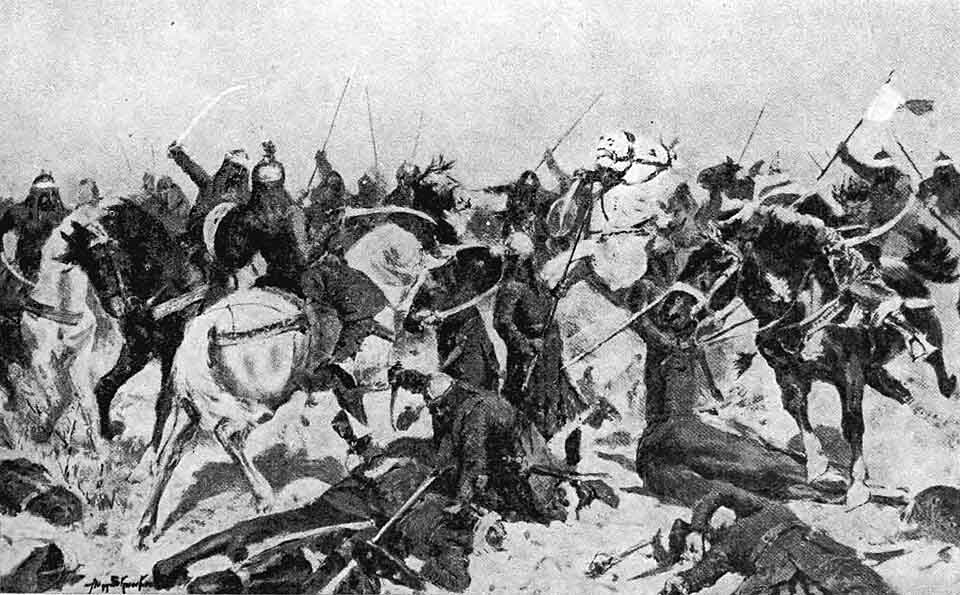
The first encounter took place at Tarain in 1191 CE, after Ghori had seized Sirhind. Prithviraj advanced with a Hindu force and inflicted a severe defeat on the Sultan’s army. Ghori himself was wounded in his encounter with Govindrai of Delhi, who was mounted on an elephant. The Sultan was carried from the field by a young Afghan soldier; his army, believing him dead, broke and fled.
Vaidya considers it possible that Ghori was captured and subsequently released by Prithviraja after a ransom, though he acknowledges that the evidence is uncertain.
The following year, in 1192, Ghori came back with an overwhelming force. The second Battle of Tarain ended in Prithviraj’s defeat. Vaidya pays particular attention to the cavalry tactics described in the Tabakat-i-Nasiri, the lightly armed mounted archers divided into mobile divisions, harassing the Hindu forces from different directions and withdrawing when confronted, before the main body delivered its attack. Ghori’s army also held its elephants and central reserves behind the advancing cavalry. Vaidya sees in these tactics a resemblance to the methods Mahmud had employed against Jayapala and Anandapala.
But there was no lack of heroism on the Hindu side, he insists, and Prithviraj fought with conspicuous bravery. He rejects the familiar story that the Chauhan ruler, after marrying Sanyogita, abandoned public affairs and neglected his army in pursuit of pleasure. Nor does he accept the elaborate account of the Raso, with its vast armies, invented formations and legendary duels, as a reliable description of the battle.
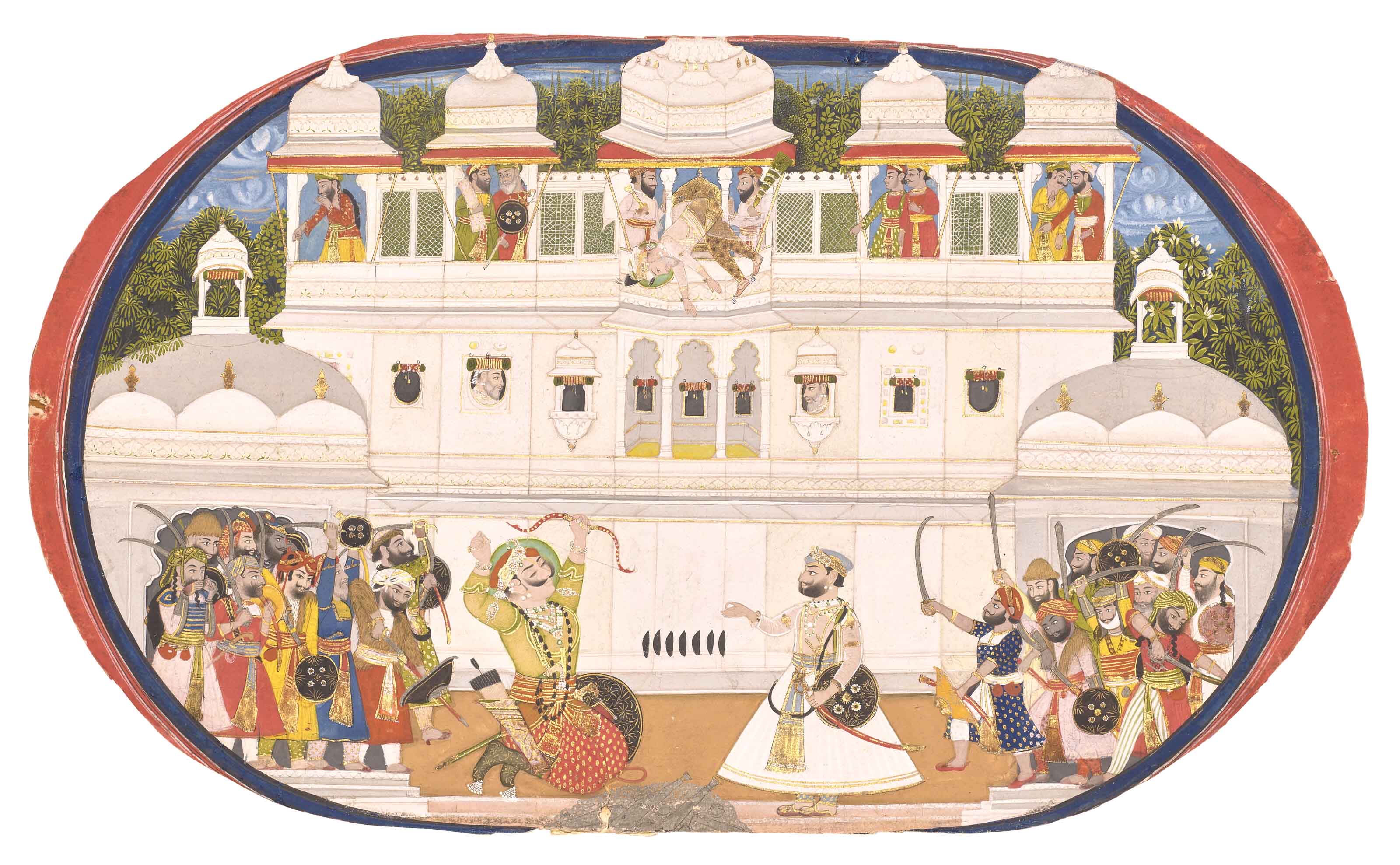
Vaidya is rightly sceptical of the celebrated story that Prithviraj, blinded and imprisoned at Ghazni, killed Ghori by aiming an arrow at the Sultan’s voice. He regards it as a tale of vengeance, fashioned after the actual circumstances of Ghori’s death had been forgotten. The Sultan was, in fact, killed years later by Gakkhar assassins on the southern bank of the Indus.
Prithviraj’s own end is less certain. The Persian accounts differ: one says he was captured and put to death after the battle; another relates that he was taken to Ajmer and subsequently executed. Vaidya prefers the account that Prithviraj was captured near the Sarsuti (possibly the lost Sarsvati River) and immediately put to death.
He also makes a significant distinction between Ghazni and Ghori. While he regards Mahmud’s Indian campaigns as animated in considerable measure by religious zeal, Vaidya argues that Muhammad Ghori’s principal purpose was territorial expansion.
Muslim chroniclers, he suggests, naturally gave the later campaigns a religious colouring, but the more historical explanation lay in the struggle for political power.
Anatomy of a Decline
The most contentious part of Vaidya’s work is his attempt to explain why a society of such evident wealth and cultural vitality proved vulnerable to successive military defeats.
His explanation of military failure begins with the commanders and the armies they led. Vaidya considers Mahmud’s personal qualities - his courage, energy, ambition and capacity for organisation - as decisive.
The Sultan inherited a military establishment from Sabuktigin but developed it into an instrument of sustained conquest. Jayapala, by contrast, possessed resources and manpower but, in Vaidya’s assessment, had failed to organise a comparably effective standing army.
Vaidya rejects several easy explanations. He does not accept that the ‘Muslim’ Turks or Afghans were inherently more physically hardy or more united than their opponents that the ‘Hindu’ Afghans.
Vaidya also advances a broader argument about the political condition of the Punjab. He suggests that the region’s long history of rule by external powers had weakened its inhabitants’ attachment to the ruling house, leaving them relatively indifferent to changes of sovereignty. He further argues that sections of the old Kshatriya population had moved into agriculture and village leadership, while ruling lineages migrated elsewhere.
For him, the central question was why a civilisation that had produced powerful rulers, sophisticated institutions and formidable military traditions eventually proved incapable of sustaining an effective resistance to the new political order.
Vaidya’s discussion of caste is particularly pointed. He is concerned with the multiplication of subdivisions and the increasing rigidity of social distinctions. The original occupational and functional divisions, he suggests, had become complicated by innumerable subdivisions, restrictions on marriage and restrictions on social intercourse.
According to him, a society divided into increasingly exclusive groups would find it difficult to generate the solidarity required for collective action.
There is, however, an important distinction to be drawn between Vaidya’s observation and his conclusion. While the existence of elaborate caste hierarchies is well documented, the more difficult question is whether these developments directly caused military weakness.
Medieval Indian armies were recruited through complex arrangements involving rulers, feudatories, professional warriors and local communities. Social stratification did not automatically prevent military mobilisation.
Indeed, Vaidya’s own account of Anandapala’s confederacy that attempted to oppose Mahmud demonstrates that substantial collective efforts could still be mounted.
Vaidya’s discussion of religious sectarianism follows a similar trajectory. He examines the multiplication of religious traditions, the emergence of new forms of worship and the increasing authority of ritual specialists. The Agamas, Upasmritis and Upapuranas, in his view, were evidence of a growing tendency towards religious formalism.
Here, too, one must separate historical description from judgement. The development of sectarian Hindu traditions was not necessarily a symptom of degeneration. It also produced new philosophical schools, temple institutions and forms of religious patronage.
Vaidya is particularly concerned with the disappearance, or weakening, of the old Kshatriya ideal. His treatment of the Punjab is instructive. He argues that the traditional warrior class had, in some areas, gradually become absorbed into agricultural life. He connects this development with the prescriptions of the Smritis, particularly the doctrine of Apaddharma, under which members of different social groups could adopt occupations outside their customary functions under particular circumstances.
Whether this interpretation adequately explains the military decline of the Punjab is debatable. But it is a major and sustained attempt to connect social history with the practical organisation of political power.
An Indian Decline and Fall
Gibbon demonstrated that the decline of an empire could be examined through multiple historical processes rather than attributed to a single catastrophic event. Vaidya wanted to apply a comparable method to trace the collapse of Hindu India.
One of the pleasures of reading Vaidya is discovering the sheer range and strands of evidence he draws upon - from inscriptions published in Indian Antiquary, Epigraphia Indica, the journals of the Bombay Branch of the Royal Asiatic Society to Muslim accounts and Sanskrit sources like the Harshacharita, the Skanda Purana, the travel account of Hiuen Tsang and epics like the Prithviraj Raso.
There is something melancholy about the fate of older and ambitious historical works. While they are now available in digital archives, many have disappeared almost completely from the intellectual conversation they once sought to influence. Vaidya’s History of Mediaeval Hindu India is one such work.
A trilogy of such erudition is increasingly rare in historical writing today. And an author willing to attempt a large explanation and to risk an overarching thesis even rarer.
Read a century after its publication, Vaidya’s opus remains a work of staggering intellectual ambition. It restores a vast and intricate political world between the age of Harshavardhana and the establishment of the Delhi Sultanate.
Gibbon had chronicled the long twilight of Rome. Vaidya believed that medieval Hindu India, too, deserved a comparable account of its decline and fall.