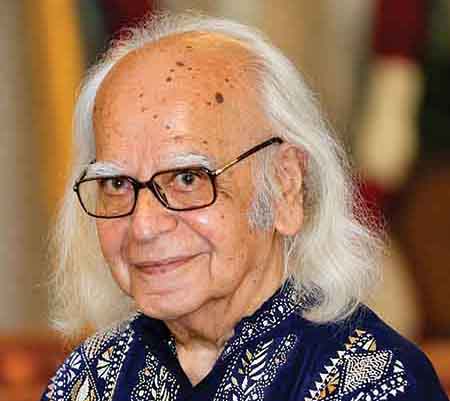
As we celebrate the birth centenary of Professor Yash Pal (on November 26), we remember one of the most distinguished scientists, visionary educationists and influential science communicators of modern India who devoted his life to scientific research, institution-building, educational reform and the popularisation of science.
His passing in July 2017 marked the end of an extraordinary life, but his ideas, ideals and contributions continue to inspire generations. His legacy transcends the boundaries of scientific discovery, reminding us that the true purpose of knowledge lies in expanding human understanding and improving society.
Towering Vision
Professor Yash Pal was an eminent physicist whose research focused primarily on cosmic rays and high-energy physics. After completing his postgraduate studies in Physics at Panjab University in 1949, he earned his Ph.D. in Physics from the Massachusetts Institute of Technology (MIT), USA, in 1958.
He began his scientific career at the Tata Institute of Fundamental Research (TIFR), Mumbai, where he became an integral part of the cosmic-ray research group. His contributions to cosmic-ray studies, high-energy physics and astrophysics helped strengthen India's presence in fundamental scientific research.
His scientific journey was characterised by intellectual curiosity, rigorous inquiry and an unwavering commitment to expanding the frontiers of human knowledge. He believed in the importance of pursuing fundamental science while recognising its wider implications for society.
One of Professor Yash Pal’s most significant contributions was his leadership as the first Director of the Space Applications Centre (SAC), Ahmedabad, from 1973 to 1981.
He played a pioneering role in demonstrating how space technology could be harnessed for national development, particularly in education, communication and rural advancement. His association with the historic Satellite Instructional Television Experiment (SITE) of 1975–76 was particularly noteworthy. The experiment demonstrated the immense potential of satellite-based television in delivering educational and developmental programmes to rural and underserved communities.
It was a landmark initiative that illustrated how advanced space technology could be used to address grassroots challenges and bridge geographical and social divides.
For Professor Yash Pal, scientific and technological progress was meaningful only when its benefits reached ordinary citizens. He envisioned science not merely as an instrument of technological advancement but as a powerful means of social transformation.
His contributions extended far beyond the domain of scientific research. As Chairman of the University Grants Commission (UGC) from 1986 to 1991, he worked towards strengthening India's higher education system and encouraging a more progressive academic environment. He championed interdisciplinary learning, research-oriented education, institutional autonomy and greater academic freedom. He firmly believed that universities should be centres of creativity, independent thinking and intellectual exploration rather than institutions confined to conventional teaching and examinations.
One of his most enduring contributions to Indian education was the landmark 1993 report, Learning Without Burden, prepared by a national committee under his chairmanship. The report challenged the excessive academic pressure imposed on schoolchildren and questioned the prevailing culture of rote learning and textbook-centred education. It advocated a more joyful, meaningful and activity-based approach to learning, encouraging children to understand, explore and discover rather than merely memorise information.
His educational philosophy placed curiosity, creativity, critical thinking and conceptual understanding at the heart of the learning process. He believed that education should nurture the natural desire to learn and empower children to become independent thinkers. These ideas remain remarkably relevant to contemporary educational reforms in India.
Perhaps one of Professor Yash Pal’s most remarkable qualities was his extraordinary ability to communicate complex scientific ideas in simple, engaging and accessible language.
Through the immensely popular Doordarshan science programme Turning Point, he brought science into the homes of millions of Indians, particularly during the late 1980s and 1990s. With his lucid explanations, engaging style and infectious enthusiasm, he transformed scientific communication into an exciting intellectual experience. He encouraged viewers, especially young students, to ask questions, challenge established assumptions and develop a scientific temper.
He believed that science should not remain confined to laboratories, universities and research institutions. Instead, it should become an integral part of everyday life and public consciousness.
For Professor Yash Pal, science was much more than a specialised academic discipline. It was a way of thinking, questioning, exploring and understanding the world around us.
Making Science Accessible
His efforts helped make scientific knowledge accessible to ordinary people and strengthened the relationship between science and society.
In recognition of his outstanding contributions to scientific research, space technology, education and science communication, Professor Yash Pal received numerous prestigious national and international honours including the Padma Bhushan (1976) for his distinguished contributions to science and technology; the Marconi International Fellowship Award (1980) for his pioneering work in applying communication technology to rural development; the UNESCO Kalinga Prize (2009) and the
Padma Vibhushan (2013).These honours reflected the remarkable breadth of his achievements and the national and international recognition he earned through a lifetime of dedicated service.
As we commemorate Professor Yash Pal’s 100th birth anniversary, his life and work invite us to reflect on the larger purpose of science and education. At a time when scientific discoveries, digital technologies and artificial intelligence are rapidly transforming human society, his ideas remain profoundly relevant.
He reminded us that education must cultivate questioning minds rather than produce unquestioning followers; science must serve humanity rather than remain confined to intellectual pursuits; and knowledge must be shared rather than restricted to a privileged few.
He was a scientist who explored the mysteries of the universe, an educationist who challenged conventional approaches to learning, an institution-builder who strengthened India's scientific and academic foundations, and a communicator who brought the wonders of science into people’s homes. His was a life dedicated not merely to acquiring knowledge but to making knowledge meaningful, accessible and transformative.
Let us remember him not merely for his scientific achievements, the institutions he helped build or the educational reforms he championed, but for the enduring spirit of curiosity, scientific temper and intellectual freedom that defined his life. His greatest legacy lies not simply in the discoveries he made or the institutions he nurtured, but in the countless minds he inspired to think independently, question fearlessly and explore relentlessly.
His life reminds us that the greatest contribution of a scientist is not only to expand the boundaries of knowledge, but also to awaken in others the desire to explore those boundaries further. Professor Yash Pal’s ideas continue to illuminate the path of scientific inquiry and educational transformation. His journey may have ended, but the spirit of discovery he ignited must continue to live on in every curious child, every questioning mind and every effort to make education a liberating force for humanity.
(The writer is Chief Executive, National Centre for Science Communicators, Mumbai. Views personal.)