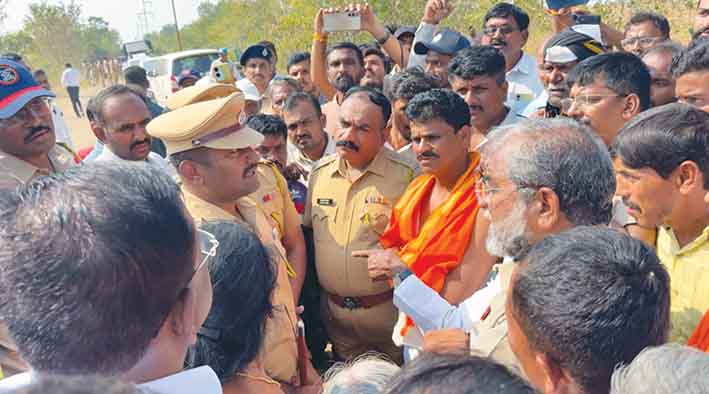
Kolhapur: There is something deeply troubling about the Maharashtra government's determination to push ahead with the proposed Shaktipeeth Expressway despite the growing resistance to it across western Maharashtra. A project originally justified in the name of religious tourism and regional connectivity has increasingly become a test of the government's understanding of public interest, economic prudence and democratic accountability.
The question is no longer merely whether farmers should be compensated adequately for the land acquired for the highway. The more fundamental question is whether the state has established a compelling economic justification for acquiring this land at all.
The revised project cost, estimated at nearly Rs 1 lakh crore, makes this question unavoidable. At such an extraordinary financial commitment, the government cannot afford to rely on broad promises of development, faster travel and pilgrimage tourism. It must demonstrate, with credible data, that the proposed expressway will generate benefits proportionate to its financial, social and environmental costs. So far, the intensity of the government's commitment appears considerably greater than the clarity of its public justification.
Public Distrust
The resistance in Kolhapur is particularly revealing. Government teams arriving to undertake land surveys have encountered fierce opposition from local residents. There have been reports of stones being thrown at survey personnel and officials being forced to withdraw. In some places, government employees have reportedly had to conduct surveys in the early hours of the morning to avoid confrontation with villagers.
These incidents should not be condoned. Violence against public servants is unacceptable. But neither should the administration reduce the entire controversy to a law-and-order problem. When government officials have to approach villages before dawn to carry out surveys, it should prompt a much more serious question: why has a project supposedly intended for public benefit generated such profound public distrust?
Fertile Land
The opposition is not restricted to Kolhapur. Farmers in Sangli, Satara and other districts along the proposed corridor, including parts of Marathwada, have raised objections to land acquisition. Their concerns are rooted in the nature of the land being targeted. Much of it is productive, irrigated agricultural land, supporting sugarcane cultivation, horticulture and other economically valuable crops.
This is not a minor consideration. The acquisition of fertile agricultural land represents a permanent transfer of productive economic capacity from farming communities to a public infrastructure project. A farmer may receive compensation for the physical parcel of land, but the government cannot easily replace the agricultural ecosystem, irrigation access, recurring income and intergenerational security associated with it.
Beyond Compensation
The argument that higher compensation will resolve the opposition is therefore fundamentally inadequate. Compensation addresses the financial value assigned to acquired property. It does not automatically establish the necessity of acquisition. Nor does it answer the more important question of whether the state should destroy an existing productive economic activity to create a new infrastructure asset whose actual utilisation and returns remain uncertain.
A farmer's refusal to surrender fertile land cannot simply be interpreted as an unwillingness to participate in development. It may equally represent a rational assessment that the proposed transaction is not in his economic interest. The government must distinguish between compensating people for a necessary public project and attempting to purchase consent for a project whose necessity itself is contested.
Economic Alternatives
There is also a larger economic contradiction that deserves scrutiny. Maharashtra is simultaneously pursuing other major road connectivity initiatives, including a proposed new highway corridor between Pune and Bengaluru. The relationship between these projects needs to be examined before the state commits an additional lakh crore rupees to the Shaktipeeth Expressway.
What is the incremental economic value of the Shaktipeeth corridor? How much additional traffic will it attract? Which existing transport bottlenecks will it resolve? What proportion of its projected traffic will comprise pilgrims, commercial vehicles and ordinary passenger traffic? Can existing highways, improved state roads or more targeted connectivity projects achieve much of the same objective at a fraction of the cost?
These are not objections to infrastructure development. They are basic questions of infrastructure economics. A government that undertakes large capital expenditure has an obligation to demonstrate that the chosen investment is superior to the available alternatives.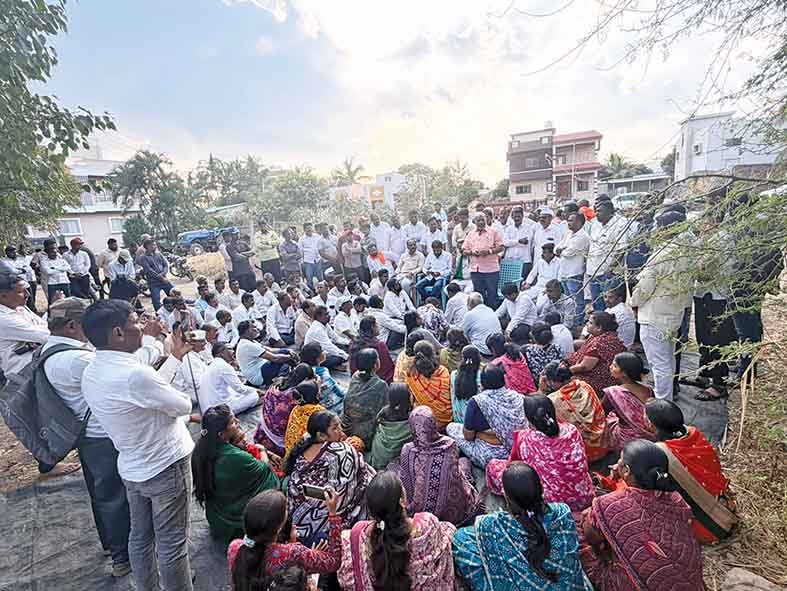
The opportunity cost is enormous. Nearly Rs 1 lakh crore could finance substantial improvements in irrigation networks, agricultural storage, rural connectivity, public hospitals, educational institutions and urban infrastructure. These investments would also generate employment, improve regional productivity and directly benefit communities across Maharashtra.
The issue, therefore, is not whether a highway is useful. Almost every highway can claim some economic or social benefit. The issue is whether this particular highway, on this particular alignment, at this particular cost, represents the best possible use of public money.
The religious dimension of the project also requires a more dispassionate examination. Connecting the state's major Shaktipeeths, including Kolhapur's Mahalaxmi temple, Tuljapur's Tulja Bhavani temple and Mahur's Renuka Devi temple, is an attractive proposition. Pilgrimage tourism can generate employment and support local economies. But the desirability of religious connectivity does not automatically establish the necessity of an 800-plus-kilometre access-controlled expressway costing nearly Rs 1 lakh crore.
There is a danger in allowing the religious appeal of a project to shield it from ordinary economic scrutiny. Public infrastructure must be evaluated on measurable outcomes, not the emotional appeal of its stated purpose. If improved access to pilgrimage destinations is the objective, the government should also examine whether upgrading existing roads, developing shorter connecting corridors and improving transport facilities around religious centres would deliver comparable benefits at significantly lower social and financial costs.
Environmental considerations further complicate the case for the project. The proposed corridor passes through ecologically sensitive regions, including parts of the Western Ghats and the Konkan landscape. Any assessment must account for forest fragmentation, biodiversity, water systems, drainage patterns and the long-term consequences of large-scale construction. The cost of environmental damage cannot be treated as an externality simply because it does not appear in the initial project estimate.
What is particularly concerning is the apparent administrative assumption that once a project has been announced and its alignment approved, its implementation becomes an objective in itself. This reverses the proper relationship between government and public policy. A project is a means to achieve public welfare, not an institutional commitment that must be defended regardless of changing circumstances or emerging evidence.
The state government must now place the complete project report, revised cost estimates, traffic projections, land acquisition details, environmental assessments and comparative feasibility studies in the public domain. An independent assessment should establish whether the project is economically justified and whether less disruptive alternatives are available. The government must also explain the relationship between the Shaktipeeth Expressway and other proposed highway corridors, rather than treating each project as an independent investment decision.
Farmers' Concerns
Most importantly, it must listen to the farmers. Public consultation cannot mean merely informing landowners that their properties are required. It must provide a genuine opportunity to question the alignment, challenge the underlying assumptions and influence the final decision.
Maharashtra's development ambitions deserve serious infrastructure planning, not infrastructure maximalism. The state cannot afford to confuse the scale of a project with the scale of its public benefit. Nor can it assume that spending more money and acquiring more land necessarily produces more development.
The government must recognise that the burden of proving public necessity rests with the project promoter, not with the farmer who refuses to surrender his land. It is the state that must explain why this highway deserves nearly Rs 1 lakh crore, why its proposed route is indispensable and why the economic benefits cannot be secured through less expensive and less destructive alternatives.
If it cannot provide convincing answers, reconsidering the project should not be portrayed as a retreat from development. It would be an exercise in responsible governance.
A highway is justified by the public value it creates, not by the political determination with which it is pursued. Before Maharashtra sacrifices thousands of hectares of productive farmland and commits nearly Rs 1 lakh crore to the Shaktipeeth Expressway, the government must answer one fundamental question: is this a highway the state genuinely needs, or an expensive project that the state has simply become unwilling to abandon?
“The Shaktipeeth Expressway is a project that threatens to destroy fertile agricultural land and render farmers landless. We will not part with even an inch of land to protect thousands of acres of irrigated farmland across 13 districts, including Sangli and Kolhapur.With the Ratnagiri–Nagpur highway already serving as a parallel route and reportedly operating at a loss, what is the rationale for constructing another highway at such an enormous cost? The government must immediately stop using police force to intimidate farmers and abandon this unnecessary project being imposed upon them.The Swabhimani Shetkari Sanghatana stands firmly with the farmers in their fight against this injustice. Our resistance will continue until the Shaktipeeth Expressway project is scrapped.” Said Raju Shetti