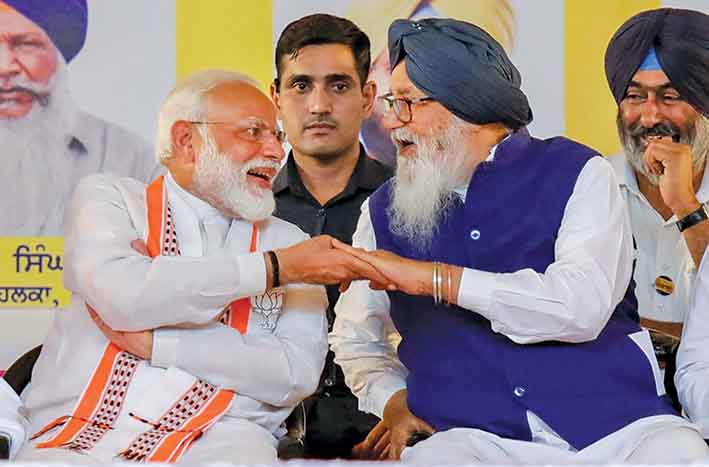
Politics has a way of bringing old allies back together, particularly when the arithmetic of going it alone becomes increasingly difficult. The renewed rapprochement between the Bharatiya Janata Party (BJP) and the Shiromani Akali Dal (SAD) reflects precisely this calculation. After nearly a decade away from power, both parties appear to have recognised that their individual political limitations may be overcome through a partnership that once dominated Punjab’s electoral landscape.
The strengths of the two parties are largely complementary. The Akali Dal has traditionally enjoyed support in rural Punjab, particularly among the Jat Sikh community and farmers, while the BJP’s influence has been concentrated mainly in urban areas. The Akalis could benefit from the BJP's national leadership, organisational capabilities and Prime Minister Narendra Modi's image as an assertive administrator. Conversely, the BJP could use the Akali Dal's experienced Sikh leadership and extensive rural network to expand its political footprint.
Bridging Gaps
Despite the induction of Captain Amarinder Singh into the BJP, the party has failed to establish the expected influence among Jat Sikhs. An alliance with the Akali Dal could help bridge this gap. Equally important is the challenge of combating drug trafficking, which is not merely a law-and-order issue but also a question of social reconstruction.
For the Akali Dal, the biggest challenge is to overcome the legacy of allegations surrounding its previous government, particularly its alleged failure to prevent the spread of drugs. During its 2012-2017 tenure, the opposition made drug abuse and trafficking a major political issue. The whitefly infestation that devastated cotton crops in the Malwa region, triggering widespread anger among farmers, further damaged the government's credibility. The Bargari sacrilege incident and the police firing at Kotkapura and Behbal Kalan also dealt severe blows to the party's reputation. In the 2017 Assembly elections, the Akali-BJP alliance was reduced to just 18 seats, while the Congress secured 77 seats and formed the government.
The Akali Dal must demonstrate that it has learnt from its past and that its commitment to fighting drugs goes beyond electoral rhetoric. The BJP's nationwide campaign against drug trafficking could offer the Akalis an opportunity to rebuild their image. The NDA government at the Centre has repeatedly projected its actions against terrorism, Naxalism and narcotics trafficking as major achievements. By aligning itself with these efforts, the Akali Dal could seek to reassure voters that it is genuinely committed to making Punjab drug-free.
Electoral figures underline the importance of an alliance. During the 2022 Assembly elections, amid a sweeping Aam Aadmi Party (AAP) wave, the BJP and Akali Dal together won only five seats. In the subsequent Lok Sabha elections, contesting separately, the Akali Dal managed to retain only the Bathinda seat, while the BJP failed to win any parliamentary constituency in the state. Nevertheless, the BJP secured 18.56 per cent of the vote, compared with the Akali Dal's 13.42 per cent. This demonstrated that fragmented electoral strength does not necessarily translate into political power.
Seat-Sharing Hurdles
A joint contest could consolidate anti-incumbency votes against the AAP government. Based on its relatively stronger vote share, the BJP may seek to claim 42-45 Assembly seats. The Akali Dal, however, is likely to demand a larger share, citing its traditional rural support base and its historical position as the BJP's senior alliance partner.
The BJP also faces significant challenges of its own. It has yet to develop a prominent Sikh face capable of giving the party widespread acceptance in rural Punjab. When Captain Amarinder Singh joined the BJP after leaving the Congress in 2021, the party expected him to help fill this leadership vacuum. However, his age and changing political circumstances prevented the BJP from gaining the anticipated advantage. Despite continued efforts to strengthen its position among Jat Sikhs, the party has not achieved a decisive breakthrough. An alliance with the Akali Dal could therefore provide a practical route to overcoming this political limitation.
The BJP’s internal electoral assessments are also believed to favour an alliance, as a joint contest could improve its prospects against the AAP. However, seat-sharing negotiations may prove difficult. The BJP could demand more seats on the strength of its improved vote share, while the Akali Dal would seek to retain its status as the larger partner, backed by its traditional support base.
Meanwhile, the AAP government faces persistent criticism over law and order, rising crime and the drug trade. The Congress and BJP have repeatedly targeted Chief Minister Bhagwant Mann's government on these issues. Growing anti-incumbency could create an opportunity for the reunited alliance. However, criticism of the incumbent government alone will not be enough. The parties must offer credible solutions to Punjab’s agricultural distress, unemployment, youth migration and drug addiction. In this context, Union Home Minister Amit Shah has announced a goal of making Punjab drug-free by 2029.
The BJP and Akali Dal share a long political history, formalising their alliance in 1996 and winning 93 of Punjab’s 117 Assembly seats in 1997. After returning to power in 2007 and 2012, they parted ways in 2020 over the farm laws. Their renewed partnership seeks to restore the Akali Dal's credibility and strengthen the BJP's rural and Sikh voter base.
Electoral unity can provide political momentum, but it cannot automatically restore public trust. The Akali Dal must offer honest answers to the allegations surrounding its previous tenure, while the BJP must demonstrate sensitivity towards Punjab’s identity, agricultural interests and Sikh sentiments.
(The writer is a senior New Delhi-based journalist. Views personal.)