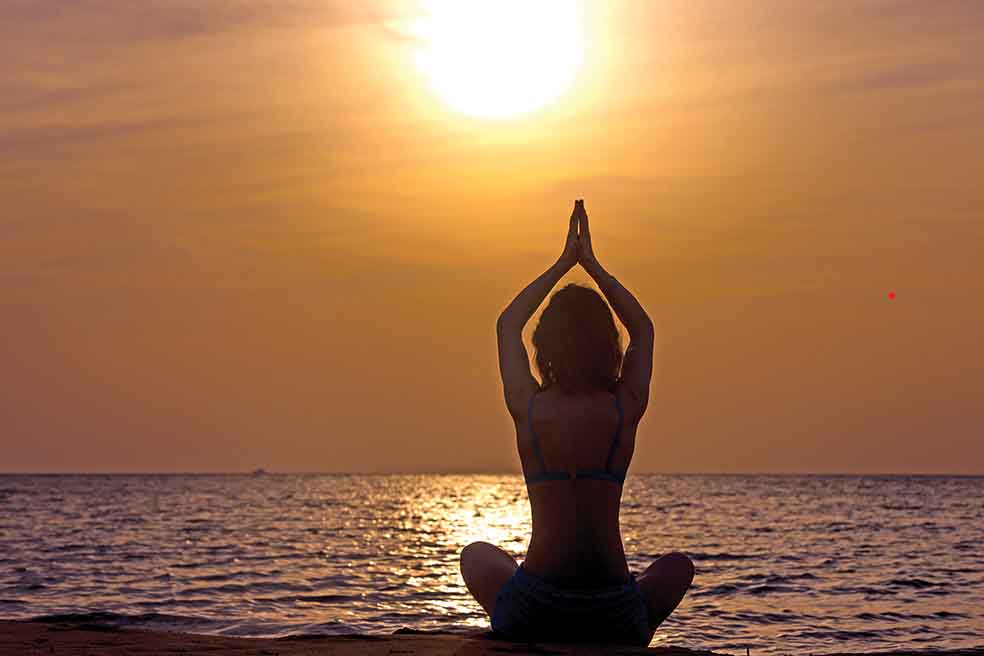
In our previous articles, we explored the first seven limbs of Ashtanga Yoga: Yama, Niyama, Asana, Pranayama, Pratyahara, Dharana and Dhyana. Each prepares the practitioner for the next stage of the yogic journey. We now arrive at the eighth limb—Samadhi, the culmination of this path.
Maharishi Patanjali defines yoga in Yoga Sutra 1.2: “योगश्चित्तवृत्तिनिरोधः॥”Yogaś citta-vṛtti-nirodhaḥ. This means, “Yoga is the cessation of the fluctuations of the mind.”
Our minds are constantly occupied with thoughts about the past, worries about the future, expectations and memories. Even when we perform a task, our attention often wanders elsewhere. Through sustained practice, yoga helps us cultivate greater control over these mental fluctuations and develop a deeper state of concentration.
Samadhi is a state in which meditative awareness becomes profoundly absorbed and the usual mental distractions subside. It is not achieved by forcibly stopping thoughts but through disciplined practice and the gradual refinement of attention.
Taking vs Attaining Samadhi
Samadhi Lāvaṇē (entering meditative absorption) generally refers to a practitioner deliberately entering a deep meditative state through sustained yogic practice. In the context of Patanjali’s Yoga, Samadhi is the culmination of concentration and meditation, in which awareness becomes deeply absorbed in the object of meditation.
Samadhi Ghenē (taking Samadhi) is also commonly used in a spiritual or traditional context to describe a saint or yogi’s final departure from the physical body, sometimes understood within that tradition as a conscious spiritual act. The term may also be used more broadly as a respectful expression for a saint’s passing.
Therefore, these expressions should not automatically be treated as identical. In the context of Ashtanga Yoga, Samadhi primarily refers to a profound meditative state—not death itself. A person entering deep meditation has not necessarily attained the highest spiritual realisation.
Important Types of Samadhi
Patanjali describes four aspects of Samprajnata Samadhi in Yoga Sutra 1.17: Vitarka, Vichara, Ananda and Asmita. He further explains the distinctions between four forms of meditative absorption in Sutras 1.42–1.44. In Savitarka Samadhi, awareness remains focused on a gross object, along with its name, meaning and associated thoughts. In Nirvitarka Samadhi, these associations subside, allowing more direct awareness of the object. Savichara Samadhi involves awareness shifting to subtler objects, while contemplation continues. In Nirvichara Samadhi, subtle contemplation subsides, giving rise to profound clarity and steadiness.
In Yoga Sutra 1.47, Patanjali describes the inner clarity and serenity associated with proficiency in Nirvichara Samadhi.
These stages are not simply about having fewer thoughts. They describe increasingly subtle dimensions of meditative absorption that require sustained practice and cannot be fully understood through intellectual knowledge alone.
In everyday life, our happiness often depends on external circumstances. Praise makes us happy, while criticism or disappointment can disturb our peace of mind. Yoga encourages us to develop a more balanced relationship with these experiences.
The serenity associated with advanced meditation is not merely a temporary feeling of pleasure. It is related to the clarity and stillness of the mind. However, ordinary moments of relaxation or happiness should not be confused with the advanced states of Samadhi described in classical yoga.
Patanjali also describes Asamprajnata Samadhi in Yoga Sutra 1.18, where the ordinary flow of mental activity becomes quiescent. These descriptions belong to a deeper philosophical framework and should not be reduced to simply sitting quietly or experiencing a blank mind.
Beyond Meditation
The eight limbs of Ashtanga Yoga form an interconnected path. Yama and Niyama establish ethical discipline; Asana and Pranayama develop physical stability and breath awareness; Pratyahara turns attention inward; Dharana builds concentration; and Dhyana sustains meditation. Samadhi marks the culmination of this progression.
In Patanjali’s Yoga philosophy, the ultimate goal goes beyond blissful experiences. Vivekakhyati, or discriminative knowledge, and Kaivalya, or liberation, are central to understanding the deeper purpose of yoga.
Not everyone needs to attain advanced states of Samadhi to benefit from yoga. Regular practice can cultivate mindfulness, patience, concentration and emotional balance in everyday life.
Samadhi represents an inward journey—from distraction to awareness and mental restlessness to stillness. It reminds us that yoga extends beyond physical practice to the disciplined exploration of the mind and consciousness.
(The writer is a yoga instructor and researcher based in Pune. Views personal.)