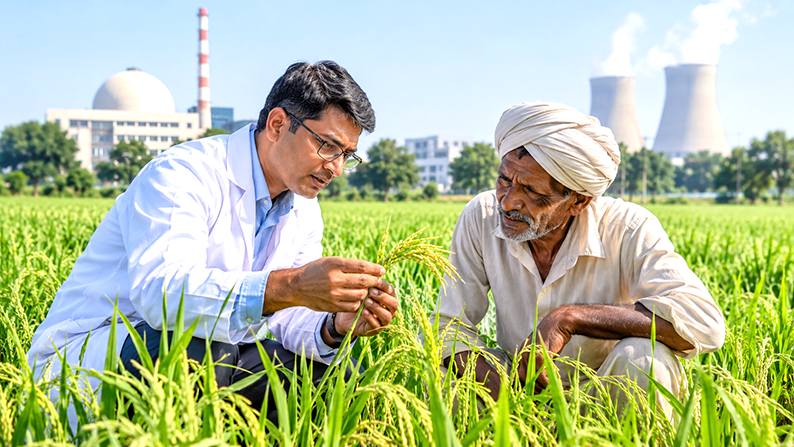
India’s nuclear establishment has made significant contributions to agriculture through radiation-induced mutation breeding, food preservation and other applications of nuclear science. The Bhabha Atomic Research Centre (BARC), under the Department of Atomic Energy (DAE), has developed improved crop varieties with desirable characteristics such as higher yield, early maturity and tolerance to environmental stresses. These achievements deserve recognition. Yet, an important question remains: how much of this scientific progress has actually reached India’s farmers?
BARC has reported the development of 72 improved crop varieties through radiation-induced mutation breeding and cross-breeding. Several varieties have been released and notified for commercial cultivation. Its research in food irradiation, crop protection and agricultural biotechnology also offers considerable possibilities. However, scientific achievement and its adoption in agricultural fields are two different measures of success.
From my experience and observations, there appears to be a considerable gap between institutional achievements and their visibility at the grassroots level. There have been memoranda of understanding and research collaborations with agricultural universities, particularly in certain southern and western regions. These are welcome initiatives. However, their geographical reach and practical outcomes need closer examination.
In several other agriculturally important regions, the presence of nuclear agricultural technologies remains far less visible. More importantly, ordinary farmers have little awareness of the agricultural research and technologies being developed by the Department of Atomic Energy.
Institutional Problem
This raises a larger institutional question. Are our scientific organisations operating within self-imposed boundaries, limiting the wider application of their research? BARC, the Indian Council of Agricultural Research (ICAR), CSIR laboratories, agricultural universities and state research institutions may have different mandates and administrative structures, but their broader national objective is shared: improving Indian agriculture and strengthening food security. Why, then, should promising research remain confined to the institution or university where it originated?
The Ministry of Agriculture and Farmers Welfare should play the role of a facilitator in bringing these institutions together. Rather than creating another administrative structure, the government could strengthen existing research-extension networks and establish a coordinated mechanism for evaluating and disseminating technologies. India’s network of Krishi Vigyan Kendras (KVKs), supported by ICAR, offers an established platform for field demonstrations, farmer training and location-specific technology assessment. These centres could become important partners in taking suitable nuclear agricultural technologies to farmers.
The experience of private agricultural enterprises offers useful lessons. Companies such as Jain Irrigation have established a visible presence among farmers through micro-irrigation, fertigation, field demonstrations and practical agronomic support. Their approach demonstrates the importance of connecting technology with the everyday requirements of agriculture. Similarly, Israeli agricultural technologies, particularly in precision irrigation, water management and protected cultivation, are being adapted to Indian conditions through institutional and commercial collaborations. Their relevance lies not merely in technological sophistication but in their application to practical farming problems.
This is not a comparison of commercial enterprises with scientific research institutions on identical terms. Their mandates are different. However, it highlights an important principle: research acquires its full societal value when it is translated into accessible and affordable solutions.
Different Challenges
Agricultural technology cannot be transferred through a uniform national prescription. The challenges of a farmer in Bundelkhand are different from those in Punjab, Vidarbha, coastal Andhra Pradesh or the Gangetic plains. Soil conditions, water availability, climatic variations, cropping patterns and economic capacities differ considerably. Farmers must therefore be involved in identifying problems, evaluating technologies and providing feedback. Solutions should be tested, adapted and tailored to local requirements rather than simply promoted as laboratory achievements.
Equally important is the language of communication. Scientific research papers are generally written for specialists and academic audiences. The farmer, who is ultimately expected to benefit from the research, often remains outside this knowledge network. Every significant research outcome with practical agricultural potential should have a simplified companion document in relevant regional languages. It should explain the problem addressed, the crops and regions suitable for the technology, its method of application, costs, expected benefits and the availability of seeds or technical assistance.
In other words, scientists must communicate not only with fellow scientists but also with the people for whose benefit their research is undertaken. Listening to farmers should be as important as presenting research findings to academic audiences.
The performance of research institutions also needs a broader perspective. Publications, patents, awards and memoranda of understanding are important indicators of scientific activity, but they cannot alone establish agricultural impact. Institutions should also document the number of farmers reached, geographical coverage, adoption rates, reduction in post-harvest losses and measurable improvements in productivity and farm incomes. Such assessments would help identify gaps and guide future research priorities.
India does not lack scientific talent or agricultural research infrastructure. What it needs is stronger institutional coordination, effective technology dissemination and a farmer-oriented approach to research commercialisation and extension. The Department of Atomic Energy should see agricultural outreach as an integral part of its societal contribution, while the Ministry of Agriculture should facilitate the convergence of scientific capabilities with the country’s extensive agricultural extension network.
Ultimately, the success of nuclear agriculture will be visible when a farmer in a remote village can access an improved seed, understand its benefits in his own language, receive appropriate technical guidance and improve his livelihood. The journey of scientific research should not end at the laboratory door. It must reach the farmer’s field.
(The writer is a former scientific officer with the Department of Atomic Energy. Views personal.)