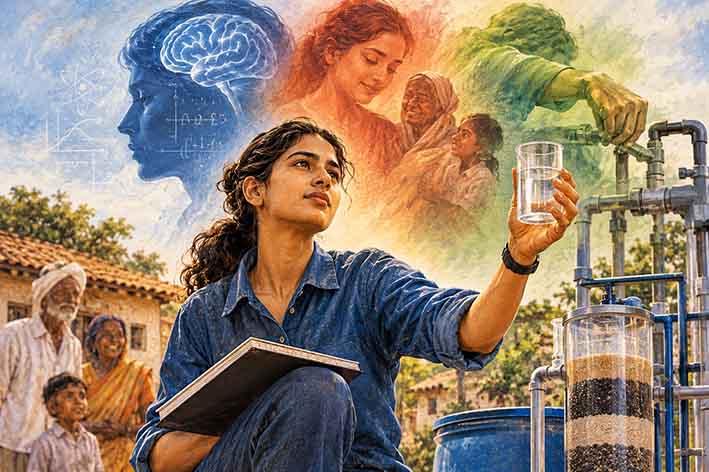
Imagine three engineering graduates asked to solve a village’s drinking water problem. The first understands water chemistry and can explain several purification technologies. The second listens to villagers and appreciates their needs, financial constraints and concerns. The third can build a treatment unit, test it and keep it running. Who is best equipped to solve the problem? Clearly, all three capabilities are necessary, whether combined in one person or brought together through teamwork. This example captures a simple but powerful idea: the Head must understand, the Heart must care, and the Hand must act.
Our education system recognizes these qualities but seldom gives sufficient attention to their integration. We reward academic achievement, appreciate empathy and acknowledge practical skills, often as separate accomplishments. Yet real problems rarely respect such divisions. A technically sound solution may fail because people cannot afford it. Good intentions may produce poor outcomes when unsupported by evidence. An excellent idea may remain useless if nobody knows how to implement it. The real question is whether education prepares people merely to acquire capabilities or to use them together.
Separate Capabilities
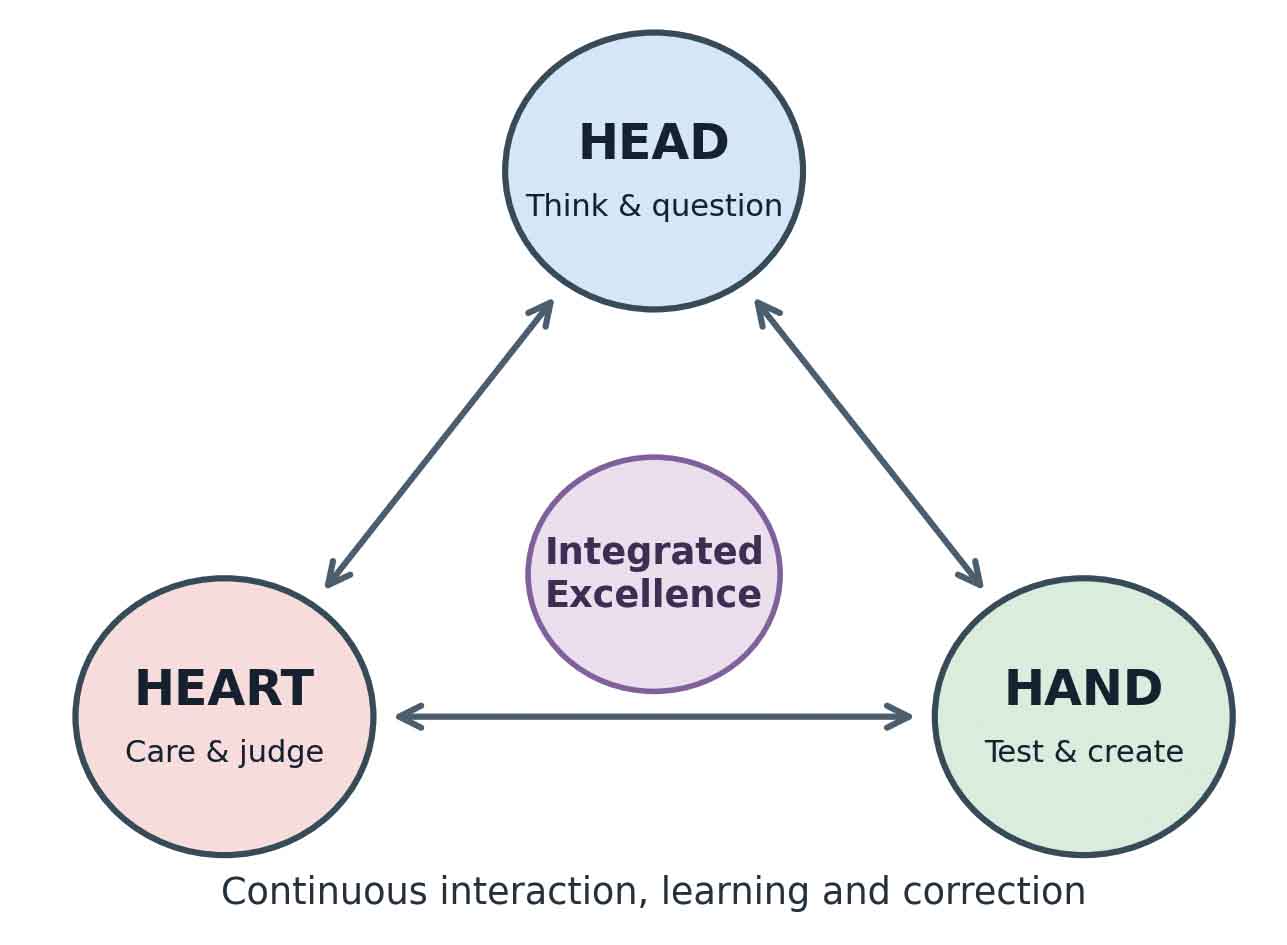
The Head represents reasoning, curiosity, imagination and the ability to question assumptions. The Heart represents human values, empathy, ethical judgement and concern for consequences. The Hand represents experimentation, craftsmanship, practical competence and learning through action. These are not separate compartments of the brain or three measurable forms of intelligence. They provide a useful framework for understanding different but complementary human capabilities.
The importance of thinking, feeling and doing has long been recognized in educational philosophy. What we propose through the 3H Synchronization Model is an emphasis on their continuous interaction. The Head may develop a promising solution, but the Heart questions whether it addresses a genuine need. The Hand tests whether the idea works under real conditions. Practical difficulties may expose weaknesses in the original reasoning, while experience with users may change the problem being investigated. The three dimensions must therefore inform, challenge and improve one another. Integrated excellence emerges not from possessing three independent qualities, but from bringing them together in purposeful action.
Consider a student who can explain the principles of an electrical circuit but struggles to identify a faulty connection. Another may understand environmental pollution yet have difficulty collecting a reliable field sample. These examples do not diminish the importance of theoretical knowledge. They reveal the limitations of learning that remains disconnected from experience. An unsuccessful experiment may expose an incorrect assumption more effectively than a perfectly executed classroom demonstration.
This concern is hardly new. Mahatma Gandh’s Nai Talim connected education with productive work and everyday life, while American philosopher John Dewey emphasized experience, inquiry and reflection. Their approaches differed, but both questioned the separation of learning from lived experience. Modern educational research reinforces this concern. A major meta-analysis led by Scott Freeman, published in Proceedings of the National Academy of Sciences in 2014, examined 225 studies in undergraduate science, technology, engineering and mathematics education. It found that active-learning approaches generally improved examination performance and reduced failure rates compared with conventional lectures. These findings do not establish the validity of the 3H model, but they reinforce the importance of moving beyond passive reception of information.
Practical activity alone, however, does not guarantee understanding. Students must examine why something worked, why it failed and what should change. In this sense, the Hand does not merely apply knowledge supplied by the Head. It can generate new questions and become a source of knowledge itself. The Heart contributes another essential perspective. A medical professional may know the correct treatment but fail to understand why a patient cannot follow it. Financial difficulties, family responsibilities or fear may influence the outcome. Listening to the patient can reveal information essential to effective care. Yet empathy must remain guided by evidence, since good intentions cannot justify ineffective treatment.
Pressing Need
Artificial intelligence makes the need for integration more urgent. Machines can retrieve information, generate explanations, write programs and assist with complex analysis. If examinations mainly reward students for reproducing information or producing convincing answers, AI challenges what those assessments actually measure. A student may submit an impressive assignment without understanding its reasoning, recognizing its errors or knowing whether the proposed solution would work.
The response should not be to abandon intellectual learning but to deepen it. Students must learn to formulate meaningful questions, evaluate evidence, identify mistakes and defend their conclusions. They should also understand who may benefit or suffer from a decision and how a proposed solution can be tested. AI can assist with these tasks, but a convincing answer is not necessarily correct, and a technically feasible proposal is not automatically desirable. Responsibility for important decisions cannot be transferred to a machine simply because it helped generate the answer.
This suggests a different approach to assessment. Instead of asking students only to describe how a system works, we could ask them to investigate why it fails, examine who is affected, propose improvements and demonstrate whether those improvements succeed. Students would need to explain their reasoning, respond to criticism and revise their work when evidence demands it. Such exercises would test not only what students know, but also how responsibly and effectively they use that knowledge.
Imagine students investigating food wastage in their institution. They could measure the waste, examine its causes, speak with kitchen staff and students, develop possible solutions and test their effectiveness. Mathematics, environmental science, economics, communication and practical problem-solving would become parts of a single learning experience. Students might also discover that a technically attractive solution fails because it overlooks human behaviour. Such an experience teaches something that a textbook alone cannot: solving a problem often requires changing our understanding of the problem itself.
Written examinations remain useful, but projects, practical demonstrations, reflective discussions and teamwork can reveal additional capabilities. We should nevertheless resist creating another numerical index for the Head, Heart and Hand. Empathy and ethical judgement cannot be meaningfully reduced to simplistic scores. The objective is not another ranking system, but an education that develops independent thinking, responsible judgement and the ability to act effectively.
Let us return to the village’s drinking water problem. An institution may produce graduates who can explain purification technologies, another may encourage them to appreciate the villagers’ difficulties, and a third may equip them with practical skills. But a truly effective education should prepare graduates to bring these capabilities together, listen to the community, test their assumptions and remain engaged until a workable solution emerges.
The real failure of education is not simply that students leave institutions without sufficient knowledge. It is that too many may leave without learning how to question that knowledge, understand its consequences and put it to meaningful use. Education must develop not merely capable minds, but responsible human beings who can translate knowledge into action. The true measure of education is not how much a person knows, but what that person can understand, care about and accomplish with that knowledge.
(Dr. Mahajan is Professor and Director, RIIL, COEP Technological University, Pune. Dr. Paknikar is ANRF Prime Minister Professor, COEP, and former Director, Agharkar Research Institute, Pune. Views personal.)