India takes immense pride in its scientific accomplishments. From the success of lunar missions to advances in nuclear technology, pharmaceuticals, digital infrastructure, and vaccine production, the country has steadily built a formidable scientific ecosystem. Yet there remains a striking contradiction at the heart of this progress: while India has produced world-class scientific institutions, scientific temper has not penetrated society with the same depth.
Superstition, misinformation, pseudoscience, and irrational fears continue to shape public opinion across subjects ranging from health and climate change to energy and technology. The problem is not a lack of scientific achievement, but the limited social spread of scientific thinking.
Culture of Curiosity
If India wishes to become a genuine scientific power in the twenty-first century, it must invest not only in laboratories and research facilities, but also in cultivating a culture of curiosity, questioning, and evidence-based thinking.
One of the country’s most valuable yet overlooked resources in this mission is its vast community of retired scientists, engineers, and technical professionals.
Anyone who has spent time in institutions such as Bhabha Atomic Research Centre or laboratories under Council of Scientific and Industrial Research would notice a common characteristic among many scientists: they are natural teachers. Most are eager to explain ideas, discuss technology, and share their experiences with younger generations. Their intellectual curiosity often extends far beyond their immediate specialization.
Unfortunately, after retirement, much of this experience disappears from public engagement. Thousands of highly trained professionals, carrying decades of scientific and technological understanding, gradually become disconnected from educational and social institutions. In a country struggling to make science education more engaging and inquiry-driven, this is an enormous wasted opportunity.
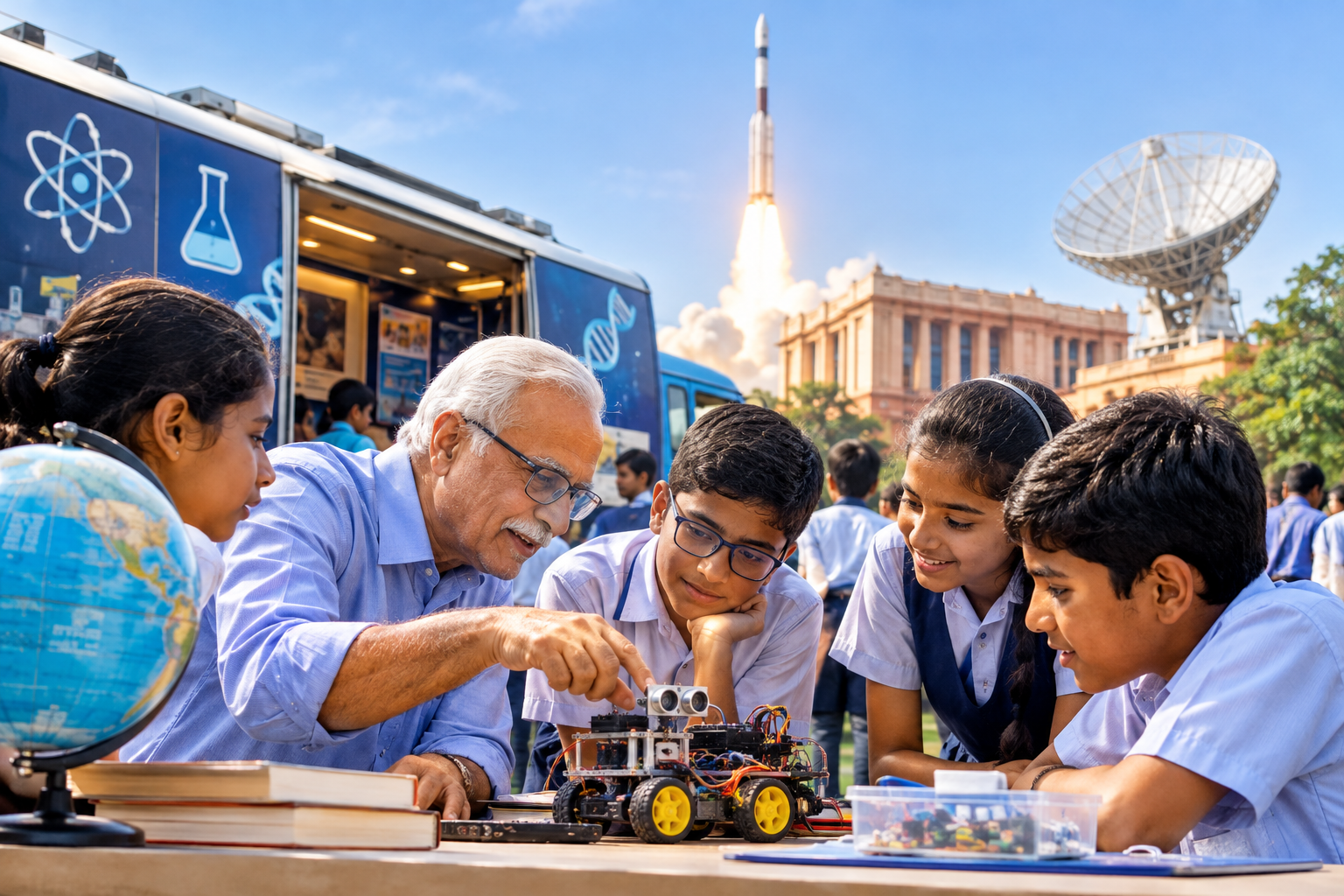
India should create a structured national programme to connect retired scientists and technologists with schools, colleges, libraries, and community centres. A scientist explaining how a reactor works, an engineer discussing everyday technology, or a researcher narrating real-world problem-solving experiences can make science feel alive in ways textbooks often cannot.
Such interactions may also help address the dominance of rote learning, a deep problem in our education system. Students are trained to cram formulas and definitions for examinations, but rarely encouraged to experiment, question or fail. Yet curiosity and experimentation are the foundations of scientific temperament.
This is why Indian schools need more than laboratories reserved for formal practical examinations. Every school should have a “science junkyard” or tinkering space where students can work with discarded machines, old motors, wires, computer components and everyday mechanical objects. A student building a small windmill from scrap material or experimenting with a simple water-saving device develops a far deeper relationship with science than one who merely reproduces textbook diagrams.
Large-Scale Outreach
India has already demonstrated that large-scale science outreach can succeed when imagination is involved. Years ago, a remarkable initiative popularly known as the “Science Express” train travelled across the country carrying science exhibitions inside railway coaches. Different scientific institutions showcased interactive models and educational displays for the public. One coach, dedicated to the Department of Atomic Energy, explained nuclear science and energy in simple, accessible language.
What made the initiative especially memorable was its attempt to communicate science to all age groups. Children could explore science literature presented through illustrated storytelling and comic-style formats similar to Amar Chitra Katha. Instead of intimidating people with technical language, the exhibitions focused on curiosity and participation.
The response was extraordinary because the train took science directly to ordinary citizens, including those living far from major metropolitan centres. For many children in smaller towns, it was perhaps their first close interaction with large-scale scientific demonstrations and scientists themselves.
Today, such initiatives could be redesigned far more effectively using modern technology. A new generation of travelling science exhibitions could include robotics, artificial intelligence demonstrations, climate science modules, renewable energy experiments, virtual reality installations, and interactive digital learning tools. Mobile science laboratories could regularly visit schools in rural and semi-urban India where access to advanced scientific infrastructure remains limited.
At the same time, scientific engagement must extend beyond formal institutions. Social media, despite its problems, offers enormous opportunities for science communication. Young Indians increasingly consume information through short videos, podcasts, and digital platforms rather than conventional classrooms or newspapers.
Unfortunately, misinformation often spreads faster online than verified knowledge. But the solution is not withdrawal from these platforms. Scientists, educators, universities, and research institutions must become far more active in creating credible, engaging, and regionally accessible science content. India particularly needs high-quality science communication in Hindi and other Indian languages if scientific temper is to move beyond urban English-speaking audiences.
Another important step could be the expansion of “citizen science” initiatives where students and local communities participate in gathering environmental data related to air quality, biodiversity, rainfall, water pollution, or urban heat. Such participation transforms science from an abstract academic subject into a lived social experience connected to daily life.
Scientific temper is not merely an educational ideal mentioned in the Constitution. It is essential for a healthy democracy and an informed society.
India already possesses the institutions, talent, and human capital needed for such a transformation. What is missing is a systematic effort to connect scientific knowledge with society itself.
(The writer is a former scientific officer with the Department of Atomic Energy. Views personal.)