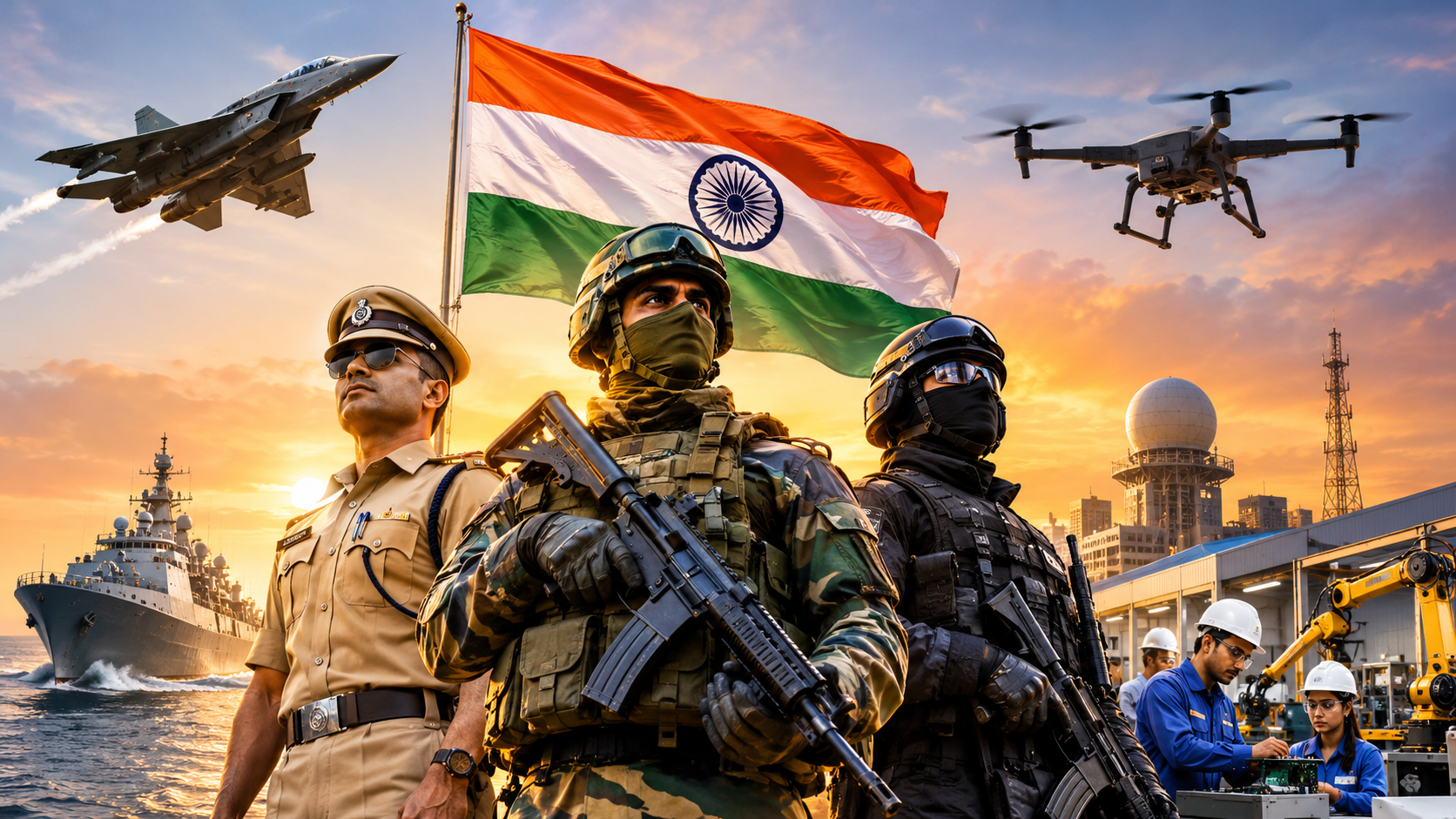
The traditional distinction between external defence and internal security is steadily losing its relevance. Defence forces were primarily entrusted with protecting the country against external aggression. Over the years, however, their responsibilities have expanded considerably. They are increasingly called upon to assist civil administration during natural disasters, tackle internal security challenges and counter terrorism. Conversely, the challenges confronting police and paramilitary forces have acquired a distinctly strategic and national security dimension.
The threats to India’s sovereignty are now so interconnected that separating the equipment, technologies and operational capabilities required by the armed forces and the police is becoming increasingly impractical. Defence forces neither possess all the necessary tools nor always receive the specialised training required to manage civilian situations involving law and order, crowd control and internal disturbances.
India’s police forces are numerically more than twice the strength of its defence forces. They are also increasingly entrusted with responsibilities extending beyond conventional policing. The Government’s policy of facilitating the absorption of Agniveers into paramilitary and police organisations after their initial four-year engagement offers an additional opportunity to strengthen this institutional relationship. Their military training and experience can be put to effective use, provided the receiving organisations have suitable equipment, infrastructure and training systems.
Expanding Responsibilities
Police and specialised security units are required to operate along international borders, including areas where international conventions do not permit the routine deployment of defence forces. India’s extensive coastline presents another formidable challenge against terrorists, illegal trafficking in narcotics, weapons and other contraband.
Operation Sindoor has further demonstrated the importance of coordination between defence and police establishments. Even during an external military confrontation, police forces are required to provide active support to the armed forces, particularly when hostile drones attempt to penetrate Indian territory. Such threats demand an integrated security architecture in which the armed forces, police, intelligence agencies and local administrations work in close coordination.
It is therefore necessary to equip police units with the same or comparable technologies and operational capabilities available to defence forces, wherever their responsibilities overlap.
The Bureau of Police Research and Development (BPR&D), functioning under the Ministry of Home Affairs, has an important role in conducting research and identifying the technological requirements of police organisations. It is time to expand its mandate to include a systematic assessment of areas where police and defence requirements converge.
The Bureau should identify equipment and technologies currently being imported by both establishments, assess the possibility of domestic substitution and prepare a phased roadmap for replacing foreign supplies with indigenously manufactured products and services. Such an exercise would not merely reduce import dependence; it would also create a predictable domestic market for Indian manufacturers.
India’s Micro, Small and Medium Enterprises (MSMEs) should be encouraged to fill this gap. They can manufacture bullet-proof jackets, body cameras, drones, surveillance equipment, amphibious boats, speed boats and a variety of specialised security devices. These are not necessarily products that only large defence manufacturers can produce. With appropriate technical specifications, quality certification and assured procurement commitments, smaller enterprises can become reliable suppliers.
Indigenisation is also a strategic necessity because international supply chains are increasingly vulnerable to geopolitical turbulence. A conflict, sanctions regime or disruption in international trade can suddenly affect the availability of critical components. Security forces cannot afford to discover during an emergency that essential equipment is unavailable because a foreign supplier has suspended deliveries.
Modern defence and police vehicles increasingly depend on lithium batteries, semiconductor chips, sensors and sophisticated software incorporating artificial intelligence. If these systems are to function reliably, India must develop domestic capabilities to manufacture critical components, using indigenous materials and research wherever feasible.
MSMEs and technology start-ups can play a significant role in this endeavour. Apart from manufacturing original equipment, they can ensure the availability of spare parts, undertake timely repairs and provide maintenance support. This would reduce dependence on overseas suppliers and considerably shorten the time required to restore equipment to operational readiness.
One of the most promising areas for intervention is the use of start-ups and artificial intelligence in training security personnel.
Defence and police organisations must constantly update their personnel on new equipment, changing laws, administrative procedures, judicial pronouncements and operational protocols.
Unfortunately, the existing training infrastructure is often unable to keep pace. The scale of personnel requiring training, shortage of expert instructors, inadequate infrastructure and geographical constraints make conventional methods increasingly insufficient. The result can be outdated knowledge, procedural errors and operational mistakes, some of which can prove extremely costly.
India should therefore encourage start-ups to develop mobile-based training assistance applications incorporating artificial intelligence. Such applications could provide customised training modules for personnel according to their rank, responsibilities, experience and individual learning requirements.
They could also identify weaknesses in a person’s understanding, recommend corrective exercises and provide trainers with reliable assessments of areas requiring improvement. Instead of depending exclusively on periodic classroom instruction, personnel could access updated training material whenever required.
The same platform could be adapted for both defence and police establishments, with modules reflecting their respective operational needs. The objective must be to create a continuously updated, accessible and individualised training ecosystem.
Recent conflicts have demonstrated how unmanned aerial systems can alter battlefield calculations, overwhelm conventional defences and impose disproportionate costs on the adversary.
India must prepare for this changing environment by actively involving domestic MSMEs and start-ups in developing counter-drone technologies. It would be economically unsustainable to rely exclusively on expensive conventional weapons to destroy inexpensive hostile drones.
Another emerging concern is the use of concealed, solar-powered CCTV cameras and other surveillance devices near border areas by hostile elements. Such installations can provide persistent intelligence about the movement of security personnel and sensitive infrastructure. India must develop technologies capable of detecting these devices quickly and accurately. Domestic enterprises working in sensor technology, artificial intelligence, image processing and electronic surveillance detection should be encouraged to undertake this work.
Securing Information
Social media platforms are increasingly being exploited by hostile countries, terrorist organisations and other inimical elements for spreading disinformation, recruiting vulnerable individuals, radicalising young people and facilitating the narcotics trade.
Despite restrictions on the use of social media by defence personnel, concerns remain about its use in private capacities. Security personnel, too, are not immune to psychological manipulation, targeted misinformation or attempts at intelligence gathering through digital channels.
There have been instances of security personnel becoming targets of such campaigns. Security establishments must educate their personnel about suspicious online contacts, hostile narratives, data leakage and the risks of sharing sensitive information.
India must simultaneously strengthen its domestic digital ecosystem. Developing indigenous social media platforms and secure communication systems would reduce strategic dependence on foreign-controlled technologies. Similarly, concerns about the influence of digital entertainment platforms on vulnerable audiences deserve informed public scrutiny and appropriate regulatory attention.
MSME Partnership
Government departments must move beyond the conventional practice of placing large orders with a limited number of established manufacturers. They should actively create opportunities for MSMEs, start-ups, research institutions and private technology partners.
The Government should also encourage collaboration between established defence manufacturers and smaller technology companies. Above all, procurement policies must reward indigenous research, reliability and operational effectiveness rather than merely the lowest initial purchase price.
India’s ambition of becoming Viksit Bharat by 2047 cannot be realised without technological self-reliance and a robust domestic manufacturing base. National security must be viewed as an ecosystem involving not only soldiers and police personnel but also scientists, engineers, entrepreneurs, researchers and skilled workers. By bringing MSMEs and start-ups into the heart of the security establishment, India can create a system that is innovative, responsive and less vulnerable to external disruptions.
Let us remember the Sanskrit exhortation: स्वमन्त्रस्वयन्त्रस्वविद्याः प्रकटय, प्रकटय .... असाध्यं साधय । (Let indigenous ideas, indigenous technology and indigenous knowledge flourish. Let us demonstrate that what appears impossible can indeed be achieved)
(The writer is former Director General of Police, Maharashtra. Views persona.)