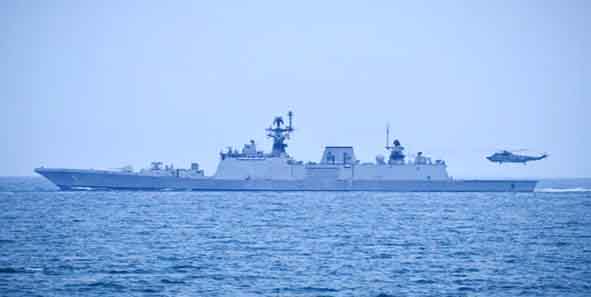
The Indian Navy’s modernisation is entering an important phase, and its latest acquisition programme offers a glimpse of how the country intends to defend its increasingly consequential maritime interests. The Ministry of Defence has recently signed contracts worth Rs. 53,866 crore for the construction of eight Next Generation Corvettes (NGCs), dividing the order between two public-sector shipbuilders: Garden Reach Shipbuilders and Engineers (GRSE), Kolkata, which will construct five vessels, and Goa Shipyard Limited (GSL), which will build the remaining three.
For the first time, the Indian Navy has undertaken the indigenous design of these warships, with construction entrusted to defence public-sector undertakings selected through a competitive process. It represents an important evolution in India’s naval acquisition philosophy, moving beyond the domestic assembly of imported designs towards the development of indigenous technologies and engineering capabilities.
Maritime Muscle
Corvettes occupy an important place in modern naval warfare. Smaller than frigates and destroyers, they are nevertheless versatile combatants, particularly suited to operations in coastal waters and contested littoral environments. The NGCs are expected to undertake coastal defence, maritime surveillance and anti-submarine operations while maintaining a credible presence across India’s extensive maritime domain.
Their combat capability will rest on an advanced combination of missiles, weapons and sensor suites, enabling them to operate across the air, surface and sub-surface domains. A hangar capable of accommodating a helicopter or an unmanned aerial vehicle (UAV) will further extend their surveillance and operational reach.
Stealth will be another defining feature. The vessels are being developed with reduced radar cross-sections and measures to minimise infrared, acoustic and magnetic signatures. Such characteristics make detection and tracking more difficult, an increasingly valuable advantage in an era of sophisticated maritime surveillance and precision-guided weapons. The NGCs will replace the Navy’s ageing Khukri and Kora-class corvettes, providing a substantial technological upgrade to its smaller surface combatant fleet.
A warship is conventionally designed around three fundamental functions: float, move and fight. While its weapons and sensors determine its fighting capability, propulsion governs its mobility, endurance and operational flexibility. The engineering challenge is to make a vessel move efficiently at low speeds while retaining the ability to generate substantial power when operational circumstances demand it.
The NGCs will employ a Combined Diesel and Gas Turbine-Cross Connect (CODAG-CC) propulsion arrangement, driving two controllable-pitch propellers. The vessels are expected to attain a maximum speed of approximately 26 knots.
The cross-connect gearbox architecture is particularly important. It permits power generated by the diesel engines and gas turbines to be distributed flexibly to either or both propeller shafts. This allows the ship to adapt its propulsion configuration to different operational requirements, balancing fuel efficiency, speed and redundancy.
However, installing sophisticated engines and gearboxes is only part of the challenge. The real test lies in integrating machinery, transmission systems and electronic controls supplied by different manufacturers into a single, reliable propulsion architecture. Every component must communicate and function seamlessly with the others. A failure in coordination can compromise the performance of the entire system.
This is where the NGC programme acquires an additional significance for India's defence technology ecosystem. AstraYAN, a deep-tech start-up incubated at the IIT Madras Incubation Cell, has secured the contract for Propulsion System Integration (PSI) for the corvettes.
Its selection is noteworthy because the competition initially involved five international and domestic participants. The evaluation, which extended over more than a year, involved the Indian Navy, the Naval Science and Technological Laboratory (NSTL) under the Defence Research and Development Organisation (DRDO), and the shipyards. Following technical and commercial assessments, three companies qualified. AstraYAN emerged as the lowest bidder (L1) and the only indigenous supplier to secure the order, competing against established international names including Italy’s Fincantieri and Germany’s RENK.
AstraYAN’s proposed integration platform, IntegARK, is designed to provide engineering and systems-integration solutions for conventional as well as unmanned vessels, including commercial, naval and specialised ships. Its assignment involves ensuring that engines, gearboxes, shafts and control systems supplied by different manufacturers operate as one coherent unit. The system must also facilitate smooth transitions between propulsion modes and respond reliably to emergency situations.
Fincantieri, headquartered in Trieste, is among the world’s leading shipbuilding groups and Europe’s largest. Established in 1959, it has inherited a shipbuilding tradition extending over more than two centuries. With over 7,000 vessels built, 18 shipyards across the world and a workforce exceeding 24,000, it operates across virtually every segment of high-technology shipbuilding, from cruise liners and naval vessels to offshore platforms and underwater systems.
RENK, founded in 1873 and headquartered in Augsburg, specialises in transmissions, engines, hybrid propulsion systems, bearings, couplings and testing equipment. Its gearboxes are used in demanding applications involving frigates, icebreakers, tanks and industrial machinery. With annual revenues exceeding €850 million and approximately 3,000 employees, it is an established player in military and marine transmission technology.
These are formidable competitors with decades, and in some cases centuries, of accumulated engineering experience. AstraYAN is a much younger enterprise, founded in 2025. Its success should therefore be seen as a recognition of its technological proposition and competitive capabilities.
Beyond Imports
The larger lesson is that indigenous defence production cannot end with the manufacture of hulls, engines or weapons. The ability to integrate complex systems, develop proprietary engineering solutions and assume responsibility for mission-critical technologies is equally important. Without such capabilities, domestic shipbuilding risks remaining dependent on foreign expertise even when the vessels themselves are constructed in Indian yards.
The NGC programme offers an opportunity to change that equation. It also illustrates how academic incubation centres, private deep-tech enterprises, defence laboratories and public-sector shipyards can contribute to a common national objective.
(The writer is a retired naval aviation officer and defence and geopolitical analyst. Views personal.)