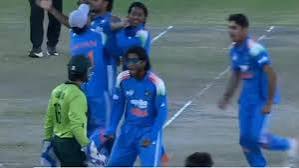
Winning against Pakistan is undoubtedly special. But when the celebrations descend into obscene gestures, verbal abuse and disrespect towards opponents, the victory loses some of its lustre. India’s Under-19 cricketers need to understand that wearing the national jersey comes with responsibilities that extend beyond winning.
There are victories that make you jump out of your seat, and then there are victories that make you hang your head in embarrassment. India’s dramatic one-wicket victory over Pakistan in the Under-19 Asia Cup final in Oman should have belonged firmly in the first category. Instead, what followed the final delivery was an unfortunate exhibition of aggression and appalling sportsmanship.
India had pulled off an extraordinary chase, hunting down Pakistan’s imposing 338-run target with a boundary off the final delivery. Mohit Ulva and Manal Chauhan had produced a remarkable rescue act when defeat seemed almost inevitable. The boys deserved every bit of celebration and every moment of unrestrained happiness.
But celebrating a victory and humiliating an opponent are two entirely different things. Videos circulating after the final showed Indian players making inappropriate gestures, directing aggressive exchanges towards their Pakistani counterparts and appearing to shout obscenities. Members of India’s support staff reportedly had to intervene.
Seriously, boys, what exactly were you celebrating? A cricket match or a street brawl?
There is absolutely nothing wrong with aggression in cricket. But aggression without dignity is merely bad behaviour dressed up as competitive spirit.
The problem becomes particularly concerning when the protagonists are teenagers representing a country with India’s extraordinary cricketing heritage. They are wearing the Indian jersey and representing an institution whose greatest ambassadors have included some of the most respected sportsmen in the world.
Would Kapil Dev have needed obscene gestures to celebrate a victory? Would Rahul Dravid, who has spent years nurturing young cricketers, consider this an acceptable expression of sporting excellence? Would Sachin Tendulkar have needed to abuse an opponent to establish his superiority?
And that brings us to the larger problem: what exactly are we teaching our young cricketers?
An Under-19 team is supposed to be a finishing school for future international stars. It is where talent is refined, temperament is developed and character is tested. Coaches are expected to teach youngsters how to handle pressure, respect opponents and conduct themselves professionally. Winning is important, but learning how to win is equally important.
If the lesson these boys take home is that defeating Pakistan gives them a licence to behave however they please, then Indian cricket has a far bigger problem than a few inappropriate gestures.
There is also a dangerous tendency to confuse patriotism with hostility. Beating Pakistan is a sporting achievement. It does not require a demonstration of hatred towards Pakistani cricketers. They are fellow professionals, albeit from a country with which India shares a complicated political relationship.
Cricket should provide an opportunity to rise above those differences, not reproduce them on a playing field. The argument that emotions were running high is equally unconvincing. Of course, emotions were running high.
A last-ball victory in a final is an extraordinary experience. Nobody expects teenagers to behave like monks after such a triumph. But there is a difference between losing control out of excitement and deliberately directing offensive gestures at another human being.
Let us not forget that Pakistan’s players had competed for the same trophy and had come agonisingly close to victory. They deserved respect, even in defeat.
The BCCI and the team management must address this incident. If the governing body wants to develop world-class cricketers, it must also develop world-class sporting ambassadors.
Senior cricketers and team managements set examples that younger players inevitably follow. When hostility becomes normalised, when gestures and snubs become part of the spectacle surrounding India-Pakistan encounters, youngsters begin to believe that such conduct is acceptable. The message from the top must be unambiguous: compete fiercely, but respect your opponent.
The irony is that India’s youngsters had already produced a performance worthy of admiration. They did not need to supplement a magnificent cricketing achievement with a display of boorish behaviour. The scorecard had done all the talking.
Cricket is often described as a gentleman’s game, although its history is hardly free of controversy. But the phrase represents an ideal worth preserving.
To India’s Under-19 cricketers, here is a simple lesson: celebrate your victories, cherish your medals. But never mistake arrogance for confidence or disrespect for patriotism.
(The writer is a senior journalist. Views personal)