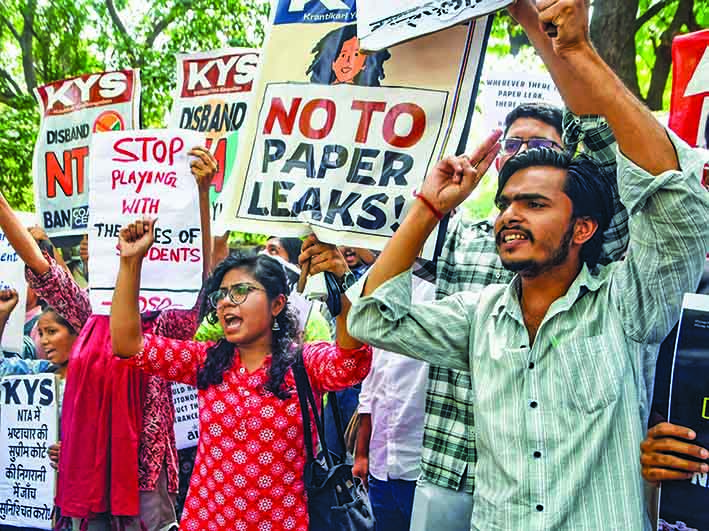
India today faces a paradox. It possesses one of the world's largest reservoirs of youthful energy and ambition, yet many of its young citizens find themselves negotiating an uncertain future, intense competition, shrinking confidence in institutions and growing frustration with the systems meant to serve them. The resulting discontent is increasingly visible in public demonstrations, online campaigns and political mobilisation. But to regard this restlessness merely as a law-and-order problem would be to mistake the symptom for the disease.
The more fundamental question is whether India is adequately listening to its young.
Pertinent Questions
Today’s Gen Z wants to be heard, not labelled; understood, not stereotyped; and given opportunities, not merely advice. Its questions are neither frivolous nor inherently subversive. Where are the jobs? Are examinations fair? Is merit rewarded? Are recruitment processes transparent? Are public institutions accountable?
A student who spends years preparing for a competitive examination, only to discover that a paper has been leaked, has legitimate grounds for anger. A graduate unable to find employment despite possessing qualifications may reasonably question the promises made to his generation.

Frustration and disappointment can harden into resentment, and resentment, when combined with hopelessness and the belief that lawful avenues are ineffective, produces alienation. Yet it would be simplistic to suggest that unemployment or dissatisfaction automatically leads to criminality. The overwhelming majority of young people facing such difficulties do not turn to crime. They persevere, innovate, pursue education, participate in peaceful movements and seek ways of improving their circumstances.
There is, moreover, a constitutional dimension to this debate that must not be lost in the din of public agitation. India’s democratic tradition was built upon the right to question authority. The freedom struggle itself drew strength from mass mobilisation, civil disobedience, public demonstrations and the courage to challenge established power. Mahatma Gandhi demonstrated that non-violent resistance could become an instrument of extraordinary political transformation.
Article 19 of the Constitution guarantees citizens freedom of speech and expression and the right to assemble peacefully and without arms, subject to constitutionally permissible restrictions. These freedoms are not concessions granted by a government of the day. They are essential features of democratic citizenship.
Consequently, disagreement with the government cannot be equated with disloyalty to the country. Young Indians have every right to question public policy, demand accountability, oppose injustice and organise peaceful demonstrations within the law. Equally, however, the right to protest cannot become a licence to assault individuals or police personnel, destroy public property, intimidate opponents or endanger human life.
Democracy protects dissent; the rule of law protects society from violence.
Discerning Law
Two dangerous extremes must therefore be resisted. The first is to treat every protester as a potential criminal simply because a demonstration challenges those in power. The second is to excuse unlawful conduct merely because its perpetrators claim to represent a popular cause. The law must distinguish between peaceful assembly and violent mob action, between political disagreement and criminal intimidation, and between civil disobedience and conduct that threatens public safety.
This also places considerable responsibility on political leadership. Youth movements frequently originate in genuine grievances, but their energy can be appropriated by organisations and individuals pursuing objectives that have little to do with the concerns that brought young people onto the streets. Political participation is legitimate and desirable. What is unacceptable is the deliberate encouragement of violence, intimidation or criminality for partisan advantage.
Young citizens must, in turn, exercise independent judgement. They should examine the motives of those seeking their support, question the methods being advocated and resist becoming instruments of somebody else's ambitions. Their conscience cannot be outsourced to a political leader, social-media influencer or ideological group.
The stakes extend well beyond public order. India’s demographic advantage will mean little if a generation of young people feels that its aspirations are inconsequential. Economic opportunity, transparent recruitment, educational reform, credible grievance-redress mechanisms and responsive governance are therefore not merely developmental objectives. They are also investments in democratic stability.
The government cannot expect trust simply by demanding it. Trust must be earned through visible fairness, institutional integrity and a willingness to listen. If examination irregularities occur, investigations must be prompt and transparent. If corruption is alleged, credible scrutiny must follow. Public institutions must demonstrate that legitimate grievances can be pursued through lawful channels and that those channels actually work.
There is also a responsibility on young Indians themselves. Fearlessness must not become recklessness, and boldness must not be confused with violence. Being a responsible citizen does not mean remaining silent. It means possessing the courage to speak and the judgement to act constructively.
The ambition that drives young Indians to question established practices can become an engine of entrepreneurship, scientific discovery and public service.
The achievements of young Indians offer reminders of what disciplined ambition can accomplish. D. Gukesh became the youngest world chess champion in 2024, demonstrating the rewards of preparation, concentration and composure under pressure. Para-archer Sheetal Devi has challenged conventional assumptions about physical limitations and human achievement.
But a nation need not produce a world champion from every household.
The real measure of a generation is not its capacity to create disturbance, but its ability to create change.
India must neither romanticise every act committed in the name of youth protest nor criminalise the aspirations of an entire generation. Its young citizens must be allowed to question authority without fear, while being held accountable for genuine wrongdoing. The country’s future will depend on whether it can convert youthful restlessness into purposeful participation.
The choice before India is not between silence and violence. There is a third, far more powerful possibility: courageous, constructive and constitutional action.
From Digital Outrage to Criminality
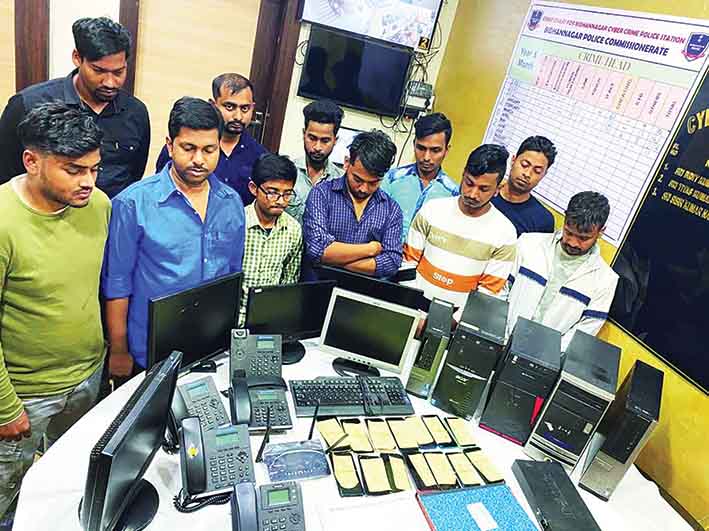
The smartphone has become the defining instrument of youthful participation in public life. It is at once a newsroom, a political platform, a meeting place and, increasingly, a vehicle for mobilisation. A grievance that once remained confined to a classroom or neighbourhood can now reach thousands within minutes. This has democratised communication but has also created new vulnerabilities.
Social media can expose corruption, amplify neglected voices and bring public attention to injustice. But the same technology can spread fabricated videos, manipulated images, deepfakes, threats and inflammatory rumours with extraordinary speed. A provocative clip detached from its original context can acquire an entirely different meaning.
For a generation accustomed to instantaneous communication, the interval between receiving information and reacting to it has become dangerously short. The temptation to forward first and verify later is particularly consequential when the subject involves communal tension, political confrontation or public disorder.
Digital discipline must therefore become an essential component of citizenship. Before joining an online campaign, consider whether its claims are supported by evidence. A digital footprint can outlast the emotion that created it, and threats, incitement and other unlawful online conduct can have serious legal consequences.
Yet the response cannot be indiscriminate censorship. Criticism of government policy, investigative journalism and peaceful online advocacy are legitimate democratic activities. The answer to misinformation is verification, media literacy, proportionate enforcement and credible public communication - not the suppression of inconvenient opinion.
The digital world is only one part of a larger problem. Peer pressure and mob psychology can also turn individual frustration into collective misconduct. An individual who might ordinarily hesitate before committing an act of violence can behave differently when surrounded by an emotionally charged crowd.
A peaceful gathering can be destabilised by provocations or a small number of instigators. This makes responsible leadership indispensable. Student organisations, political parties, community leaders and protest organisers must make it unequivocally clear that violence, intimidation and destruction are unacceptable. Participation in a crowd does not absolve an individual of responsibility for his or her actions.
Youth-related criminality has several faces, and a serious examination must look beyond the immediate spectacle of street violence. Cyber fraud, online extortion, drug trafficking, stalking, sexual violence, assault and organised criminal recruitment all demand attention.
Cybercrime presents a particularly deceptive threat. Digitally skilled young people can themselves become instruments of criminal networks. Some are recruited as money mules, fraudulent account operators or intermediaries in financial transactions, sometimes under the guise of legitimate employment. The promise of quick money, easy rewards or social status can draw vulnerable individuals into arrangements whose criminal implications they may not initially appreciate.
Drug trafficking and substance abuse pose another challenge. Criminal networks can exploit financial insecurity and the desire for acceptance, while addiction can damage educational prospects, family relationships and the prospects of a productive life. Enforcement against traffickers must therefore be accompanied by awareness, treatment, rehabilitation and support for recovery.
There is an equally important dimension concerning young people as victims rather than offenders. Young women, in particular, face harassment, stalking, sexual violence and online abuse. Their safety and freedom of movement are essential conditions of an equal society. Young people may also be exploited through coercion, deception and criminal networks that take advantage of their vulnerability.
This is why the debate must avoid reducing youth and crime to a question of unruly demonstrators. The same generation that needs protection from criminal exploitation may also contain individuals who perpetrate offences. Public policy must recognise both realities.
The most effective intervention is often preventive. Families, educational institutions, community organisations and law-enforcement agencies must work together to identify vulnerability before it becomes entrenched.
Political leaders, too, must exercise restraint in their language. The encouragement of hostility, the dehumanisation of opponents and the legitimisation of intimidation can have consequences beyond electoral rhetoric. Those who seek to mobilise young people must recognise that they bear a responsibility for the methods they endorse.
Youthful energy is neither inherently virtuous nor inherently dangerous. The challenge is to ensure that the generation most comfortable with digital communication becomes equally adept at digital responsibility.
Building a Culture of Prevention
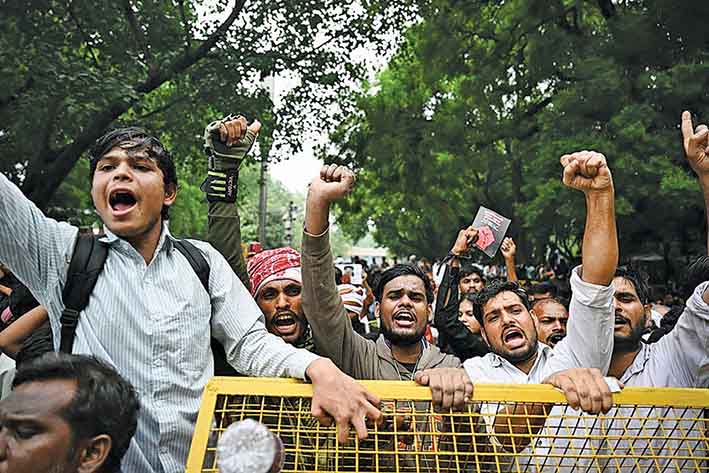
A society cannot police its way out of every social problem. The police are indispensable to maintaining public order, investigating offences and protecting citizens, but the prevention of youth crime demands professional policing, supportive families, responsible educational institutions and a justice system that recognises the possibility of reform.
The police occupy a particularly sensitive position. They are often the first public institution to confront the consequences of social anger. Their handling of a demonstration or public disturbance can either strengthen confidence in the state or deepen existing mistrust. The distinction between firmness and indiscriminate coercion is therefore fundamental.
Effective policing begins well before a crowd gathers. Local intelligence, community engagement and coordination with relevant authorities can help identify emerging tensions and credible threats. But intelligence-gathering must remain evidence-based and subject to legal safeguards.
Crowd management requires more than the deployment of personnel and barricades. Police officers need training in communication, negotiation, de-escalation and emergency response. Equally important is impartial enforcement. The law cannot operate differently depending on whether those responsible for violence support or oppose the government. Police personnel must be firm without being vindictive. But they, too, are entitled to protection against assault and intimidation.
Technology can assist in identifying organised criminal networks and credible threats, but surveillance and investigative powers must remain subject to appropriate safeguards. Technology should strengthen professional judgement, not replace it. Police stations must also become more accessible to young citizens.
The responsibility of government extends further. A generation repeatedly told to aspire cannot be expected to remain indefinitely indifferent to institutional failures.
Dialogue with peaceful protest organisers should be encouraged. Listening does not mean accepting every demand; it means recognising that citizens have a legitimate claim to be heard.
Young people need environments in which they can discuss frustration, rejection and disagreement without fear of humiliation.
Teachers, meanwhile, must look beyond academic performance. Critical thinking, emotional resilience, constitutional values, respect for differences and the ability to resolve conflicts peacefully are essential attributes of citizenship. The media, too, must distinguish verified facts from speculation. Sensational reporting and unsubstantiated allegations can inflame tensions rather than illuminate them.
There is another dimension to justice that deserves greater attention: what happens to a young offender after an offence has been committed?
Accountability is indispensable. But punishment alone does not necessarily prevent the repetition of crime. A system that offers no possibility of rehabilitation risks converting a youthful mistake into a permanent criminal identity.
India’s juvenile-justice framework recognises the importance of care, rehabilitation and reintegration for children in conflict with the law, subject to the applicable legal procedures. The distinction between children and adults, and the circumstances and seriousness of individual offences, must be respected.
Rehabilitation must not trivialise the suffering of victims or dilute accountability. It must, however, recognise that the ultimate objective of justice is not merely to punish wrongdoing but also to prevent its recurrence.
The same principle applies to young people vulnerable to drug abuse, cybercrime recruitment and other forms of exploitation. Treatment, recovery and reintegration must complement enforcement. A young person rescued from a criminal network should have a realistic opportunity to return to education or employment.
Youth crime cannot be addressed through a single institution or a single instrument of state power. India must create a society in which young people have both reasons to trust the system and the confidence to question it.
The measure of a mature democracy is not the absence of disagreement. It is the capacity to accommodate disagreement without allowing it to descend into violence. A nation confident in its institutions need not fear peaceful protest; equally, a society committed to liberty cannot tolerate criminal intimidation.
The choice is neither repression nor lawlessness. It is prevention, opportunity, professional policing and constitutional responsibility.
India’s youth should not have to choose between ambition and dissent, or between patriotism and the freedom to question authority.
(The writer is former Special Director General of the National Investigation Agency (NIA). Views personal.)