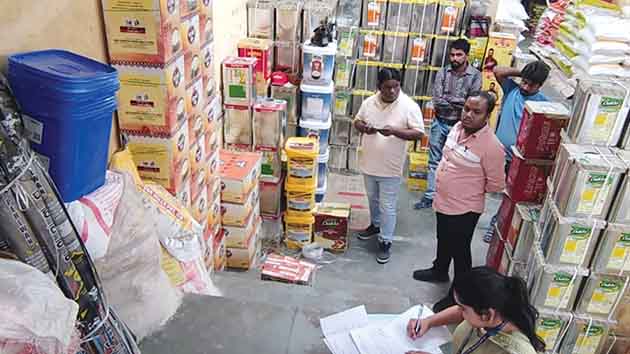
New Delhi: Festivals in India are increasingly turning into a test of the country’s food-safety machinery. This Diwali, raids across Delhi, Maharashtra, Uttar Pradesh, Bihar and Haryana uncovered thousands of kilograms of synthetic khoya, adulterated paneer, counterfeit ghee and contaminated sweets. The seizures exposed a regulatory system that appears better at conducting periodic crackdowns than preventing unsafe food from entering the market.
In Delhi, following directions from Chief Minister Rekha Gupta, who was also present during the operation, the Food Safety Department raided the khoya market at Mori Gate and seized nearly 7,000 kg of rotten and foul-smelling khoya, which was subsequently destroyed. The total quantity of fake and substandard khoya destroyed in the capital reached 10,660 kg. More troublingly, 35 of the 44 samples sent for testing failed to meet prescribed standards, suggesting that the problem extends well beyond isolated violations.
Maharashtra reported an even larger enforcement operation. During a special drive, the Food and Drug Administration (FDA) seized more than 3,098 tonnes of adulterated and counterfeit food products valued at approximately Rs. 63.45 crore. The haul included synthetic khoya, vegetable fats passed off as ghee, fake silver leaf and expired food products. Authorities inspected 9,667 establishments, suspended 954 licences and cancelled another 25. Action against warehouses involved in repackaging and selling expired products also resulted in 34 arrests.
Uttar Pradesh presented an equally disturbing picture. In Kanpur, 1,200 kg of spoiled and artificially coloured sweets prepared under unhygienic conditions were destroyed. In Lucknow, 802 kg of synthetic khoya was seized from a factory whose premises were subsequently sealed. Adulterated paneer, mawa and rasgullas were destroyed in Noida and Greater Noida, while 300 kg of suspected adulterated paneer was seized in Deoria.
In Patna, raids resulted in the destruction of substantial quantities of counterfeit ghee, stale paneer and burnt refined cooking oil. Several unlicensed shops were identified. Haryana authorities, meanwhile, acted against the supply of counterfeit rasgullas and adulterated paneer and khoya in Faridabad and Mewat.
Enforcement Gap
The question is if such enormous quantities of unsafe food are circulating in the marketplace, why are they not being detected before reaching consumers?
The Food Safety and Standards Act, 2006, provides the statutory framework, with the Food Safety and Standards Authority of India (FSSAI) laying down standards and state agencies responsible for inspections, sampling and enforcement. Yet, the distance between regulatory provisions and actual compliance remains considerable.
Official figures show that 170,535 food samples were tested in 2024-25, of which 34,388 failed to meet prescribed standards. Roughly one in five samples was therefore non-compliant. While this does not establish the prevalence of unsafe food across the entire market, it points to significant gaps in compliance and oversight.
India’s fragmented food supply chain compounds the problem. Products move through farms, manufacturing units, warehouses, transport networks, wholesale markets and retail outlets before reaching consumers. Monitoring this sprawling network cannot depend on festival-season inspections and occasional raids. It requires sustained surveillance, reliable intelligence and coordination between regulatory agencies and local administrations.
Beyond Adulteration
Food safety is also about more than synthetic khoya or counterfeit ghee. Contaminated water, unclean utensils, poorly maintained kitchens, improper storage temperatures, pest infestations and inadequate hygiene can all cause serious illness. A valid licence is no guarantee that an establishment consistently follows safe food-handling practices. India has expanded its testing infrastructure, with 252 NABL-notified food laboratories and 24 reference laboratories. But laboratories can protect consumers only when samples are collected systematically, results are delivered promptly and violations invite timely action. Testing capacity is of little value if enforcement does not follow. The Maharashtra FDA’s drive under Commissioner Tukaram Mundhe demonstrates what determined enforcement can achieve. The larger challenge, however, is to institutionalise such vigilance rather than make it dependent on individual officers or seasonal campaigns.
A risk-based regulatory approach that focuses on repeat offenders, suspicious supply chains and large wholesale operations is the need of the hour. Traceability from production to the final consumer must improve, while small food businesses need practical training in hygiene, storage and quality control.