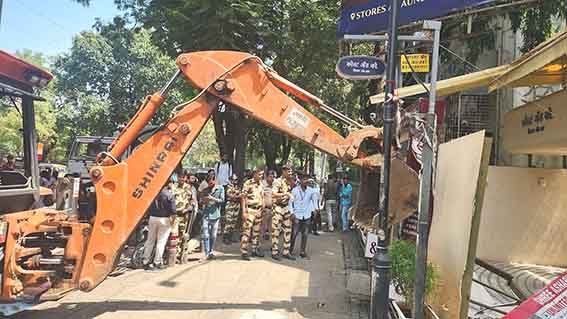
Pune: The city’s battle against encroachments has acquired an unprecedented momentum, with Municipal Commissioner Naval Kishore Ram launching an aggressive city-wide campaign to reclaim public spaces and dismantle unauthorised structures. Planned to continue for two months, the drive has received considerable support from citizens, but it has also opened up an uncomfortable political front for the BJP which is caught between disgruntled traders and residents demanding cleaner streets.
The municipal administration has moved swiftly across some of Pune’s busiest commercial and public spaces, including Fergusson College Road, Laxmi Road, Tulshibaug, the vicinity of the Shrimant Dagdusheth Halwai Ganpati Temple and stretches of Sinhagad Road, besides several locations in the suburbs. JCB machines and demolition equipment, along with a substantial police contingent have been deployed to remove illegal stalls, unauthorised restaurants, food-vending clusters and constructions encroaching upon roads and building margins.
The action on Laxmi Road, one of Pune’s busiest shopping districts, brought the administration into direct confrontation with traders whose unauthorised extensions were demolished.
This has led to sections of the trading community threatening a Pune bandh. The administration, however, has continued the operation, signalling that the campaign would not be restricted to token action.
Political Crossfire
The immediate trigger for the administration’s action on Fergusson College Road was a protest by five BJP corporators, who staged a sit-in during a Pune Municipal Corporation general body meeting, demanding the removal of unauthorised hawkers and structures obstructing the road. Commissioner Ram responded by directing officials to take stringent action and subsequently drew up a comprehensive two-month enforcement programme.
There may have been a more specific political calculation behind the BJP corporators’ original intervention on Fergusson College Road. But the administration’s decision to extend the operation across Pune has transformed what could have remained a localised exercise into a city-wide campaign, creating a political dilemma for the party.
Traders and business owners affected by the demolitions have begun holding the BJP responsible for the disruption to their livelihoods. The party consequently finds itself caught between two constituencies: traders who are angry about the demolitions and citizens who want the administration to reclaim public spaces.
Public Mandate
The campaign has, meanwhile, attracted support from beyond the usual civic constituencies. Retired military officers, prominent doctors, respected citizens and organisations concerned with civil rights have submitted representations to Chief Minister Devendra Fadnavis, urging him to ensure that the municipal administration sustains the drive rather than allowing it to peter out under political pressure.
Their intervention reflects a larger public frustration. Encroachments on Pune’s roads, footpaths and commercial thoroughfares did not emerge overnight. Many have existed for seven to eight years, gradually becoming entrenched through administrative neglect, political patronage or the failure of municipal officials to enforce existing regulations. The present campaign may be removing the visible manifestations of the problem, but it also raises the question of how these unauthorised structures were allowed to flourish in the first place.
This is where Commissioner Ram must take the campaign beyond demolition. If shopkeepers and hawkers are being held accountable for unauthorised occupation of public spaces, the officials who permitted these encroachments to continue for years cannot remain beyond scrutiny.
An effective anti-encroachment campaign must therefore reclaim public spaces and establish accountability within the administration.
The Commissioner deserves credit for taking on a politically sensitive civic problem with determination. But the real measure of success will be whether Pune’s roads and footpaths remain free of encroachments and whether those who allowed the problem to grow are finally made answerable.