A Century of Service, A Legacy of Nationhood

The Rashtriya Swayamsevak Sangh (RSS), in its 101-year journey, represents a significant chapter in India’s social and political history. The seed of national consciousness sown in 1925 has grown into a vast banyan tree, with its principles nourishing the roots and millions of volunteers extending its branches across diverse spheres of society.
In India’s Sanatan tradition, selfless service is regarded as one of life’s noblest pursuits. This spirit occupies a central place in the RSS’s working philosophy, captured in the evocative ideal: ‘Service is a sacred fire; let us burn like offerings.’
During Partition, RSS volunteers assisted refugees and participated in running more than 3,000 relief camps. Volunteers also laid down their lives defending the motherland against Pakistani tribal incursions into Kashmir. The meeting between RSS chief M.S. Golwalkar and Maharaja Hari Singh during Kashmir’s accession to India remains a prominent episode in the organisation’s historical narrative.
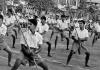
During the 1962 India-China War, volunteers assisted soldiers and the administration. At Jawaharlal Nehru’s invitation, 3,500 volunteers participated in the 1963 Republic Day parade, reportedly preparing within just two days. Despite criticism, Nehru defended the decision. During the 1965 India-Pakistan War, volunteers helped regulate traffic, donated blood, cleared snow at airports and provided other civilian assistance.
Vital Role
The RSS also played a significant role in the integration of Goa and Dadra and Nagar Haveli into India. Its participation in the resistance against the Emergency from 1975 to 1977, including underground mobilisation after mass arrests, remains an important part of its political history.
Through organisations such as the Bharatiya Mazdoor Sangh, Akhil Bharatiya Vidyarthi Parishad, Vidya Bharati, Vanavasi Kalyan Ashram and Seva Bharati, the wider RSS network expanded into labour, education and social welfare.
From the 1971 Odisha cyclone and the Bhopal gas tragedy to the 1984 anti-Sikh violence, Gujarat earthquake, tsunami, Uttarakhand floods and the Kargil War, RSS volunteers participated in relief and rehabilitation efforts. Their humanitarian activities have also extended to disasters in Nepal, Sri Lanka and Sumatra.
Having completed 101 years, a milestone considered auspicious in India’s Sanatan tradition, the RSS must be assessed for its role in the freedom struggle through historical records, contemporary documents and the broader national context, rather than emotional claims or ideological prejudices.
Dr. Keshav Baliram Hedgewar founded the RSS in Nagpur on Vijayadashami in 1925. Its stated objectives were to unite Sanatan Hindu society, cultivate discipline and collective spirit, strengthen awareness and pride in Indian culture, and actively participate in the freedom movement. The central question remains: what was the RSS’s actual role in the freedom struggle?
Under British Eyes
British intelligence records provide an important insight into the RSS’s early activities. They indicate that the colonial administration monitored the organisation’s expansion, membership and growing influence among young people.
The RSS expanded considerably during 1938-39. Historical accounts mention the presence of Vinayak Damodar Savarkar, Lala Gyan Chand and other nationalist figures at its programmes. N.V. Gadgil, a senior Congress leader, also presided over an RSS event.
In a speech on 25 March 1939, Govindrao Pradhan, the RSS chief in Pune, emphasised collective strength. According to his statement quoted in intelligence records: ‘If countries with populations of seven to eight crore can change the map of the world, can 28 crore Hindus not win freedom for their country?’
In the 1940s, the British government moved to restrict uniformed activities, parades and military-style training by voluntary organisations. These measures also affected RSS shakhas and training activities. An intelligence report from 1943 viewed the organisation as a potential challenge to colonial rule.
In December 1943, the Punjab government prohibited government employees from participating in the RSS. Disciplinary action against Laxminarayan Murthy, a railway employee in Madras, and a show-cause notice issued to another government employee in Delhi point to the extent of official surveillance.
Hedgewar was himself associated with the freedom movement. He was imprisoned in 1921 for his activities against colonial rule and again in 1930 for participating in the Jungle Satyagraha.
In 1940, the British government compiled a list of voluntary organisations, identifying the RSS as the strongest among them. Restrictions on their physical activities were imposed in August that year, against the backdrop of the organisation’s expansion and growing appeal among young people and national leaders.
The Quit India Movement of 1942 was a decisive chapter in the freedom struggle. Various writers have cited instances of RSS volunteers participating in these developments and assisting underground activists. To claim that no individual associated with the RSS participated in the freedom movement would overlook the historical complexities of the period.
After stepping down as Congress president in 1939, Subhash Chandra Bose visited Nagpur on 20 June 1940 to meet Hedgewar. The English-language daily The Hitavada reportedly carried a report on the meeting. This contact highlights the place the RSS occupied in the nationalist political landscape, although it does not establish a shared political programme or joint revolutionary plan.
Meanwhile, during the Second World War, the British Empire sought to slow the momentum of the 1942 movement and encouraged negotiations involving the Congress, the Muslim League and the colonial government.
Nationalist Jamnalal Mehta raised the issue of action against the RSS with R.M. Maxwell, a member of the Viceroy’s Executive Council. Maxwell justified the action as being in the interests of the British Empire.
During the freedom struggle, rather than establishing a separate platform, flag and leadership for the anti-imperialist movement, the RSS supported both the Congress and revolutionary movements. Accounts refer to intensified police action against RSS offices, volunteers’ homes and training camps under the Parade and Camp Act.
Gandhi and the RSS
In December 1934, Gandhi visited Wardha at the invitation of industrialist Jamnalal Bajaj. Opposite the two-storey house where he was staying, the RSS was holding its winter camp on Bajaj’s grounds, attended by around 1,500 volunteers. Impressed by their discipline and organisation, Gandhi expressed a desire to visit the camp.
Through Mahadev Desai, contact was established with Appaji Joshi, an RSS office-bearer. On 25 December 1934, Gandhi visited the camp at 6 a.m., inspected the kitchen and enquired about food arrangements and costs. According to RSS-associated writer Devendra Swarup, Gandhi was particularly impressed by the volunteers’ willingness to bear the expenses of their uniforms, food and accommodation, as well as the reported absence of caste discrimination. Hedgewar, who was not present at the camp, met Gandhi the following day.
Thirteen years later, on 16 September 1947, while addressing RSS volunteers in Delhi’s Bhangi Colony, Gandhi recalled his Wardha visit and praised the organisation’s discipline, simplicity and absence of untouchability.
Amid the violence of Partition, Gandhi also referred, at a prayer meeting on 12 September 1947, to his conversation with RSS chief Madhav Sadashiv Golwalkar. Gandhi said he had heard allegations that the organisation had blood on its hands, but Golwalkar assured him that these were false. According to Gandhi, Golwalkar maintained that the RSS was not an enemy of anyone, did not aim to kill Muslims, and sought to defend India and preserve peace. Golwalkar requested Gandhi to make his views public. Gandhi subsequently published an account of the conversation in Harijan.
These episodes indicate Gandhi’s appreciation of the RSS’s discipline, self-sacrifice, self-reliance and social harmony.