

A Century of Reinvention

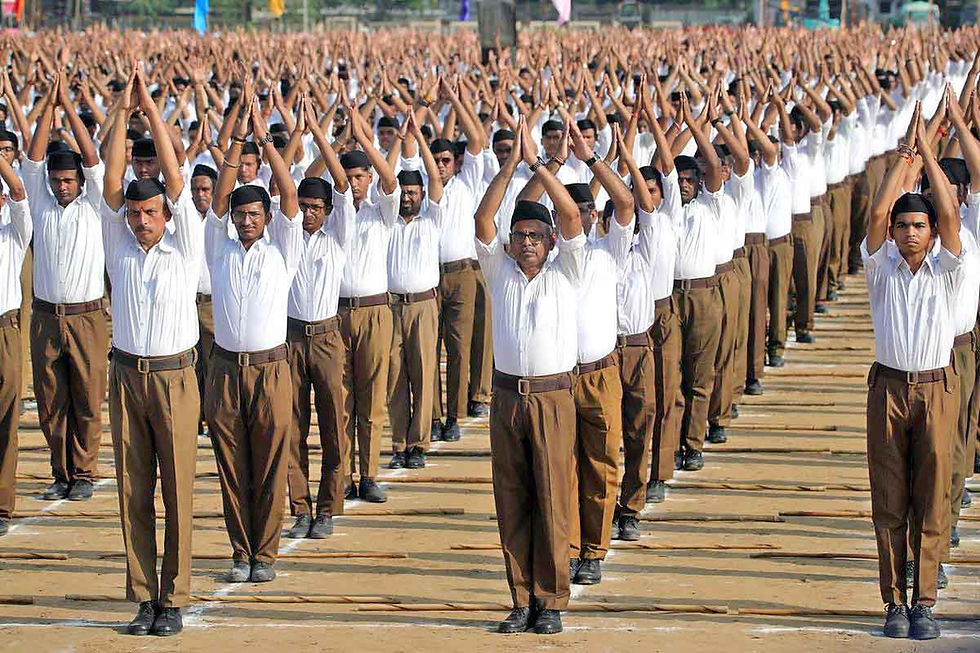
The centenary of the Rashtriya Swayamsevak Sangh (RSS) is more than a milestone in the history of a voluntary organisation. It is an occasion to examine how an institution founded in colonial India has survived political upheavals, ideological conflicts and repeated attempts to marginalise it, emerging a century later as a formidable force in the country’s public life. Its principal achievement has been organisational: the creation of a durable network that connects local communities to a larger national project.
National Renewal
Founded by Dr. Keshav Baliram Hedgewar on Vijayadashami in 1925, the RSS began with a deceptively simple proposition: national renewal required social cohesion, disciplined citizens and a stronger sense of collective identity. Hedgewar believed that India’s weakness under colonial rule could not be explained by foreign domination alone. Internal divisions, fragmented loyalties and the absence of sustained organisation had also impeded national consolidation. His answer was to build an institution that would work patiently at the grassroots, cultivating character and commitment through regular interaction.
Hedgewar’s intellectual formation was eclectic. Influenced by Swami Vivekananda’s call for national regeneration and Lokmanya Tilak’s assertive nationalism, he was also exposed to revolutionary networks during his years in Calcutta. His involvement in the Indian National Congress brought him into the mainstream of the freedom movement. At the Congress session in Nagpur in 1920, he advocated complete independence, a demand that would subsequently become the Congress’s formal objective.
Yet Hedgewar eventually concluded that political mobilisation alone could not resolve India’s deeper organisational weaknesses. The RSS was his attempt to address what he regarded as a deficit of social solidarity. Its daily shakhas, physical exercises, collective activities and emphasis on discipline were intended to produce a cadre bound by common purpose. Hindu identity supplied the cultural framework, while voluntary service became a practical expression of organisational commitment.
This vision overlapped with, but was not identical to, the ideas of Mahatma Gandhi and V.D. Savarkar. Gandhi emphasised service, cleanliness and the removal of untouchability; Savarkar developed a cultural and political conception of Hindutva. Hedgewar operated within the intellectual currents of his time, seeking to combine cultural nationalism with a disciplined programme of social organisation. The tensions between these traditions would remain part of the Sangh’s larger ideological story.
The RSS’s subsequent history demonstrates that longevity depends as much on adaptation as on conviction. Under its second chief, M.S. Golwalkar, the organisation expanded its network and developed a wider institutional presence. The Bharatiya Jana Sangh, established in 1951, provided a political expression of ideas associated with the broader Sangh family. The Akhil Bharatiya Vidyarthi Parishad, the Bharatiya Mazdoor Sangh and the Vishwa Hindu Parishad extended its reach into student politics, organised labour and religious mobilisation. Other affiliated bodies concentrated on tribal welfare, education and community development.
This institutional diversification was central to the RSS’s growth. Rather than confining itself to a single political platform, it cultivated multiple channels through which its ideas could circulate and its volunteers could participate in public life. The result was an ecosystem capable of operating across generations, professions and regions.
Complex Relationship
The organisation’s relationship with the Indian state has, however, been far from uncomplicated. Bans, political suspicion and ideological opposition repeatedly tested its resilience. Its role during national emergencies and crises, its participation in relief work, and its expansion through voluntary networks contributed to its public standing among supporters. The invitation extended to RSS volunteers to participate in the Republic Day parade in 1963, following the Chinese invasion, was an important moment of national recognition. It did not erase ideological differences, but demonstrated that relations between the organisation and the political establishment could evolve.
Later chiefs introduced different emphases. Balasaheb Deoras gave greater prominence to social reform and the removal of caste barriers, advancing samajik samrasta, or social harmony. Rajendra Singh, known as Rajju Bhaiya, brought a scientific and educational orientation to the organisation’s public discourse. K.S. Sudarshan stressed self-reliance and an alternative development model. Under Mohan Bhagwat, the RSS has increasingly articulated a programme of social engagement that includes family values, environmental responsibility, civic consciousness and social harmony.
These priorities are reflected in the centenary campaign’s emphasis on Panch Parivartan, or five transformations: social harmony, family awareness, environmental protection, self-awareness and civic responsibility. The programme suggests an effort to translate a broad cultural philosophy into everyday practices. Its success will depend on whether these aspirations produce measurable improvements in social relations, public conduct and community participation.
(The writer is a political commentator. Views personal.)


Comments