

A Death That Demands Answers

The death of Twisha Sharma has reignited uncomfortable questions about dowry, domestic abuse and family power structures.
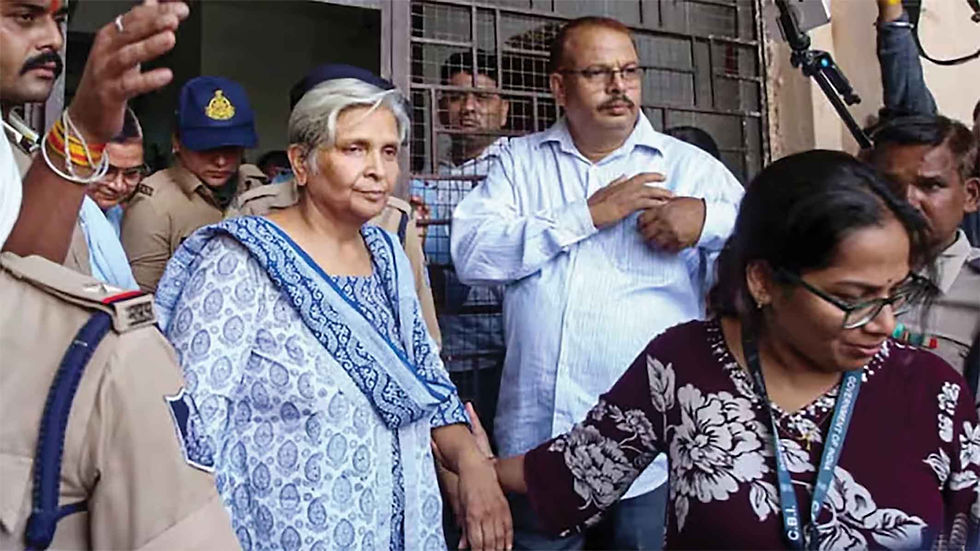
Last week, scrolling through some reels on my cell phone trying to find out more about the Twisha Sharma case, I came across a reel on Kiran Bedi’s views on the girl’s tragic end. For some reason, the reel was dubbed in Bengali. I was shocked at what Kiran Bedi said. She questioned why at all did Twisha Sharma, all of 33, well-educated with a career to fall back on, need to call up her parents at all to request them to take her back as the torture at the hands of her mother-in-law, a retired judge and her vanished son? “She was educated, smart, modern, so why did she just not leave the home which tortured her and venture out on her own?”
“On her own?” Was it that easy Miss Bedi for Twisha to walk out “on her own?” Walk out where? For how long? What guarantee was there that she would not be followed by her husband and the powerful mother-in-law and got killed? How would she support herself? Did she have any money of her own? Few brides and even housewives have any access to any money including what they have brought with them personally and perhaps, privately. Even earning wives are forced to part with their salaries and hand them unquestionably to the husband and or in-laws.
I know personally of a real-life story of a high-ranking officer in the Indian railways who was married by negotiation to a similar Maharashtrian government officer in Mumbai. The minute she stepped into her husband’s home, she found that the entire family was firmly held in the iron grip of her husband’s eldest sister who had remained unmarried to bring up her three kid brothers when their parents died in an accident. This sister-in-law asked her directly to hand over her pass book, her service book, the depositing slips and the cheque book to her and no questions asked. She never saw her money ever again over the two or more years of the marriage after which, her father took her back.
Way back in 2003, Nisha Sharma, then a 21-year-old college student studying computer programming in New Delhi had her marriage arranged by her parents to a computer instructor.
Nisha’s father, who owns a car battery factory, found the groom by placing an ad in the local paper. He negotiated Nisha’s dowry with the groom’s family, and he said that they insisted he give them two sets of appliances - one for the new couple and one for the groom's brother. Her father saved for ten years to pay for the car, the reception, and even the wedding video. But it still wasn’t enough. Flower girls were already welcoming the groom, along with 1,500 guests when the groom’s mother made a last-minute demand. Nisha’s father said she asked for another $25,000 in cash.
Bold Stand
When Nisha’s father refused to pay, the wedding video captured a shoving match between the two families. That’s when Nisha made a split-second decision that changed her life forever. “I called the police and I said I don’t want to marry that guy,” said Nisha.
The police arrested Nisha’s would-be husband, and her story caused an immediate sensation. But instead of being ostracized, Nisha became a national hero, a poster girl for all those fighting to rid India of dowry abuse. And it wasn't just the activists saluting her. Nisha started getting support and even love letters and marriage proposals from would-be groom right across the Indian map.
The Dowry Prohibition Act, in both its original and amended form, has served no constructive purpose due to inherent deficiencies such as the narrow view taken in determining possible complainants. In addition to this, while there have been landmark judgments that have served to forward the cause of Dowry prevention, there have also been hindrances in the form of judgements setting bad law.
In September 2004, a young woman died and two of her sisters were battling for their lives in West Bengal after they drank poison so that their poor father, beset by dowry demands, would not have to worry about their marriage.
The three sisters said in their suicide note that they were killing themselves to save their father, priest Manik Gangopadhyay, the trouble of having to raise money to marry them off. The incident occurred in Balithya, a village in Bankura district, police said.
Social Pressures
The father, a priest who found it difficult to provide for his family of wife, a son and three daughters, had been trying hard to marry off the trio. He had even spoken to a few prospective grooms, but the latter’s families asked for hefty dowry that he could not possibly arrange. For months, the young women watched their father try hard to raise money to marry them off and face insults from prospective grooms’ families for failing to comply with their demands. The father had earlier sold much of his ancestral property to marry of his two elder daughters. His son had tried but failed to find a job. The hard life often led to quarrels in the family. Then, one day, the three young women apparently spoke among themselves and decided to end their father's misery by killing themselves. The eldest of the three first drank a pesticide. When the others in the family and neighbours were taking her to hospital, the other two sisters too consumed the poison.
Anna Lindberg, director of the Swedish South Asian Studies Network (SASNET) at Lund University who has written a lot on Kerala’s dowry systems, says that the custom spread to all communities — including Nairs and even Pulayas who did not practise dowry — after the 1950s, and the Gulf boom made it worse. She noted that an Indian researcher concluded in the mid-1970s that dowry was paid in about one-fourth of all Nair marriages in south Kerala.
If it was Uthara, who was killed by her husband Sooraj through a snake bite in 2020, now it is Vismaya of Kollam who died after a string of domestic violence incidents. Vismaya’s father gave her 100 sovereigns of gold, some land and a car, but her husband Kiran Kumar was not satisfied enough. And between Uthara and Vismaya, there are many other women who have died, who survived, and who still live with the trauma of dowry harassment in the state.
A large number of women have filed cases against their in-laws and husband under the Dowry Act, but see what is the rate of conviction? But till now it is possible for the prosecution to prove their innocence as initial phase of any relation tells the truth. But how much is the “initial phase”?
Lopsided Laws
During the time limit of seven years if a woman dies in mysterious circumstances, an investigation is a must and the onus to prove themselves innocent falls on the accused. But after a long marriage, it would be grotesque to prove the accused did not commit the crime. Added to it, in our country even the dowry in cash or kind is often demanded by the parents and they keep it in their possession as well. But punishing husband after 30 years when his father is even no longer alive is gross injustice. Even assuming the time limit section should be done away with, then what about fixing the responsibility. To prove that the accused didn’t commit the crime is unfairly lopsided. There should be no hurry at all. Till then, let us wait and watch what happens to the Twisha Sharma case.
(The writer is a noted film scholar who writes extensively on social issues. Views personal.)


Comments