

A Summit of Strategic Silences and Subtle Signals
- Akhilesh Sinha

- Dec 11, 2025
- 5 min read
Part 1: In three-part series, we are exploring India’s longstanding ties with Russia and dissecting the behind-the-scenes diplomacy and dealmaking during Vladimir Putin’s recent visit.
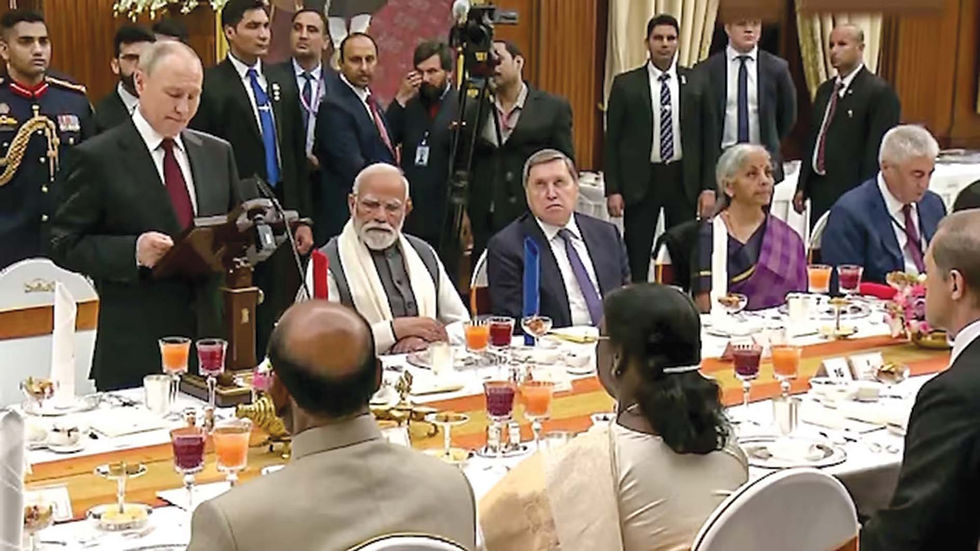
The recent joint press conference between Indian authorities and their Russian counterparts which followed President Vladimir Putin’s visit left many observers expecting headline grabbing announcements, be it the arrival of S-400 or the prospective 5-500 missile systems, or the induction of the advanced Su-57 fighter jets. Yet, none of these were explicitly declared, leaving the public wondering What exactly transpired during Putin’s visit with his expansive delegation? Did Putin simply come to embrace Prime Minister Narendra Modi, or was the presence of over 80 VVIP delegates merely ornamental for a diplomatic spectacle in Delhi?
To understand this, one must look beyond public theatrics to the delicate realities of international relations today. Far from being an unproductive visit, several significant agreements and strategic understandings were quietly sealed between India and Russia, carried out with discretion, reflecting a conscious and calculated approach. Several factors explain this muted diplomacy.
Quiet Dealmaking
The geopolitical environment at present is fraught with complications. Major arms deals by India from Russia trigger the threat of sanctions under the Countering America’s Adversaries Through Sanctions Act (CAATSA), an instrument the United States has wielded against countries perceived as indulging adversaries’ interests. Washington regards defence, energy supplies, and related technology transactions with suspicion. Consequently, India has navigated these sensitive waters with care, concluding essential deals without media fanfare or public disclosures. This approach preserves strategic autonomy while managing international pressures. When the time is right, all details are expected to be revealed transparently.
President Putin’s delegation was unprecedented in size and importance. Few leaders arrive in a foreign country with such a large, carefully curated group of policymakers and experts from critical sectors. The delegation included heads and decision-makers from military hardware, rocket propulsion, energy, banking and other key industries.
At the helm of Rosneft, Russia’s largest state oil company and a global crude oil powerhouse, is Igor Sechin. A close confidante of Putin since 2012, Sechin’s role was crucial given the significance of energy cooperation between the two nations
Similarly, VTB Bank, a major state-controlled financial institution, was represented by CEO Andrei Kostin, along with senior officials responsible for online and digital banking operations. Their presence signalled the importance of ongoing financial and economic ties.
The Roscosmos’ director general Dmitry Rogozin (Roscosmos is Russia’s counterpart to India’s ISRO) was also part of the delegation. Roscosmos leads in rocket engine development and space technology, a sphere in which Russia has historic primacy, being the first country to send a human to space.
Further, Alexander Mikheev, CEO of Rosoboronexport, the state arms exporter responsible for selling the Su-57 fighter jets, was present. Mikheev advises President Putin directly on military production and arms exports, indicating the seriousness of defence collaboration.
Other key members included First Deputy Prime Minister Denis Manturov, Defense Minister Andrey Belousov, Finance Minister Anton Siluanov, Central Bank Chair Elvira Nabiullina, Agriculture Minister Oksana Lut, Economic Development Minister Maxim Reshetnikov, as well as ministers from health, internal affairs, and transport. Altogether, about 80 VVIPs from varied sectors were present, underscoring an integrated approach to strategic partnerships.
The delegation also featured prominent figures like Margarita Simonyan, editor-in-chief of RT, Russia’s international news network, which recently launched a channel in New Delhi, facilitating stronger people-to-people and media exchanges.
Representatives from federal customs services, financial watchdog Rosfinmonitoring, and heads of metallurgy and allied industries added to the diversity and depth of the delegation. This comprehensive assembly signified a well-orchestrated effort to solidify and expand bilateral ties across military, energy, commerce, media, and technology realms.
Strategic Negotiations
Over numerous detailed meetings, these leaders engaged with their Indian counterparts (from relevant ministries and departments) to finalize critical agreements. The scale and range of these talks reveal a profound level of confidence and coordination. While public announcements remain limited, it is evident that fundamental decisions shaping the future of India-Russia collaboration have been reached.
This calculated discretion reflects New Delhi’s preference to withhold sensitive details due to geopolitical complexities and pressures from western allies.
Despite the absence of explicit declarations about arms acquisitions, credible sources indicate India is set to receive multiple squadrons of the Su-57 stealth fighter jets, becoming the first significant foreign customer for this cutting-edge platform. India’s existing maintenance and support infrastructure for Su-30 fighters will be adapted and enhanced to accommodate the Su-57 fleet, ensuring seamless integration.
Furthermore, the deal for the S-400 air defence missile systems has already been concluded, with additional shipments expected soon. More importantly, the next generation S-500 missile systems, capable of intercepting ballistic missiles and advanced aerial threats, are anticipated to join India’s strategic arsenal within two to three years.
A defining feature of the ongoing partnership is Russia’s commitment not only to supply military hardware but also to transfer critical military technologies. This technology sharing has been instrumental in developing indigenous projects like the BrahMos supersonic cruise missile, which is a flagship example of India-Russia defence collaboration.
Addressing the energy security issue, President Putin affirmed Russia’s unwavering commitment to uninterrupted oil supplies to India. He further criticized political forces seeking to curb India’s influence by disrupting its energy imports, implicitly questioning the double standards in global diplomacy.
On the economic front, Prime Minister Modi announced the issuance of 30-day e-tourist visas for Russian citizens, anticipating enhanced bilateral tourism. This will foster direct people-to-people contacts and potentially generate billions of dollars in trade, transacted in mutually agreed currencies.
Currently, bilateral trade volume stands at approximately $69 billion, with oil constituting the largest portion. To reduce the trade imbalance, India is actively exploring exports of pharmaceuticals, agricultural products, chemicals, automobiles, including two and four-wheelers, and machinery to Russia. The Russian side has expressed willingness to support these initiatives, promising greater balance and diversification in commerce.
Significantly, India is poised to sign a Trade and Economic Dialogue (TED) agreement with the United States shortly Parallel negotiations are underway with several European nations and the European Union. Given these simultaneous engagements, India is effectively walking a tightrope, endeavouring to strengthen longstanding ties with Russia while nurturing new partnerships in the West for maximum benefit.
Moreover, India is on track to formalize a Free Trade Agreement (FTA) with the Eurasian Economic Union (EEU), a bloc led by Russia comprising post-Soviet states. Modi’s government acknowledges the strategic importance of reinvigorating Russia’s trade with these neighbours, offering a potential boost to economic integration. The India-EEU FTA could create a significant stimulus for all parties involved.
India’s quiet but firm engagement with Russia transcends occasional media speculation and apparent silences. When the time comes, the nation will witness the tangible outcomes of this enduring friendship-advanced fighter jets gracing the skies, fortified missile defences, uninterrupted energy supplies, and expanding economic corridors.
In a complex and multipolar global order, India’s deft balancing act between Russia’s strategic partnership and its growing ties with the West reveals its prudent pursuit of sovereign interests-a testament to its evolving stature on the world stage.


Comments