

Atoms and Anxiety
A culture of secrecy and poor communication is weakening informed scientific voices in India’s nuclear debate
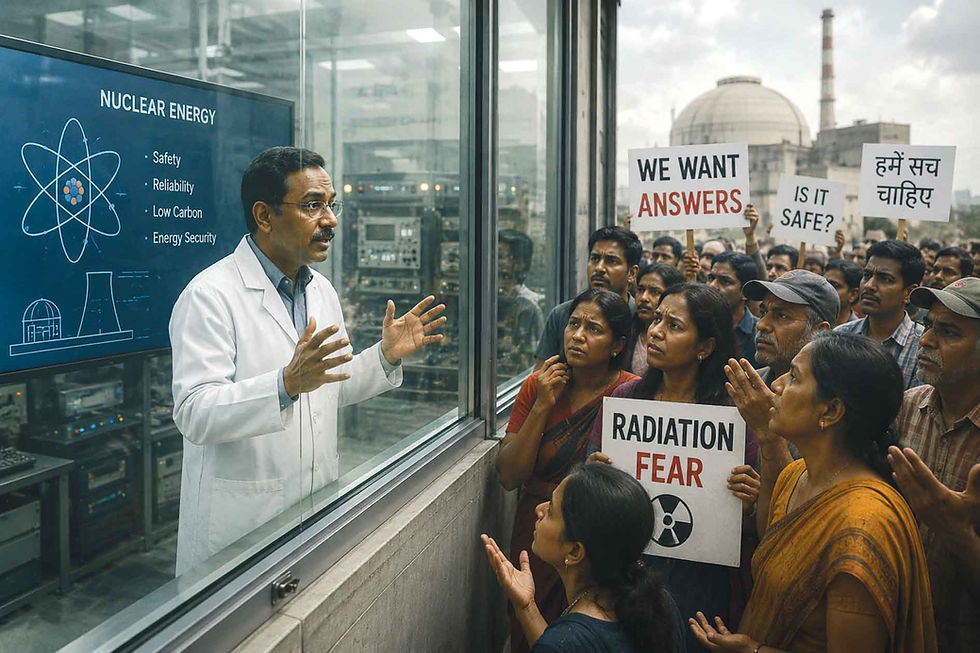
India’s nuclear establishment has long been associated with scientific excellence, strategic achievement, and technological self-reliance. From the early vision of Homi Jehangir Bhabha to the development of indigenous reactors and advanced fuel-cycle technologies, the country’s nuclear program has played a crucial role in shaping India’s global standing. Yet despite these achievements, nuclear scientists in India rarely influence public debate in a meaningful way. Whenever discussions emerge around nuclear energy, safety, radiation, uranium mining, or waste disposal, public discourse is often dominated not by scientists but by activists, political commentators, television panels, and social media narratives.
This communication gap between experts and society has become one of the biggest challenges facing India’s nuclear future.
The problem is not that Indian nuclear scientists lack expertise. Institutions such as Bhabha Atomic Research Centre, Nuclear Power Corporation of India Limited, and the Department of Atomic Energy employ some of the country’s finest engineers, physicists, and researchers. India’s nuclear program has successfully operated reactors, produced isotopes for medicine and agriculture, and maintained a credible strategic deterrent. Technically, the country possesses a highly competent scientific ecosystem.
The real issue lies elsewhere: nuclear experts in India have historically remained distant from public communication.
Culture of Secrecy
Unlike economists, environmentalists, or public health professionals who frequently participate in television debates, write newspaper columns, or engage with civil society, nuclear scientists often remain confined within institutional boundaries. Much of this is rooted in the culture of secrecy that evolved around India’s atomic program after independence. Since nuclear technology was closely linked with national security and strategic autonomy, scientific institutions developed an inward-looking structure where information sharing became tightly controlled.
While this approach may have served strategic purposes during the Cold War era, it has created unintended consequences in a democratic and digitally connected society. Today, information vacuums are quickly filled by speculation, misinformation, and fear. In the absence of credible scientific voices, emotionally charged narratives gain greater influence over public opinion.
This communication failure becomes most visible during controversies surrounding nuclear projects. Protests near Kudankulam Nuclear Power Plant or debates around uranium mining often reveal a troubling pattern: local communities frequently feel unheard, while scientific institutions struggle to explain complex technical issues in accessible language. Officials tend to respond with technical reports and official statements, whereas public anxieties are emotional, social, and livelihood-oriented. Facts alone rarely persuade people unless trust already exists.
Another major problem is the communication style adopted by many scientific institutions. Nuclear experts are trained to speak in technical precision, probabilities, and engineering language. Society, however, responds to stories, human concerns, and emotional reassurance. When scientists speak only through data tables and regulatory terminology, they unintentionally widen the gap between themselves and ordinary citizens.
The Fukushima accident in Japan demonstrated how even technologically advanced societies can experience public distrust after a nuclear crisis. In India, where scientific literacy remains uneven and social media misinformation spreads rapidly, the challenge is even greater. A single rumour regarding radiation exposure can create panic far beyond the actual risk. Unfortunately, nuclear institutions often react slowly in the public domain, allowing fear to spread before facts emerge.
Sociological Factors
Media dynamics also contribute to the problem. Television debates reward confrontation more than nuance. Complex scientific discussions are reduced to dramatic headlines such as “nuclear danger” or “radiation threat.” Scientists who prefer careful, evidence-based explanations often struggle to fit into this format. As a result, loud voices overshadow informed voices.
There is also a deeper sociological issue at play. In India, scientists are respected, but they are not always publicly visible. Unlike in some Western countries where experts actively shape policy debates through books, interviews, podcasts, and public lectures, Indian scientific institutions have traditionally prioritized research over outreach. Public engagement is often treated as secondary rather than essential.
This disconnect has serious implications for India’s energy future. Nuclear energy cannot expand successfully in a democracy without social acceptance. Projects involving reactors, waste management facilities, or uranium mining require cooperation from local communities and state governments. Public trust becomes as important as technological capability.
India’s energy demands are growing rapidly, and the country faces the difficult challenge of balancing economic growth with climate commitments. Renewable sources such as solar and wind are important but intermittent. Nuclear energy offers stable low-carbon electricity that can support industrial expansion without increasing greenhouse emissions. Yet if scientists remain absent from public debate, nuclear policy risks being shaped more by fear and political rhetoric than by informed discussion.
The solution is not propaganda or public relations campaigns. What India needs is a culture of scientific openness. Nuclear experts must engage directly with universities, journalists, local communities, and digital platforms. Scientists need to explain not only the benefits of nuclear technology but also its risks, limitations, and safety mechanisms in honest and accessible language. Transparency builds credibility far more effectively than secrecy.
Educational institutions and media organizations also have a responsibility. Science communication should become a serious public function rather than an occasional exercise during crises. India needs more scientists willing to write op-eds, participate in interviews, and interact with society beyond laboratory walls.
In the twenty-first century, technological expertise alone is not enough. Democracies increasingly depend on public trust. If nuclear scientists do not shape the debate through communication and engagement, others will shape it through fear, ideology, and misinformation. The future of India’s nuclear program may therefore depend not only on reactors and research, but also on the ability of experts to speak meaningfully to society.
(The writer is a former scientific officer with the Department of Atomic Energy. Views personal.)


Comments