top of page

By:

Abhijit Mulye

21 August 2024 at 11:29:11 am

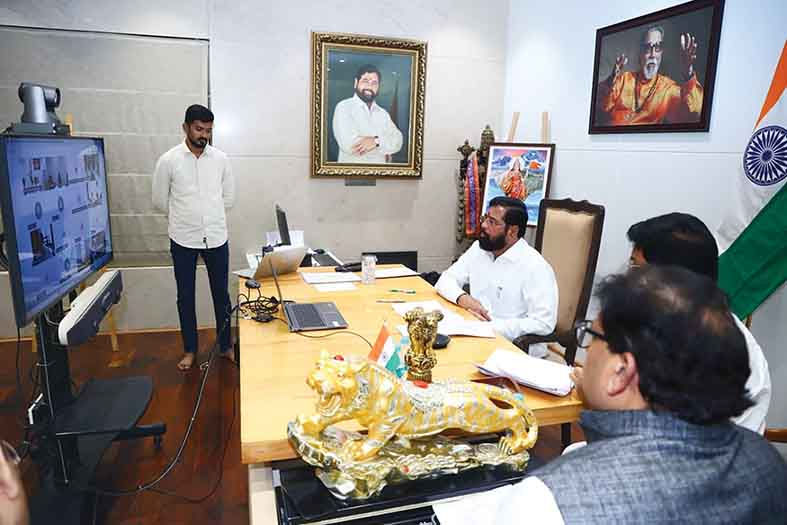
Shinde hauls up Shirsat as BJP fumes over controversial visit

Mumbai: In a glaring display of internal friction within Maharashtra’s ruling Mahayuti alliance, Deputy Chief Minister Eknath Shinde has reportedly issued a stern reprimand to Shiv Sena leader and social justice minister Sanjay Shirsat. The dressing-down comes in the wake of Shirsat’s highly controversial visit to the family of Abhijeet Dipke, the founder of the newly floated Cockroach Janta Party. The meeting has touched a raw nerve within the Bharatiya Janata Party, turning into a major...

Shinde hauls up Shirsat as BJP fumes over controversial visit

Mumbai: In a glaring display of internal friction within Maharashtra’s ruling Mahayuti alliance, Deputy Chief Minister Eknath Shinde has reportedly issued a stern reprimand to Shiv Sena leader and social justice minister Sanjay Shirsat. The dressing-down comes in the wake of Shirsat’s highly controversial visit to the family of Abhijeet Dipke, the founder of the newly floated Cockroach Janta Party. The meeting has touched a raw nerve within the Bharatiya Janata Party, turning into a major flashpoint between the alliance partners and raising serious questions about their internal coordination. The political storm began brewing when Shirsat called upon Dipke’s residence in Chhatrapati Sambhajinagar on July 26. The visit immediately raised eyebrows in the BJP camp, given that Dipke’s recent agitations have been squarely aimed at the saffron party, with direct rhetorical attacks on Prime Minister Narendra Modi and Union Home Minister Amit Shah. The simmering anger boiled over during Shah’s visit to Pune on August 1, where the Union Home Minister is said to have expressed his profound displeasure over the Sena minister’s diplomatic faux pas. Taking immediate cognizance of the BJP’s mounting outrage, Shinde reportedly summoned Shirsat over a phone call, demanding a swift explanation and firmly reprimanding him for the political indiscretion. However, neither the government nor party officials have issued an on-the-record confirmation of these developments. Political Battle Despite the fierce political backlash, Shirsat has stubbornly stood his ground, offering a personal justification for the contentious rendezvous. Defending his actions, the minister clarified that his ties with the Dipke family go back a long way and that he firmly believes in keeping political battles separate from personal relationships. He further noted that Abhijeet Dipke was in Delhi during the time of the visit, and the meeting was strictly limited to Dipke’s parents. Shirsat also pointed out that he had deliberately avoided visiting the family earlier to steer clear of the ongoing political controversies, though his belated visit seems to have done little to prevent a political firestorm. For the BJP, the visit is not just a matter of poor optics but a glaring breach of alliance protocol. Senior BJP leaders are reportedly furious that they were kept completely in the dark, insisting that the party leadership should have been informed in advance before a sitting Mahayuti minister extended an olive branch to a vocal critic. This lack of communication has once again brought the fragile issue of coordination within the Mahayuti alliance to the forefront, prompting the BJP to officially register its objection. Disciplinary Action The controversy has now sparked intense speculation about whether Shinde will wield the same disciplinary stick against MLC Bachchu Kadu. Kadu recently stirred the pot by not only meeting Dipke but doing so in the company of Shiv Sena (UBT) leader Chandrakant Khaire. The BJP has already been nursing a grievance against Shinde for generously accommodating Kadu with a legislative council seat from his party’s own quota. As the dust refuses to settle on these controversial meetings, political circles in Maharashtra are watching with bated breath to see if this episode will further vitiate the atmosphere within the Mahayuti or trigger a fresh set of consequential political realignments.

Broken Corridors

India likes to celebrate its growing tiger population as one of conservation’s great success stories. But tigers survive and thrive because their habitats remain connected. Fragmenting those forests entails risks for thriving tiger populations. The decision to grant an in-principle wildlife clearance for a third railway line through the Satpura-Melghat tiger corridor carries with it precisely that risk.


The proposed railway line between Jujharpur and Chichonda cuts through one of central India’s most critical wildlife landscapes, linking the Satpura and Melghat tiger reserves and forming part of the larger Satpura-Pench-Melghat landscape. This corridor is a biological highway, allowing tigers and other wildlife to disperse, breed and maintain healthy genetic diversity.


The Standing Committee of the National Board for Wildlife has insisted that mitigation measures such as wildlife overpasses be scientifically designed and reviewed before implementation. Yet the clearance itself exposes an unsettling contradiction. The committee’s own inspection found that the proposed 34 wildlife overpasses were based largely on field observations and mortality records rather than rigorous scientific assessment. Detailed engineering designs are still absent. Importantly, the comprehensive landscape study by the State Forest Research Institute, Jabalpur, is still awaited.


The approval has been granted before the study is in. This reverses the basic principle that should govern projects in ecologically sensitive landscapes. Scientific evidence must guide approvals, not merely refine them after the fact. Once a project gathers administrative momentum, conditions often become exercises in compliance rather than conservation. There have been far too many examples where mitigation structures were inadequately designed, poorly located or inconsistently monitored, leaving wildlife to bear the consequences.


The danger extends beyond tigers. The Satpura-Melghat landscape supports leopards, sloth bears, wild dogs, gaur and countless smaller species that depend on uninterrupted forests. Railways have already emerged as a significant source of wildlife mortality across India. Faster trains, higher traffic density and expanding rail infrastructure multiply these risks, especially where animal movement corridors intersect transport networks.


None of this argues against development. India’s expanding economy requires better freight movement and modern transport infrastructure. But development ceases to be sustainable when it treats ecological safeguards as hurdles instead of foundations. While a railway can be built, a forest corridor, once fragmented, cannot simply be reconstructed through concrete overpasses and engineering optimism.


India has spent decades and enormous public resources restoring tiger habitats and expanding protected areas. Allowing critical corridors to shrink through piecemeal clearances would squander those gains.


The Satpura-Melghat corridor is the artery through which one of India’s finest wildlife landscapes continues to breathe. That said, if the government gets the balance between development and conversation right, this project could well become a model for reconciling economic ambition with ecological responsibility.

Comments


bottom of page