top of page

By:

Quaid Najmi

4 January 2025 at 3:26:24 pm

MVA accuses Mahayuti of ‘banditry, betrayal’

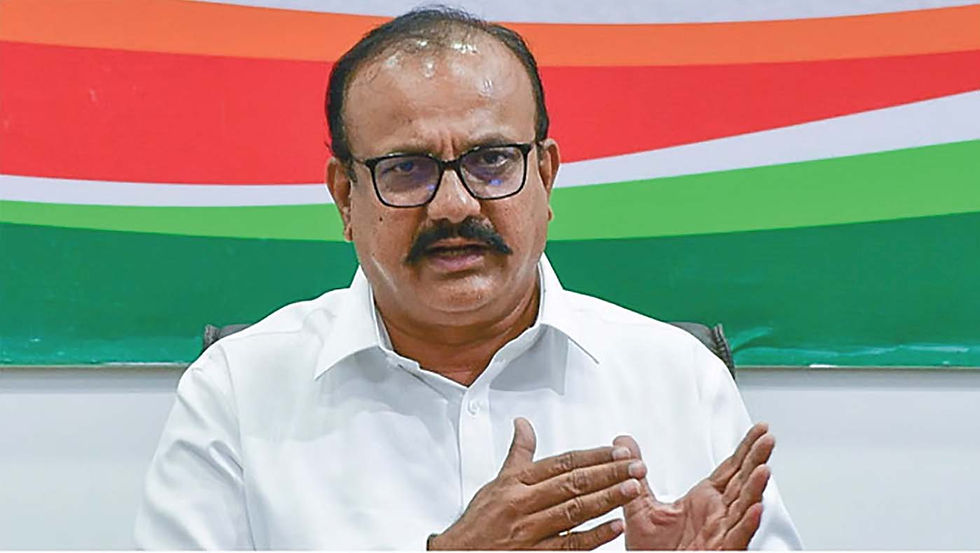
Mumbai: The simmering political storm over the Mahayuti government’s ‘Mukhyamantri Majhi Ladi Bahin Yojana’ intensified with the Maharashtra Vikas Aghadi (MVA) taking the recent CAG Report’s cautionary signals on state finances, to question if the state regime is a ‘gang of bandits’. State Congress President Harshwardhan Sapkal, Nationalist Congress Party (SP) National Spokesperson Clyde Crasto and Shiv Sena (UBT) MP Sanjay Raut attacking the government over the CAG revelations pointing to Rs...

MVA accuses Mahayuti of ‘banditry, betrayal’

Mumbai: The simmering political storm over the Mahayuti government’s ‘Mukhyamantri Majhi Ladi Bahin Yojana’ intensified with the Maharashtra Vikas Aghadi (MVA) taking the recent CAG Report’s cautionary signals on state finances, to question if the state regime is a ‘gang of bandits’. State Congress President Harshwardhan Sapkal, Nationalist Congress Party (SP) National Spokesperson Clyde Crasto and Shiv Sena (UBT) MP Sanjay Raut attacking the government over the CAG revelations pointing to Rs 3,541-cr excess spending plus significant shortcomings in financial management, budget estimation and expenditure control. Sapkal slammed the Mahayuti for allegedly committing a financial fraud of Rs 3,500-cr, while Crasto termed the removal of 92-lakh women beneficiaries as ‘betrayal’ and Raut accusing that the scheme was launched only to collect the votes of ‘Ladki Bahin’ in the 2024 Assembly elections. The Congress chief reiterated that a potential welfare scheme degenerated into another vehicle for corruption as the “step-brothers in power have looted their own beloved sisters”. “After looting every sector of the government, they have plundered the ‘Ladmi Bahin’ scheme… Is this a government or a gang of bandits,” demanded Sapkal sharply. Various Reasons Terming the government’s move to delete 38 pc (92 lakh) ‘Ladki Bahins’ from the scheme for various reasons as ‘fooling’ the women of Maharashtra to grab their votes. “They are citing different excuses for this act… Then how were they eligible before the elections, they took the votes, gave them money for so long, and now they are betraying them,” said an irked Crasto. Sapkal pointed out how, as per the CAG Report, an amount of Rs. 29,693-cr was budgeted for the scheme, but the government spent over Rs 3,500-cr beyond the sanctioned amount without maintaining proper records or accounts, and unsolicited withdrawals. Schemes Sacrificed “Spending on housing had fallen by 54 pc, and expenditure on water supply-sanitation slashed by nearly 32 pc. The CAG had cautioned against prioritizing the ‘Ladki Bahin’ scheme at the cost of other critical infrastructure projects that could hit long-term sustainability of public services,” Sapkal pointed out. He further stated that an amount of Rs 3,490-cro intended for the ‘Lek Ladki’ scheme (beloved daughters, launched in Oct. 2023) from economically backward families was allegedly diverted to ‘Ladki Bahin’, and earlier funds from the Social Justice Department were also rerouted. Raut and other SS (UBT) leaders raised questions on the government’s financial management as the CAG’s findings vindicate their stance over how the ‘Ladki Bahin’ scheme was launched hastily for reaping a rich electoral harvest in November 2024. Several NCP (SP) leaders demanded a detailed explanation for the excess expenditure red-flagged by the CAG, deflecting funds from other projects to ‘Ladki Bahin’ and pinning accountability for all such irregularities. The MVA allies urged the Mahayuti to present a comprehensive report on the scheme and fixing accountability in the legislature while ensuring that genuine beneficiaries are not deprived of the assistance. Major lapses in fiscal discipline Among other things, the Comptroller and Auditor General (CAG) Report of 2024-2025, pinpointed an excess spend of Rs. 3,541-cr, plus major lapses in fiscal discipline over the flagship ‘Ladki Bahin’ scheme. It said that the Women and Child Development Department spent Rs. 33,237 cr against the sanctioned Rs. 29,693-cr – or, Rs. 3,541-cr extra – without providing a proper explanation for the overspend. Announced with great fanfare barely months ahead of the 2024 Assembly polls, the ‘Ladki Bahin’ scheme promised a monthly dole of Rs 1,500 - with a promise to hike it to Rs 2,100 per month – to eligible women, if the Mahayuti was returned to power. It emerged the Mahayuti’s winning initiative, helped strengthen its support among the women, especially rural voters and enabled the coalition romp home – barely six months after it was badly mauled in the Parliament elections of 2024.

Buried Lives

Pimpri-Chinchwad is fond of advertising itself as a model city. Its gleaming roads, industrial estates and ambitious infrastructure projects have helped make the Pimpri-Chinchwad Municipal Corporation (PCMC) one of India’s wealthiest civic bodies. The shocking accident in which eight labourers died after a massive garbage heap collapsed onto the administrative building of the Waste-to-Energy plant at Moshi, exposes the rot beneath PCMC’s outwardly prosperous edifice.


The contrast is impossible to ignore. A civic body flush with resources failed to prevent workers from being buried alive under its own waste. The facility should have been governed by the most basic principles of engineering and workplace safety.


The Indian Army, the National Disaster Response Force, firefighters, police and municipal personnel have worked for days in dangerous conditions. Heavy excavators painstakingly removed unstable concrete while specialist teams searched for survivors. But their professionalism has only served to highlight the incompetence that had made their deployment necessary in the first place.


Garbage dumps do not collapse without warning. Any administrative building situated in the shadow of such an unstable waste mass should have been subjected to rigorous risk assessment. If those assessments existed, they evidently failed. If they did not, the negligence is even graver.


The tragedy also raises uncomfortable questions about the Waste-to-Energy project itself. It was inaugurated with much fanfare as a technological milestone, boasting India’s largest boiler of its kind. International engineering expertise and sophisticated machinery were proudly showcased. Yet impressive technology is meaningless if basic occupational safety is treated as an afterthought. Grand inaugurations make headlines. Routine maintenance rarely does. But it is the latter that determines whether workers return home alive.


Municipal administrations have developed an unfortunate habit of measuring success in kilometres of roads laid, flyovers inaugurated and crores spent. The true measure of governance is far simpler. Can the poorest employee leave work safely at the end of the day? At Moshi, the answer is a devastating no.


While compensation packages and promises of inquiries will inevitably follow and committees will submit reports, the danger is of responsibility becoming diluted across the chain of contractors, engineers and officials until accountability disappears into bureaucracy. That familiar script must not be allowed to play out again.


PCMC cannot plead poverty nor cite a lack of technical expertise. It cannot claim that the dangers of unstable waste dumps were unknowable. A corporation with such financial strength possesses the means and the obligation to enforce the highest safety standards. The dead were casualties of preventable negligence. The wealth of a city is ultimately measured not by the size of its municipal budget, but by the value it places on the lives of those who keep it running. At Moshi, that value proved tragically cheap.

Comments


bottom of page