top of page

By:

Abhijit Mulye

21 August 2024 at 4:59:11 pm

Bhagwat to outline roadmap for next century

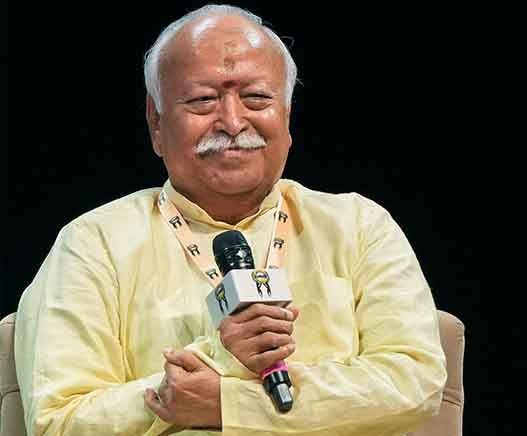
Mumbai: Rashtriya Swayamsevak Sangh (RSS) Sarsanghachalak Dr Mohan Bhagwat will address thousands of volunteers and key political observers at Reshimbagh grounds in Nagpur tomorrow at 7.40 am on the occasion of Vijayadashami, formally concluding the organisation’s centenary-year celebrations. He is expected to deliver an ideological and operational blueprint intended to recalibrate Hindu society, counter ongoing opposition mobilisation across India, and outline internal organisational changes...

Bhagwat to outline roadmap for next century

Mumbai: Rashtriya Swayamsevak Sangh (RSS) Sarsanghachalak Dr Mohan Bhagwat will address thousands of volunteers and key political observers at Reshimbagh grounds in Nagpur tomorrow at 7.40 am on the occasion of Vijayadashami, formally concluding the organisation’s centenary-year celebrations. He is expected to deliver an ideological and operational blueprint intended to recalibrate Hindu society, counter ongoing opposition mobilisation across India, and outline internal organisational changes through a wide-ranging policy address. The annual Vijayadashami address, historically the most definitive forum for the RSS chief to articulate the organisation’s stance on domestic policy, cultural objectives and global affairs, carries heightened significance this year. Marking the completion of 100 years since Dr K.B. Hedgewar founded the organisation on Vijayadashami in 1925, Bhagwat’s address is designed to chart the strategic framework for the RSS as it enters its second century. Over the past 12 months, Bhagwat has personally anchored a series of outreach programmes across four Indian metropolitan hubs and two global nerve centres in the United States and Europe, signalling an appetite to project ideological clarity and broaden the organisation’s institutional footprint beyond traditional shakhas. The address comes against the backdrop of sustained street agitations orchestrated by the Congress party and newly formed groups such as the CJP in the national capital and several states. These demonstrations, centred on unemployment, social justice rhetoric and institutional accountability, have explicitly targeted India’s youth demographic — a constituency that has historically formed the primary recruitment pipeline and ideological backbone of the Sangh. Political observers believe Bhagwat will offer an unyielding response to these attempts to disrupt governance and erode the social coalition, reflecting an unmistakable determination within the Sangh Parivar leadership to resist political attrition and mount an active counter-narrative. The diplomatic and constitutional significance of the event is underscored by the deliberate selection of guests. Former Vice-President Jagdeep Dhankhar and Israel’s Consul General in Mumbai, Yaniv Revach, are attending as special invitees. Revach’s presence hints at possible remarks addressing global geopolitical realignment, the rise of civilisational conflicts, cross-border terrorism and national security challenges. Dhankhar’s attendance provides a platform to reaffirm constitutional patriotism and legislative stability at a juncture marked by sharp parliamentary confrontation. Equally consequential is the invitation extended to Sanjay Gupta, Editor-in-Chief of Dainik Jagran. For an organisation that has historically maintained a measured distance from mainstream media machinery, engaging with the leadership of India’s largest Hindi daily indicates an institutional shift towards proactive public communication. The gesture suggests that the Sangh recognises that narrative warfare in its next century requires strategic engagement with popular media platforms rather than a traditional reliance on insular organisational word of mouth. Beyond external ideological positions, the Nagpur gathering is expected to provide indicators of the structural transitions under way within the RSS. The organisation has been quietly restructuring its administrative echelons, revamping functional wings and adjusting internal deployment models in recent months. With additional leadership realignments slated across key tiers in the near future, Bhagwat’s speech is expected to define the organisational ethos for these generational handovers, emphasising flexibility in outreach while preserving core organisational discipline. As dawn breaks over Reshimbagh, the address will serve both as a balance sheet of a century-old journey and as a declaration of intent for an increasingly combative political era.

Calculated Deception

Aug 12
2 min read

The grand narrative constructed around Abhijeet Dipke and his self-styled Cockroach Janta Party (CJP), which was at the forefront of the NEET exam paper leak protests, is now unravelling rapidly under basic factual verification. Designed as a viral, internet-fuelled pressure front, Dipke’s crusade presented itself as an organic revolt of students frustrated with the lapses in the Indian education system. However, a closer examination of Dipke’s timelines, credentials and digital footprint reveals a stark pattern of systemic hypocrisy and institutional manipulation.


A primary pillar of Dipke’s public persona has been his academic background at Boston University. Yet, his timeline contains glaring physical impossible realities. Dipke publicly displayed a scholarship letter claiming enrolment for the Fall 2024 academic term, which spanned September to December 2024. But during this precise window, Dipke was physically present in India actively participating in campaign activities for the Aam Aadmi Party (AAP) despite having claimed that left that party in 2023.


Furthermore, location logs and reviews place him in Schaumburg, Illinois, and Orlando, Florida, thousands of miles from the Boston campus during times he was purportedly pursuing his studies. Dipke’s claims of a USD 12,500 per semester partial scholarship leaves tens of thousands of dollars in tuition and living expenses unaccounted for, raising serious questions about the origin of funds unsecured by standard collateral for someone claiming modest familial income.


Dipke has repeatedly asserted that his political association with AAP was limited between 2020 and 2023. Yet digital records confirm his operational involvement with AAP stretching back a decade. To sustain this sanitized origin story, Dipke allegedly scrubbed his historical social media data, altered his public X profile handle and systematically attempted to delete legacy posts. This alleged obfuscation is now being seen as an active effort to mislead the young demographic behind his anti-establishment posturing.


Several have pointed that CJP’s tactical playbook relying on ‘laughtivism,’ satirical subversion, and symbol appropriation mirrors specific regime-change and protest methodologies associated with Western political strategy institutes like the Albert Einstein Institution and CANVAS. Far from being a spontaneous outburst of Gen Z anger, the operational signature of the movement fits established international frameworks designed to leverage civic frustration for targeted political disruptions.


Dipke’s claims of state censorship are equally bizarre. Dipke had alleged that the Indian government dictatorially shut down the official CJP domain. But technical analysis of global DNS zone files tells a completely different story. Domain registration data reveals the site was created via a budget foreign registrar, and was placed on clientHold status, triggered directly by the registrar or the domain owner for compliance or technical non-payment.


The youth who have placed their trust in Dipke’s platform deserve transparency, not a scripted political project operating behind a veil of curated outrage.

Comments


bottom of page