

CJP Must Remain as Watchdog

After forcing Dharmendra Pradhan’s resignation, the Cockroach Janata Party faces a defining choice: remain an independent citizens’ watchdog or risk losing its credibility by entering electoral politics.
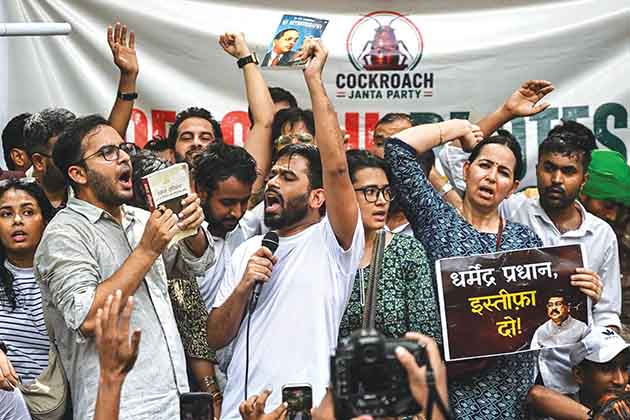
Minutes after Dharmendra Pradhan resigned ‘on his own’, a friend from Delhi who understands politics very well called me in an exalted voice. Having followed Indian politics closely for over 60 years, the businessman felt the Cockroach Janata Party (CJP) would win 100 seats across India in the next general elections considering the zenith it had reached in popularity.
He also had valid reasons to offer in support because he detests BJP’s overall governance in New Delhi and in states like MP or Maharashtra, despite having had good friends within the saffron party. I instantly disagreed.
Knee-Jerk Response
The CJP is a very young grouping, having been born in May this year, as a knee-jerk response to the weird and shocking comment by Chief Justice of India Surya Kant while hearing a petition. What may have prompted Abhijeet Dipke to swiftly post on X, asking, “What if all cockroaches come together?”, is not known. But the non-political platform opposing the “rotten system” came together before you could even spell cockroach.
It is a fact that while the Bharatiya Janata Party (BJP) and its Government at the Centre suffered greatly in the process, the remark came from none of its leaders who are otherwise known for insulting anyone and uttering anything at any time. The power-drunk BJP leaders have embarrassed the party umpteen times, not even sparing women army officers or women wrestlers.
However, in this case, it was a top judicial officer of the country who triggered a storm and Pradhan became the scapegoat. Of course, I have no sympathy whatsoever for the former Union minister because he was clearly incapable of handling a ministry which was headed by political stalwarts like Narasimha Rao, MM Joshi, Arjun Singh and Madhavrao Scindia in the past. The CJP was thus born in the Supreme Court, brought up in Boston where Dipke was studying and started running at Jantar Mantar in June. Everything happened with electrifying speed.
Having claimed the scalp of Pradhan after a long-drawn struggle, the Gen Z has heightened the expectations of millions who are victims of poor governance and corruption. CJP must function as a fierce watchdog.
Farmers, students, businessmen, women, the middle class and those who are ideologically anti-BJP all see a ray of hope in CJP to check corrupt practices and make BJP accountable. This is because Rajnath Singh, whom I personally like, is a seasoned and honest leader of the party and one who talks less. Yet, in another context, he made that pompous statement “NDA me istiphe nahi hote” (None resigns in NDA regime). CJP capitalized on it while setting a single-point agenda of its unique protests in New Delhi in June.
Bad Governance
Examination paper leaks, similar to the shady Vyapam scam of Madhya Pradesh, are crimes governments committed against the lives of students and job-seekers. In both cases it was BJP under which it all happened. BJP has always talked in glowing terms about its ‘good governance’. Paper leaks and Vyapam were specimens of bad governance of the highest order.
Dipke and his core group were intelligent enough to pick the pulse of students and parents and carefully launched the massive agitation which grew by the day to spread across the country. But now they should stop, look back and reorganize their strategies.
As I see it, CJP has now emerged as a solid pressure group that took up the issue of a totally collapsed education system, headed by Pradhan since 2024. How well-knit a force CJP will remain in the months to come is yet to be tested. But they should be thanked for reopening the blocked path of peaceful demonstrations in the country for exposing the wrongs.
There are already ideas floating and, as my friend hinted, some of the CJP members are nursing political ambitions.
I strongly feel that CJP must abhor politics. It should remain what it is—an altruistic platform to set wrong things right in sectors like education, health and the environment.
Everyone knows Dipke has links with the AAP and Arvind Kejriwal but he has been able to create an apolitical image today which is unmatchable.
The way Kejriwal and his party have performed over the last few years is a burning example of what happens when activists turn into politicians in India’s hopeless political system. Raghav Chadha’s case is another example. He did not utter a single word on students’ and Gen Z’s concerns for which he was well-known before joining the ruling BJP. Elected politicians are meant to raise their voices for the people when they need them but the otherwise vocal RS member, Chadha, was hidden deep inside an unseen burrow.
If CJP becomes a political party, it will run the risk of getting sucked into the quagmire of dirty Indian politics. It should resist that temptation, for it cannot match the cunning of the BJP, the Congress or the NCP.
(The writer is a senior political and environment journalist based in Bhopal. Views personal.)


Comments