

CM to unveil Mumbai Dabbawalas’ global gallery on Thursday
- Quaid Najmi
- Aug 11, 2025
- 4 min read
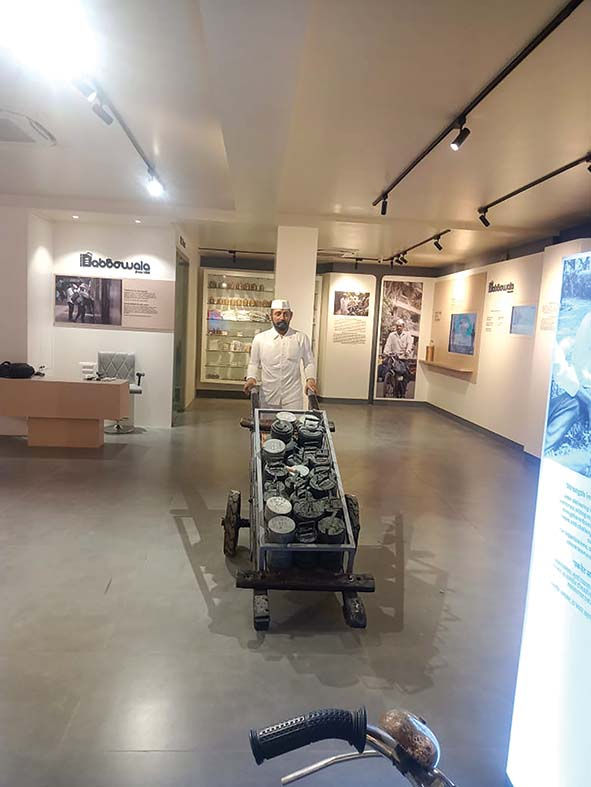
Mumbai: Come Thursday, Mumbai will witness a cherished piece of its heart immortalized in the form of the ‘Mumbai Dabbawala International Experience Center (MDIEC), a thrilling walk-through swank gallery in Bandra west.
Marking a momentous and emotional development, Chief Minister Devendra Fadnavis will inaugurate the MDIEC - a mini-museum showcasing and celebrating the 135-years history of the world-renowned but dwindling tribe of Mumbai’s Dabbawalas - the familiar tiffin-box carriers, ranked as the most punctual and most loved delivery service.
“The swank MDIEC, with a dabba-full of digital displays and experiences, is spread over 3,000 sq.feet in Harmony Building in a space allotted by the Brihanmumbai Municipal Corporation (BMC),” said Nutan Mumbai Tiffin Box Suppliers Charity Trust (NMTBSCT) President Ulhas S. Muke.
“Nearly 18 months back, the then Deputy CM Fadnavis had performed the ground-breaking ceremony for MDIEC and announced a grant of Rs. 5-cr from his MLA fund, and MLC Shrikant Bharatiya declared another Rs. 2-cr. from his MLC fund. As desired by Fadnavis, it was constructed as a world-class exhibition center,” a proud Muke told ‘The Perfect Voice’.
The centre of attraction is a statute of Lord Vitthoba, the Dabbawalas’ revered deity, Panduranga of Pandharpur, glittering in a glass cage designed as the iconic tiffin-box (Dabba) which they ferry in a tearing hurry, daily, across Mumbai, as members of the Mumbai Tiffin Box Suppliers Association (MTBSA), said its President Ramdas Karvande.
From the entrance, the 135-year-old history of the unique and unparalleled trade unfolds, with a benign portrait of its founder-patriarch, the late Mahadu Havaji Bachche, who started it all in 1890.
“It started with him, then others joined in and it grew to a robust team of around five to six dozen tiffin-box carriers who picked from homes in south Mumbai, delivered to various offices, banks, shops, etc., and returned the empty tiffins back home late afternoon,” said a spokesperson Ritesh S. Andre.
The early clientele comprised mostly Parsi, Marathi, Gujarati, Marwari, Dawoodi Bohra and other Muslims working in banks, private companies, government offices, shopkeepers and others who longed for and relished the warmth of fresh home-cooked lunch-boxes delivered by the tiffin-carriers.
“In those days, they mostly walked down to nearby locations pushing their tiffin boxes in handcarts, later many got sturdy bicycles on which they hoisted 20-25 boxes gingerly balancing them. It was exactly 100 years ago, in 1925 that they started commuting by the fast, efficient and economical suburban local trains,” recall Muke and Andre of those fledgling days.
The exhibit centre has displayed 10 original pieces of the tiffin-boxes as they evolved from copper to metal and now light tin-boxes, from a single-piece ‘dabba’ to a multi-layered tiffin as public needs changed over the decades, painstakingly sourced from old customers who had still preserved the defunct items, said Muke.
“Today, the Dabbawalas numbers have dwindled sharply, from over 5000 during the peak in 1970s-2000s ferrying over 200,000 tiffin-boxes, to now barely 1,500 rushing to deliver around 80,000 lunch-boxes,” rued Muke.
The reasons are localised delivery online orders and delivery options by huge corporations, their services ranging from 10-minutes to 30-minutes on two-wheelers, cost-effectiveness and other factors which are edging out the toiling Dabbawalas.
MDIEC: A peep into the legacy of Dabbawalas
The founder of the modern-day Dabbawalas – the first tiffin-box carrier, Mahadu Havaji Bachche, welcomes the viewers to the mini-museum opposite Rizvi College in Bandra west.
The humble beginnings to the current era, spanning more than 13 decades, is traced in the traditional and digital format with a brief description in English and Marathi, plus several venerated statues or figurines scattered around.
These include: a full-uniformed Dabbawala, sporting his white Gandhi Topi, dazzling white thigh-length kurta and a loose pyjama, all cool comfy yet suited for their speedy operations, pushing the tough two-wheeler handcarts in which dabbas were laden as per their final destination with unique symbols marking them;
There’s the later day sturdy bicycle on which over a score Dabbas were hung for zooming to the nearest railway stations, a six-feet tall replica of the modern-day ‘Dabba’, and a replica of the square white-red-blue Mumbai’s railway station sign with the destination here proclaiming ‘DABBAWALA’.
Outside the MDIEC is a huge carved mural of a speeding Mumbai local, images of Dabbawalas at various points in the journey of each tiffin-box, collecting from the customers’ homes, ferrying to the railway station, loading the precious cargo in the luggage compartment, rushing to the termination point, with vivid details of some of Mumbai’s greatest monuments serving as a backdrop.
On one wall is a collection of important national-international awards, honour and accolades over the past five decades when their work grabbed the world’s attention.
Another wall has exhibited the Dabbawalas rubbing shoulders with the high and mighty – at the wedding of Prince Charles (now, King Charles III) of England in 2005, Queen Maxima of The Netherlands (2018), the late Prime Minister DR. Manmohan Singh (2010), besides a host of other national-international celebs.
“In 2004, Virgin Group’s founder-chief Sir Richard Branson spent a day with us, he even carried a few Dabbas to his colleagues in their office following our route and style,” chuckled Andre, who is working on his PhD thesis on his family vocation.


Comments