
Course correction in right-wing ecosystem

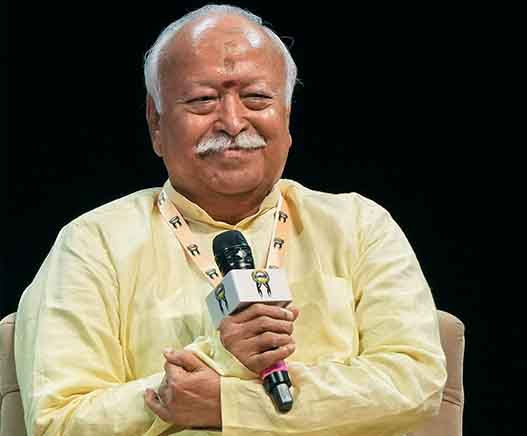
Mumbai: When Rashtriya Swayamsevak Sangh (RSS) Sarsanghachalak Dr. Mohan Bhagwat took the stage at the Nita Mukesh Ambani Cultural Centre in Mumbai, the ideological head of the Sangh Parivar delivered an address that left political analysts and attendees alike surprised by its strikingly progressive and youth-centric tone.
Speaking to nearly 2,000 Gen Z and Gen Alpha students at the 15th-anniversary conference of India’s International Movement to Unite Nations (IIMUN), Bhagwat dismantled several rigid perceptions of the RSS. Instead of delivering a dogmatic ideological monologue, he faced a barrage of contemporary questions ranging from student protests and education policy to LGBTQIA+ inclusion and social media. His remarkably candid responses not only validated the anxieties of modern Indian youth but also laid bare a fascinating political subtext, revealing significant divergences from the hardline rhetoric frequently deployed by the ruling BJP.
The most resonant takeaway from the interaction was Bhagwat’s fierce defense of young protesters, a stance that sharply contrasts with the political establishment’s recent playbook. Over the last decade, dissenting students—whether agitating over university policies or recent examination paper leaks—have routinely been discredited by the ruling ecosystem as “anti-national” state adversaries. Bhagwat flatly rejected this framing. He categorically stated that protesting youth are the nation’s own people and the next generation, asserting that they should never be branded as anti-national.
Validating their grievances as genuine, he philosophically redefined protest as a legitimate democratic tool and a form of dialogue meant to build consensus when other communication channels fail. By acknowledging that the current generation is “more honest and sincere” because they demand logical answers rather than blindly deferring to authority, Bhagwat effectively shielded student protesters from the political right’s favourite slur.
Complex Issues
This accommodative tone extended into complex social issues, most notably LGBTQIA+ rights. During the Supreme Court hearings on marriage equality, the Union Government took an aggressively orthodox stance, opposing legal recognition for same-sex couples and dismissing the concept as an urban elitist import. Bhagwat, however, offered a far more nuanced middle ground. While he maintained that the traditional institution of marriage should remain focused on heterosexual couples for societal continuity, he firmly stated that the LGBTQIA+ community is an integral part of society deserving of dignity and respect.
Crucially, he advocated for the creation of a separate legal framework to recognize same-sex companionship, ensuring these couples can live together with social acceptance. Observers point out that this acceptance of a parallel legal framework marks a significant departure from the government’s outright legal blockade, positioning the RSS as a far more pragmatic and adaptable organisation.
Policy Matters
On matters of governance and policy, Bhagwat continued to strike a discordant note with the establishment. Aligning with long-standing academic demands, he threw his weight behind allocating six percent of the GDP to education, explicitly warning that education must not be treated as a commercial business—a quiet but sharp critique of the systemic privatization flourishing under current policies.
He also displayed pragmatism regarding technology and foreign policy. Opposing outright bans on social media, he advocated for cultivating self-discipline and media literacy to combat misinformation. On the geopolitical front, he suggested that while citizens must stand firmly behind the government during conflicts, permanent enmity is never a lasting solution, introducing a layer of diplomatic pragmatism that contrasts heavily with the hyper-nationalistic domestic messaging regarding India’s neighbours.
Political analysts view this Mumbai interaction as a calculated ideological recalibration. The underlying question of why Bhagwat chose this specific platform to voice such progressive views can be answered by looking at the shifting demographic winds. While the BJP operates on the immediate, high-stakes compulsions of electoral victories—often relying on polarization and aggressive rhetoric to consolidate votes—the RSS views itself as playing the long game of civilisational and societal integration.


Comments