

Diplomacy in a time of Chaos
- Ruddhi Phadke

- Sep 12, 2025
- 3 min read
The Nepal crisis is testing India’s role as South Asia’s anchor amid increasing political turbulence.
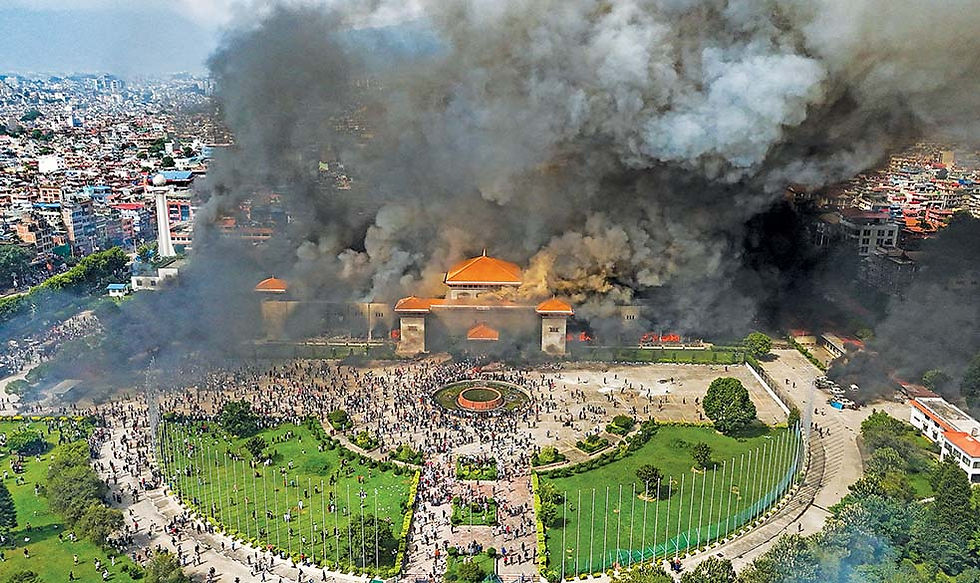
South Asia’s latest bout of turmoil comes from Nepal, where widespread protests have left the political order in tatters. The pattern is eerily familiar. Over the past few years, Bangladesh, Sri Lanka, and Myanmar have experienced similar convulsions. Different triggers, but similar outcomes of political chaos and social disarray. At the heart of this maelstrom sits India, tasked with navigating the fallout of its volatile neighbours while remaining true to its democratic values.
First, Sri Lanka, to India’s south, spiralled into crisis in 2022. Plagued by unsustainable debt and economic mismanagement, the island nation faced acute shortages of medicines, fuel and food. Mass protests culminated in the Rajapaksa family fleeing their stronghold, with the presidential palace stormed by angry demonstrators. India extended financial aid and diplomatic support, but the Rajapaksa exodus marked a painful chapter in regional stability.
To the east, Bangladesh’s recent turmoil was triggered by a controversial quota policy last year. What began as a student protest in Dhaka rapidly morphed into an insurgency as radical groups hijacked the movement causing Prime Minister Sheikh Hasina, a stalwart in South Asian politics, to seek refuge in India.
Myanmar’s descent into civil war after the 2021 military coup remains a grim reminder of the region’s fragility. Despite scheduled elections later this year, dozens of ethnic armed groups continue to wage war against the junta, and the country’s prospects of democratic restoration appear bleak.
And now, Nepal - the jewel of the Himalayas - has joined the list. Prime Minister K.P. Sharma Oli’s resignation follows a brutal crackdown in which 19 protesters were killed and hundreds injured. The trigger was a government ban on 26 social media platforms, including Instagram and Facebook. But the anger ran deeper than digital censorship. Gen Z protesters demanded an end to endemic corruption, unemployment, and political instability. Nepal’s parliament and Supreme Court were torched and its ministers were thrashed. Even opposition figures were not spared. Oli’s retreat was not so much a triumph of democracy than a capitulation under pressure.
The immediate challenge for India is to manage the humanitarian and security implications. Nepal shares an open border stretching 1,750 kilometres with India across five states - Uttarakhand, Uttar Pradesh, Sikkim, Bihar and West Bengal. Cultural and familial ties run deep between the populations. Furthermore, Kathmandu relies heavily on Indian exports, particularly oil and food, with bilateral trade standing at $8.5 billion annually.
Beyond economics and people-to-people ties, there are strategic calculations. China’s Western Theatre Command is stationed just across Nepal, making Kathmandu a potential fulcrum in Beijing’s ambitions to project power into the Indo-Gangetic plains. Moreover, over 32,000 Gurkha soldiers from Nepal serve in the Indian army under a special agreement, creating additional interdependence. Against this backdrop, India’s concerns about refugee flows, cross-border insurgency, and demographic manipulation are far from academic.
For all these risks, India is not the United States. It does not meddle in its neighbours’ affairs as a matter of policy, nor does it seek to impose solutions. New Delhi’s approach is one of strategic patience, backed by a record of assistance when invited. From supporting East Pakistan’s liberation in 1971 to offering billions in aid to debt-stricken Sri Lanka, India’s role has often been one of quiet stewardship rather than overt intervention.
The wider lesson of South Asia’s upheavals is not that democracy has failed but that it is fragile. India stands as a counter-example to the region’s instability. With 1.4 billion citizens governed by civilian institutions and regular elections, India has demonstrated time and again that democracy, however messy, works in the end.
The choice facing India today is stark. Either it helps its neighbours nurture democratic processes or it stands by as instability festers, empowering foreign influence and creating security vacuums. The recent protests in Nepal have shown that staging a revolution is far easier than preserving its outcomes. The rise of Gen Z leaders such as Balendra Shah, Kathmandu’s 35-year-old mayor and former rapper, may offer a glimmer of hope, but the path ahead is uncertain.
Ultimately, India’s diplomatic tightrope walk will be about securing a future where stable borders and not conflict zones, define South Asia. Without a peaceful neighbourhood, India’s ambitions of economic growth, technological advancement and global leadership will always face a looming shadow.
The choice India faces is not whether to intervene, but how to do so without compromising its democratic ideals. In this test of diplomacy, silence is not an option.


Comments