

Dissent Is a Democratic Right, Not a Licence for Disorder
- Vikram Pachpute

- 1 day ago
- 3 min read
The Supreme Court has protected genuine protesters – but it has not created immunity for those who misuse a protest for unlawful ends.
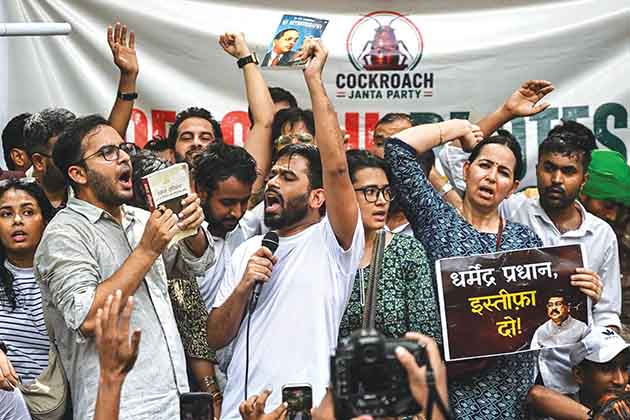
The Supreme Court’s decision concerning the recent student protests deserves to be welcomed—not selectively, but in its entirety.
For me, this is not merely a question of the ruling party versus the Opposition, nor should every public protest be viewed through that narrow political prism. As a legislator, I have myself raised several issues of public interest, questioned existing systems and sought corrective action from the Government. On issues affecting ordinary citizens, students, farmers, consumers and public health, I have experienced first-hand that raising an uncomfortable question need not make one anti-government.
More importantly, my party and the Government have supported legitimate issues that I have raised and, in several instances, acted upon them.
That experience has strengthened my conviction that a strong government need not fear questions; it must have the capacity to listen to them, examine them and act where correction is required.
That is also why I welcome the spirit of the Supreme Court’s decision.
In a constitutional democracy, students and citizens have every right to disagree with the Government. They have the right to assemble peacefully, raise questions, demand accountability and protest within the framework of the Constitution and the law.
A young student’s entire future should not be destroyed merely because he or she participated in a bona fide, peaceful protest.
But this is only one half of the judgment’s message.
The other half is equally important.
The Court has not converted the right to protest into a blanket immunity from the law. It has left room for lawful action against persons falling within the category specifically carved out in its order. Therefore, nobody should interpret judicial protection given to genuine protesters as a licence for individuals with ulterior or unlawful objectives to enter a legitimate movement and use students as a shield.
Protect the student who raises a question.
Protect the citizen who peacefully dissents.
But identify and act against the person who enters that crowd to pursue an unlawful agenda.
These principles are not contradictory. Together, they constitute responsible democracy.
This distinction has become increasingly important in our public discourse.
A genuine public grievance can bring thousands of ordinary young people onto the streets. But if a few organised elements exploit their anger, provoke confrontation, encourage violence or attempt to turn a peaceful movement towards an entirely different objective, the greatest victims are often the genuine protesters themselves.
The law must therefore be intelligent enough to distinguish between the two.
A democracy that criminalises every dissenter becomes weak. But a State that becomes helpless merely because unlawful activity takes place under the banner of a “protest” becomes weak too.
India should accept neither extreme.
As legislators, we too have a responsibility. Our role cannot be limited to defending every decision of the Government merely because we belong to the ruling side. We are elected first and foremost to represent people.
When a genuine public-interest issue reaches us, we must have the courage to raise it. When the Government responds positively, we must acknowledge it. When correction is necessary, we must pursue it. And when a legitimate public cause is deliberately hijacked for political, criminal or other ulterior purposes, we must have the courage to say that too.
My own experience in public life has convinced me that constructive dissent and good governance are not opponents; often, one strengthens the other.
The Government must listen. The Opposition must question responsibly. Citizens must be free to protest peacefully. The police must protect peaceful protesters. And those who deliberately cross the boundary of law must remain answerable to law.
The Supreme Court’s intervention therefore offers a larger lesson beyond the immediate controversy.
Let our young people protest if they believe something is wrong. Let them question us. Let them disagree with us. Governments and legislators should have the confidence to hear them.
But let nobody—political organisation, pressure group or individual—believe that the Constitution can be invoked as a shield after deliberately violating the law.
The Constitution gives you the right to raise your voice.
It does not give anyone the right to weaponise someone else’s voice.
That distinction must become the new democratic consensus.
Because ultimately, dissent strengthens democracy when it remains constitutional; those who exploit dissent for unlawful ends weaken both the cause and democracy itself.
(The writer is a BJP MLA from Shrigonda, Ahilyanagar. Views personal.)


Comments