

From Mud to Money

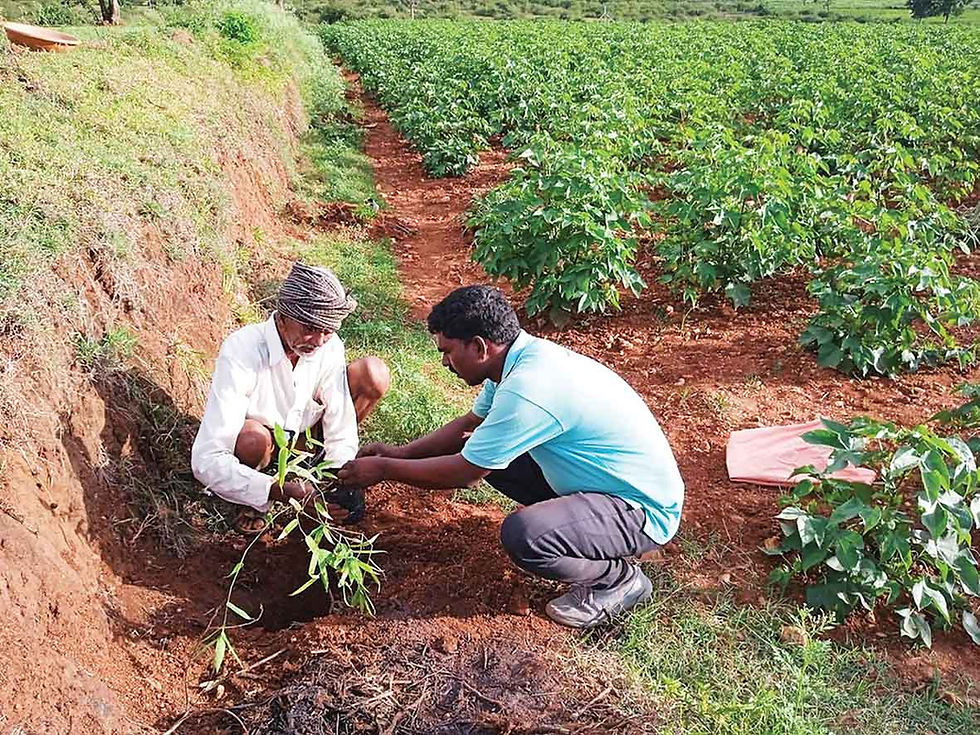
The global carbon market is quietly undergoing a profound transformation. For years, companies eager to offset emissions favoured inexpensive carbon credits generated by projects that merely avoided future emissions. Increasingly, however, investors, regulators and corporate buyers are demanding something more tangible: carbon that is actually removed from the atmosphere and securely stored. That shift is elevating nature-based solutions, particularly agroforestry, from a niche environmental practice to a potentially valuable financial asset.
Yet one of the world’s greatest carbon sinks remains largely invisible to global finance. It is not found in vast corporate plantations but in the tiny farms that dominate much of Asia and Africa. These smallholders cultivate roughly two-thirds of the agricultural land in developing economies, but few are able to participate in the expanding market for carbon removals. The irony is striking. Those who could contribute most to climate mitigation are least able to access the capital that rewards it.
Structural Causes
The reasons are structural rather than ecological. Carbon markets are designed for scale, legal certainty and measurable outcomes. Smallholders, by contrast, operate fragmented plots, often no larger than two hectares, with limited access to finance, technology or regulatory expertise. The costs of measuring, verifying and certifying carbon sequestration frequently exceed the value of the credits produced by individual farms. As a result, institutional investors prefer large commercial projects, leaving millions of rural producers excluded from a market that is increasingly worth billions.
This need not remain the case. What is required is not another pilot project but an institutional architecture that allows small farms to function as one investable asset.
The first building block is aggregation. Individual farmers should not be expected to navigate global carbon registries on their own. Instead, they should be organised through Farmer Producer Organisations or cooperatives that combine thousands of small, scattered holdings into a single commercial entity. Such organisations would handle contracts, compliance and administration while dramatically reducing transaction costs. Carbon buyers, in turn, would gain access to large volumes of verified credits through a single institutional counterparty rather than negotiating with countless individual producers.
Aggregation alone is insufficient. Carbon markets have long been burdened by expensive measurement, reporting and verification procedures. Traditionally, projects relied on field inspections, manual tree counts and repeated site visits. Such methods are prohibitively costly for small farms.
Reaching out directly
Technology offers a more efficient alternative. Satellite imagery, remote-sensing drones and artificial intelligence can now estimate biomass growth with remarkable accuracy. Automated digital monitoring systems can reduce verification costs substantially while improving transparency and consistency. They ensure that a larger share of carbon revenues reaches farmers rather than intermediaries.
Finance presents an equally formidable challenge. Trees do not generate carbon credits overnight. They require years of growth before significant sequestration can be certified. Few smallholders can afford to wait five or ten years for an uncertain financial return while sacrificing immediate agricultural income.
The solution lies in treating future carbon revenues as a financial asset today. Development banks, rural lenders and climate-finance institutions should develop forward-payment mechanisms that allow farmers to borrow against expected carbon income.
Like many agricultural commodities, carbon credits often pass through layers of brokers, consultants and intermediaries before reaching international buyers. Each layer captures a share of the value, leaving farmers with only a modest fraction of the final price.
Digital payment systems and blockchain-enabled smart contracts could help correct this imbalance. Transparent payment mechanisms linking buyers directly to cooperatives or individual producers would reduce opportunities for value leakage.
Governments and international institutions also have an essential role. Carbon registries should establish standardised regional biomass baselines to eliminate the need for expensive project-specific studies. Digitised land records must be integrated with satellite monitoring systems to simplify verification and strengthen confidence in land tenure. Regulators should also recognise that agroforestry delivers benefits extending well beyond carbon storage. Biodiversity conservation, soil restoration and rural livelihoods deserve to command a premium over monoculture plantations that merely maximise carbon volumes.
Perhaps most importantly, market rules should require that the majority of carbon-credit revenues flow directly to producers. Climate finance cannot claim success if the principal beneficiaries are consultants and brokers rather than farmers.
The future of carbon markets will ultimately be decided not only by financial innovation but by institutional design. High-integrity carbon removals are becoming one of the world's most valuable environmental commodities. If properly organised, millions of smallholder farms can become suppliers of that commodity while simultaneously strengthening food security, restoring degraded landscapes and raising rural incomes.
(The writer is a member of Maharashtra Agriculture Price Commission. Views personal.)


Comments