
From Rakshabandhan to Rivalry

As daughters and sisters stake their claims, succession in Indian political families is getting increasingly contested.

Dynastic politics has long been a defining feature of Indian democracy. Since independence, parties have often witnessed leadership transitions along familial lines, most notably the Indian National Congress. Over time, this tendency deepened, and nepotism became a recurring critique of the system. In recent years, however, dynastic politics has evolved into a more complex phenomenon. Political rivalries are no longer confined to father-son or brothers or uncle-nephew equations as increasingly, brother and sisters and extended family members are confronting each other directly in contests for power and legacy.
Much more than private family discord, this shift signals a transformation in the structure of political inheritance. The debate has gained further intensity in the context of the Women’s Reservation Bill, which proposes 33 percent representation for women in legislatures. As discussions around its implementation gather momentum, a critical question emerges: does the growing visibility of women in these family-centered political battles represent empowerment, or merely an expansion of dynastic control?
Succession Wars
A striking example of this trend can be seen in Telangana. On April 25 this year, K. Kavitha launched the Telangana Rashtra Sena (TRS), challenging not only the legacy of her father K. Chandrashekar Rao but also intensifying her rivalry with her brother K. T. Rama Rao. This development underscores a crucial shift that the succession in dynastic parties is no longer automatic, it must be asserted and contested. Daughters, once perceived as secondary actors, are now emerging as principal claimants.
Kavitha’s move also carries symbolic weight. By reviving the old TRS identity, she signalled a reclaiming of ideological ownership. Her criticism that the party had lost its ‘soul’ highlights how political branding itself has become part of family inheritance. Equally significant is her grassroots engagement through women’s and cultural organizations, indicating that newer women leaders are building independent political capital rather than relying solely on lineage.
The intersection of family and politics becomes even more complex in Andhra Pradesh. The ongoing conflict between Y. S. Jagan Mohan Reddy and his sister Y. S. Sharmila extends beyond political rivalry into legal disputes over property and inheritance. What began as a relationship rooted in familial affection has transitioned into courtroom battles. This evolution reveals how, in dynastic politics, power and property often intertwine, transforming personal relationships into competitive arenas.
Sharmila’s decision to align with the Congress and publicly criticize her brother’s ideological trajectory demonstrates another emerging trend. The assertion of independent political identities within families. While this may strengthen democratic pluralism, it risks reducing political discourse to personal acrimony and legal confrontation. It raises a deeper concern whether political parties are being treated as private estates?

Legacy Feuds
In Maharashtra, the rivalry between Pankaja Munde and Dhananjay Munde reflects a similar struggle over the legacy of late Gopinath Munde. Despite belonging to different parties, their contest operates simultaneously in personal and political spheres. Cultural symbols like Raksha Bandhan coexist uneasily with electoral competition, illustrating the layered nature of Indian political relationships.
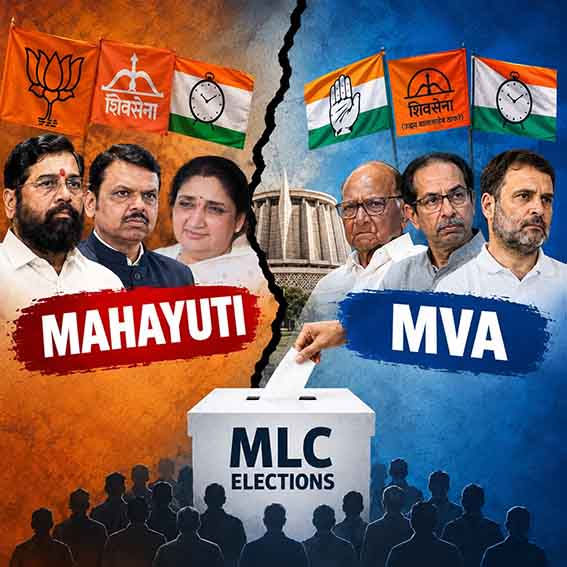
The fissures within the Nationalist Congress Party (NCP) provide one of the most detailed case studies of intra-family political conflict. Differences between Sharad Pawar, his daughter Supriya Sule, and his nephew Ajit Pawar became visible in 2023. In April that year, parallel meetings by rival factions highlighted growing tensions. By May, Ajit Pawar had reportedly initiated discussions with the Bharatiya Janata Party leadership. The decisive moment came on July 2, 2023 when he rebelled, joining the ruling Mahayuti alliance with around 40 legislators and taking oath as Deputy Chief Minister, effectively splitting the party founded by his uncle Sharad Pawar. In 2024, the Election Commission formally recognized his faction as the official NCP, granting it the party name and symbol.
On January 28 this year, Ajit Pawar tragically died in a Learjet 45 crash near Baramati. His funeral was held the next day, with Supriya Sule standing by the family. On January 30, Sunetra Pawar took oath as Deputy Chief Minister, a move that drew disapproval from the Sharad Pawar-led NCP (SP) faction, which claimed it had not been consulted. By February, prospects of reconciliation had collapsed. Sunetra Pawar has publicly questioned the circumstances of the crash and demanded a fair investigation. These developments underline the deepening political divide within the Pawar family, where Sule has emerged as the principal leader of her faction.
In Uttar Pradesh, ideological divergence defines the friction between Akhilesh Yadav and Aparna Yadav. Aparna’s decision to join the BJP and adopt a confrontational stance against the Samajwadi Party suggests that political ideology is beginning to outweigh familial affiliation, at least in public narrative. Symbolic acts such as flag burning have further sharpened this divide.
Bihar offers the most dramatic illustration. Tensions among Tejashwi Yadav, Tej Pratap Yadav, and their sister Rohini Acharya reveal the extent of internal dissent within dynastic parties. Following electoral setbacks, disagreements spilled into the public domain, with Rohini distancing herself and criticizing leadership decisions. This episode underscores the absence of institutional mechanisms for succession, making conflict almost inevitable in each generation.
Even in relatively stable political families, such as that of M. K. Stalin and his sister Kanimozhi in Tamil Nadu, speculation about succession persists. While no overt conflict is visible, the underlying question of inheritance continues to shape political narratives.
Similar patterns are visible elsewhere, including in Gujarat, where Rivaba Jadeja is a minister in the Government whereas her sister-in-law is holding the Congress flag.
This phenomenon is not limited to regional parties. Within the Congress, tensions were reported in 2018 when leadership preferences differed between Rahul Gandhi and Priyanka Gandhi Vadra over Rajasthan’s Chief Ministerial candidate. Ultimately, Ashok Gehlot assumed office, but the episode highlighted the subtle dynamics of intra-family influence even at the national level.
Empowerment or Conflict
Across these cases, one common thread stands out that the growing and decisive role of women. Figures such as Kavitha, Sharmila, Rohini Acharya, and Aparna Yadav are not merely participants but active contenders. In the context of the proposed women’s reservation law under the Narendra Modi-led BJP government, this shift gains added significance. Even before full implementation, the law appears to be reshaping political aspirations and family dynamics.
This transformation can be interpreted in two ways. On one hand, it represents genuine empowerment, challenging patriarchal norms and expanding opportunities for women. On the other, it may simply extend dynastic politics by incorporating more family members into the power structure.
Does this trend strengthen or weaken democracy? The answer is not straightforward. Increased competition within families can dilute centralized authority and foster internal pluralism. However, when such conflicts devolve into personal disputes, property battles, and public acrimony, they risk undermining the quality of political discourse and diverting attention from governance.
It would be premature to declare the end of dynastic politics in India. Rather, it is entering a new phase-more fragmented, more visible, and more contested. After conflicts between brothers and between uncles and nephews, we are now witnessing rivalries among siblings, sisters-in-law, and even members of the next generation within the same family, indicating that political power remains deeply intertwined with familial structures.
The Curse of Dynastic Politics
Dr. Ram Manohar Lohia once asserted that leadership should belong to those with merit, not lineage. Decades after independence, however, Indian politics tells a different story. Dynasticism has not only survived but flourished, embedding itself deeply across parties and regions. What began as a trend in the Congress with the Nehru-Gandhi family has now become a widespread phenomenon, cutting across ideological lines.

Data from the Association for Democratic Reforms indicates that about 21 percent of MPs and MLAs in India come from political families, with the Congress leading at 33 percent. Even regional parties that claim to represent marginalized communities increasingly pass leadership within families. The result is a troubling paradox: a democratic framework functioning like an undeclared monarchy.
Across northern India, this pattern is stark. In Jammu and Kashmir, the Abdullah family has dominated the National Conference for decades, with leadership passing from Sheikh Abdullah to Farooq Abdullah and then to Omar Abdullah, and now extending into a fourth generation. Similarly, the People’s Democratic Party, founded by Mufti Mohammad Sayeed, is now led by his daughter Mehbooba Mufti, with the next generation already visible.
Punjab reflects a similar trend, with the Shiromani Akali Dal effectively controlled by the Badal family. In Haryana, the Chautala family has maintained influence since the late 1980s, with multiple offshoots of the family running separate parties.

Uttar Pradesh presents perhaps the most visible example, where the Samajwadi Party, founded by Mulayam Singh Yadav, is now led by his son, Akhilesh Yadav, alongside several other family members holding key positions. The Rashtriya Lok Dal is following a comparable trajectory, transitioning leadership from one generation to the next.
Eastern India is no exception. In Bihar, Lalu Prasad Yadav’s political legacy continues through his son Tejashwi Yadav. Jharkhand Mukti Morcha, founded by Shibu Soren, is now led by his son Hemant Soren. In West Bengal, Mamata Banerjee’s nephew Abhishek Banerjee has emerged as a central figure in the Trinamool Congress. Odisha and Chhattisgarh also exhibit similar patterns, with leadership concentrated within families.
Western and southern India further reinforce this narrative. Maharashtra’s politics is heavily influenced by families like the Pawars and Thackerays, where leadership transitions remain within kinship lines. In Karnataka, the Janata Dal (Secular) continues under the Deve Gowda family. Telangana’s Bharat Rashtra Samithi and Andhra Pradesh’s YSR Congress Party both showcase generational leadership transitions. Tamil Nadu’s Dravida Munnetra Kazhagam stands as a classic example, with power moving from Karunanidhi to his son M.K. Stalin, and now to the next generation.
Dynastic politics undermines the very essence of democracy. Merit is sidelined, accountability weakens, and corruption finds fertile ground. Citizens may believe they are participating in a democracy, yet the concentration of power within families suggests otherwise. To preserve the integrity of democratic institutions, political parties must adopt genuine internal democracy rather than symbolic gestures. Without structural reform, India risks normalizing a system where electoral choice exists, but leadership remains inherited.
Reserved Seats, Inherited Power

The Nari Shakti Vandan Act, the 106th constitutional amendment, promises a decisive shift to move women from the margins of the electorate to the centre of lawmaking. By reserving a third of seats in Parliament and state assemblies, it seeks to correct a stubborn imbalance and make representation more reflective. Yet, as with many reforms in India, there is a yawning gulf between ambition and fulfilment.
The experience at the grassroots offers a warning. When Bihar introduced 50 percent reservation for women in panchayats in 2006, a parallel vocabulary soon took hold: the terms “Mukhiya Pati” and “Sarpanch Pati” came into vogue. These titles were telling as in far too many cases, elected women were mere figureheads, while their male relatives wielded the real authority behind the chair. The phenomenon spread across Rajasthan, Madhya Pradesh and Uttar Pradesh, becoming shorthand for proxy power. Official campaigns have since tried to curb the practice, but its persistence underscores a deeper social inertia.
At higher levels, the arithmetic is stark. Women account for only 74 of 543 members in the 18th Lok Sabha (13.6 percent), and under 10 percent of legislators in state assemblies. The case for intervention is thus unambiguous. But quotas do not operate in a vacuum; they interact with India’s entrenched dynastic politics.
Here, the numbers are equally revealing. Nearly half of the country’s 539 women MPs and MLAs come from political families, according to recent analyses. In the Lok Sabha, the share is still higher. In states such as Maharashtra and Bihar, a majority of women legislators are linked to established political lineages. Reservation, in such a context, risks becoming less a ladder for outsiders than an escalator for the well-connected.
This is the reform’s central tension. Will quotas widen the pipeline, bringing in first-generation women leaders, or will they consolidate existing networks under a more inclusive veneer? Without shifts in party selection practices, social attitudes and administrative enforcement, the latter outcome looks plausible.
The Nari Shakti Vandan Act is best seen not as a culmination but as an opening. While it does create the possibility of a more representative politics, it certainly does not guarantee it. India has legislated inclusion in the past as well, only to find it mediated by old hierarchies.
The test will lie in whether new political idioms emerge or whether familiar distortions acquire new labels. If “Sarpanch Pati” once captured the gap between form and substance, the risk now is of its national equivalents. The promise is that half the population will shape the republic’s future. The peril is that power will merely change hands within the same families, under a different name.


Comments