top of page

By:

Akhilesh Sinha

25 June 2025 at 2:53:54 pm

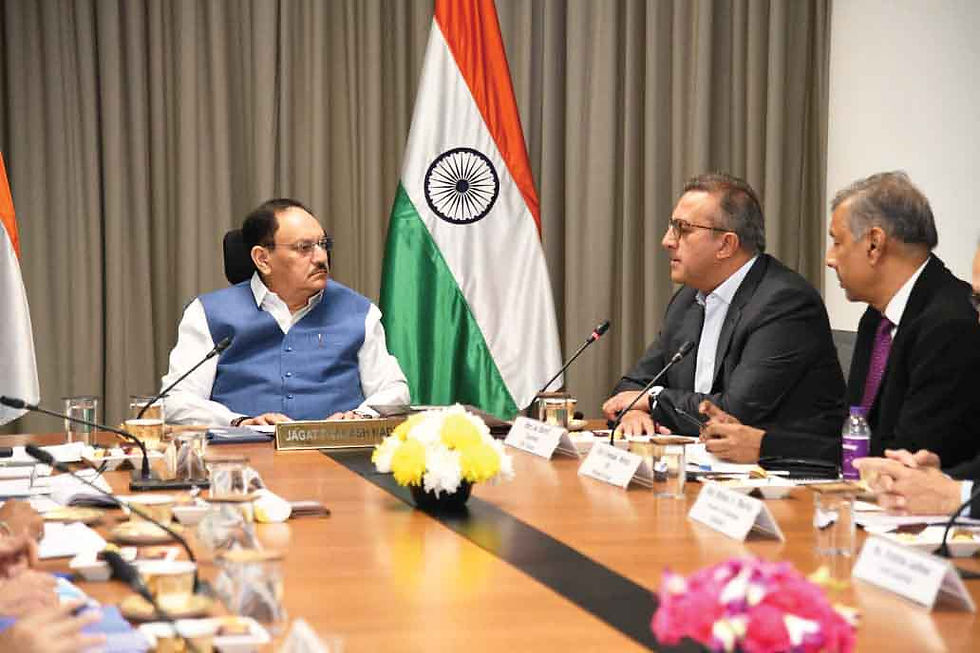
Nadda's strategic meet signals urgency for chemical sector

New Delhi: As war simmers across the volatile landscape of West Asia, whether in the form of a direct confrontation between Israel, United States and Iran, or through Iran's hybrid warfare involving groups like Hezbollah and the Houthis, the tremors are no longer confined to the region's borders. They are coursing through the arteries of the global economy. India's chemicals and petrochemicals sector, heavily dependent on this region for critical raw materials, finds itself among the earliest...

Nadda's strategic meet signals urgency for chemical sector

New Delhi: As war simmers across the volatile landscape of West Asia, whether in the form of a direct confrontation between Israel, United States and Iran, or through Iran's hybrid warfare involving groups like Hezbollah and the Houthis, the tremors are no longer confined to the region's borders. They are coursing through the arteries of the global economy. India's chemicals and petrochemicals sector, heavily dependent on this region for critical raw materials, finds itself among the earliest and hardest hit by this geopolitical turbulence. It is in this backdrop that the recent meeting convened by Union Minister for Chemicals and Fertilisers J. P. Nadda at Kartavya Bhavan must be seen not as a routine consultation, but as a signal of strategic urgency. India's ambition to scale this sector from its current valuation of $220 billion to $1 trillion by 2040, and further to $1.5 trillion by 2047, will remain aspirational unless the country confronts its structural vulnerabilities with clarity and resolve. India today ranks as the world's sixth-largest producer of chemicals and the third-largest in Asia. The sector contributes 6-7 percent to GDP and underpins a wide spectrum of industries, from agriculture and pharmaceuticals to automobiles, construction, and electronics. It would be no exaggeration to call it the backbone of modern industrial India. Yet, embedded within this strength is a paradox. India's share in the global chemical value chain (GVC) stands at a modest 3.5 percent. A trade deficit of $31 billion in 2023 underscores a deeper issue: while India produces at scale, it remains marginal in high-value segments. This imbalance becomes starkly visible when disruptions in West Asia choke the supply of key feedstocks, shaking the very foundations of domestic industry. Supply Disruption The current crisis has laid this fragility bare. Disruptions in the supply of LNG, LPG, and sulfur have led to production cuts of 30-50 percent in several segments. With nearly 65 percent of sulfur imports sourced from the Middle East, the ripple effects have extended beyond chemicals to fertilisers, plastics, textiles, and other downstream industries. Strategic chokepoints such as the Strait of Hormuz have witnessed disruptions, pushing shipping costs up by 20-30 percent and adding further strain to cost structures. This is precisely where Nadda's emphasis on supply chain diversification and resilience appears prescient. In today's world, self-reliance cannot mean isolation; it must translate into strategic flexibility. While India imports crude oil from as many as 41 countries, several critical inputs for the chemical industry remain concentrated in a handful of sources, arguably the sector's most significant vulnerability. Opportunity Ahead A recent report by NITI Aayog outlines a pathway to convert this vulnerability into opportunity. It envisions raising India's GVC share to 5-6 percent by 2030 and to 12 percent by 2040. If achieved, the sector could not only reach the $1 trillion mark but also generate over 700,000 jobs. However, this transformation will demand more than policy intent, it will require sustained investment and disciplined execution. The most pressing challenge lies in research and innovation. India currently spends just 0.7 percent of industry revenue on R&D, compared to a global average of 2.3 percent. This gap explains why the country remains largely confined to basic chemicals, even as the world moves toward specialty and high-value products. Bridging this divide is essential if India is to climb the value chain. Equally constraining is the fragmented nature of the industry. Dominated by MSMEs with limited access to capital and technology, the sector struggles to compete globally. Cluster-based development models offer a pragmatic way forward, such as PCPIRs and the proposed chemical parks.

From RTO officer to Rocket Science

Sujata Madke quits lucrative job to join ISRO

Thane: In a groundbreaking achievement, Sujata Ramchandra Madke, a farmer’s daughter from the small village of Shirgaon in Shahapur taluka, has become the first woman from Thane district to be appointed as a Scientist at the Indian Space Research Organisation (ISRO), Bengaluru. What makes her story even more inspiring is that she voluntarily resigned from a secured government job as an Assistant Motor Vehicle Inspector at the Thane RTO to pursue her dream of contributing to India’s space program.


Sujata joined ISRO on May 27 as a Gazetted Scientist, marking a proud moment not just for her family but also for her district. Her journey from a humble village school to India’s premier space agency stands as a testament to perseverance, determination, and the power of dreams.


Born in the remote village of Shirgaon, located 15 kilometers from Shahapur in Thane district, Sujata received her early education at the local Zilla Parishad school the same school her father and grandfather attended. Her father, Ramchandra Madke, a former clerk at the Thane Zilla Parishad and part-time farmer, ensured that all four of his children received higher education despite limited resources.


Sujata’s academic excellence began early. She secured 94.91 per cent in her SSC board exams and 77.50 per cent in her HSC. She went on to complete her B.Tech in Mechanical Engineering from Dr. Babasaheb Ambedkar Technological University, Lonere, Raigad. Later, she worked as a Research Engineer in the Ministry of Education’s Virtual Lab Project (Phase III) at IIT Kharagpur and was also selected as an Assistant Engineer at MAHAGENCO.


She cleared the Maharashtra Public Service Commission (MPSC) examination and joined the Thane RTO as an Assistant Motor Vehicle Inspector. However, her passion for space research never faded. While working full-time at the RTO, she continued her studies late into the night, preparing rigorously for ISRO’s recruitment process. Her family still preserves the two sacks of books she used during her preparation a symbol of her relentless dedication.


Kalam, the inspiration

While Speaking to ‘The Perfect Voice’, Sujata said, “Dr. A.P.J. Abdul Kalam always said, ‘Dream big, and work hard to make those dreams come true.’ His words inspired me to never settle. Leaving a stable government job was not easy, but I had to follow my calling.”


Her father Ramchandra Madke expressed immense pride “She was the first in our family to step outside Maharashtra for education. Watching her serve the nation through science is the proudest moment of my life.” Her mother, Savita Madke, recalled Sujata’s childhood passion for painting and science, saying, “She used to say she wanted to be a scientist when she was just a little girl. Today that dream has come true.”


Sujata’s elder sister Chetna Sonawane added, “She would study for 8 to 12 hours every day. Among the four siblings, Sujata was always the most focused and determined.”


Before being selected by ISRO, Sujata had also made it to the interview rounds of top Indian institutions such as DRDO and BARC. Her recent appointment as an ISRO scientist is not only a personal milestone but also a landmark for young women across rural Maharashtra who dream of a career in science and technology.


Her hardworking parents and elder sisters were her source of inspiration during this journey. While working at RTO Thane all officers of RTO motivated her for study and RTO Hemangini Patil lso supported her for studies in office.


Her story is a shining example of how grit, family support, and an unyielding dream can take a girl from a remote village to the stars quite literally.

Comments


bottom of page