
top of page

By:

Anandajit Goswami

15 April 2026 at 11:15:27 pm

Lessons from the Mountains

How much of the Himalayas must melt before we rediscover our humanity? I have carried this question for some time. Perhaps it came from the mountains, the rain and the silence. The Himalayas feed rivers, sustain communities and carry memories of centuries. Yet their changing landscape reminds us that nature has limits. We discuss melting glaciers, disappearing water sources and climate change, but too often these remain statistics. What happens when they become part of daily life? I imagine...

Lessons from the Mountains

How much of the Himalayas must melt before we rediscover our humanity? I have carried this question for some time. Perhaps it came from the mountains, the rain and the silence. The Himalayas feed rivers, sustain communities and carry memories of centuries. Yet their changing landscape reminds us that nature has limits. We discuss melting glaciers, disappearing water sources and climate change, but too often these remain statistics. What happens when they become part of daily life? I imagine sitting on those mountains on a rain soaked afternoon, watching clouds descend and the earth being washed clean. In that silence, love arrives. Not the dramatic love we celebrate, but a quieter love that simply sits beside us. And then I ask myself: have I learned to love another human being, or only the idea of humanity? Humanity as an idea is easy to love. The person before us is different. He has fears, weaknesses, anger and wounds. To love a human being requires patience. It requires us to stay. The question stays with me. We often imagine spirituality as a journey away from people, towards mountains, forests and solitude. But perhaps the journey into the mountains is only half the journey. The other half is returning to people. Perhaps we enter the forest not to escape humanity, but to understand it better, and then return to everyday life with a greater ability to see those around us. If spirituality creates distance between us and others, what have we gained? True spirituality should make that distance smaller. It should make us more compassionate, not more detached. We can speak to someone thousands of kilometres away in seconds, but may not know what the person next to us is going through. How much of Nepal do we really reach when we admire its mountains? Perhaps Nepal represents every distant place we admire without truly knowing, every landscape we photograph without understanding, and every suffering we discuss without allowing it to change us. We can cross mountains and borders without ever truly arriving. A journey is complete only when it brings us closer to another human being. Perhaps that is where a spiritual journey becomes meaningful. And then there is violence. A missile can cross the sky in seconds. A bullet can end a life in an instant. But fear travels much faster. It moves from one heart to another and changes the way people see each other. Grief becomes anger, anger becomes hatred, and hatred makes it easier to see another human being as an enemy rather than as a person. At such moments, our philosophies disappear. The mask falls. I imagine looking beside me. I expect to find a gun. But there is no gun. There is a guitar. I do not know who placed it there. Perhaps it was love. Perhaps it was music or another human being reminding me that there is a choice. The gun represents hatred, revenge, intolerance and the desire to silence another voice. The guitar represents conversation, empathy and creativity when the world is full of noise. We can decide what we add to the world. We can add to anger, or we can reduce it. We can answer hatred with hatred, or begin a conversation. Every choice shapes society. Perhaps that is where being human really begins. The Himalayas may continue to melt. Rivers may shrink. Fear may return, and guns may continue to speak. But we still have a choice. We can add another weapon to the noise, or pick up the guitar. We can continue speaking the language of fear, or learn the language of compassion. Perhaps spirituality is making that choice again and again. Humanity begins with the person standing next to us. It could be a stranger, neighbour, colleague, or someone we strongly disagree with. The moment we stop seeing that person as another human being and begin to see something of ourselves in him, the distance becomes smaller. The mountains may teach us silence. Rivers may teach us movement. Rain may teach us renewal. But their greatest lesson is simple: we are all standing on the same fragile earth. The world will continue to change, whether we are ready or not. The real question is what we will become while it changes. Where we expected a gun, perhaps there can be a guitar. Perhaps we should begin there. We may not control the future, but we can influence the human atmosphere we leave behind. (The writer is an author and musician. Views personal.)

Ladki Bahin’ scheme wows House of Lords  
3 hours ago
2 min read

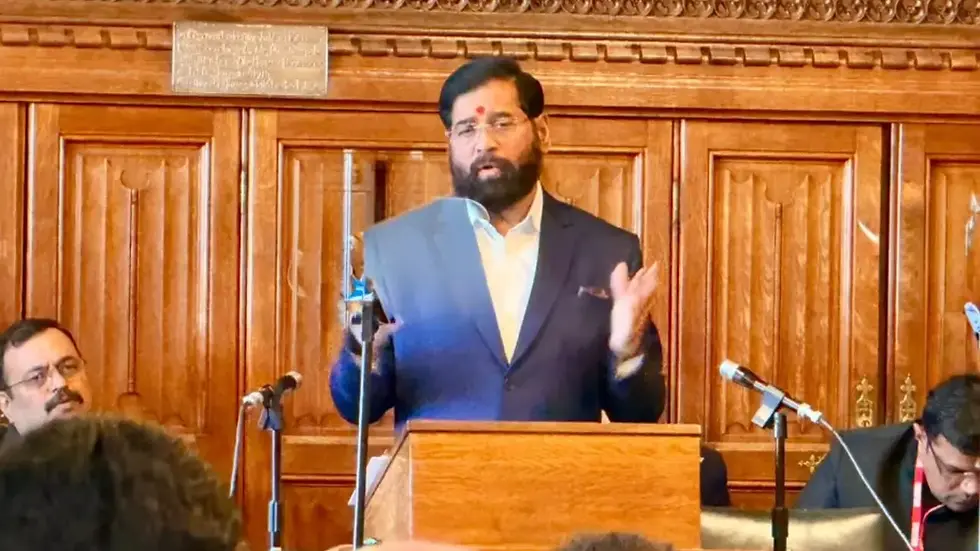
Mumbai: Deputy Chief Minister Eknath Shinde’s ‘Ladki Bahin’ scheme – launched when he was the CM, reached the world stage, bagging him the coveted ‘Commonwealth Public Leadership Recognition’ award at a glittering function in the House of Lords, London.


Presented at a joint event of the UK-Asian Business Council and Canvas for Care Creative Art Campus, it specifically lauded Shinde’s women and citizen focused governance initiatives - ‘Mukhyamantri  Majhi Ladki Bahin Yojana’ (2024) and ‘Shasan Aplya Dari’ (2023) - unveiled when he helmed the state.


Several bigwigs, including former Northern Ireland First Minister, Baroness Arlene Foster, UK Asian Business Council Chairman Andrew Grocock and vice-chairman Sudeep Sakale were among those present, as a smiling Shinde accepted the honour with gratitude and dedicated it to the people of Maharashtra.


In his address starting in Marathi, “Namaskar, Jai Maharashtra”, Shinde switched to English to discuss the two schemes and weaved them into the larger aspect of women empowerment and public welfare with long-term implications as the state races to become a USD One Trillion economy and the country races to catch the deadline of 2047 to earn the ‘developed nation’ tag.


Clad in semi-formals, he recalled his own humble beginnings, the travails of his mother and wife growing up in a humble farmer family that shaped his approach to the peoples’ problems and attempting to resolve them.


“I have only sister, but thanks to the ‘Ladki Bahin Scheme’, I have gained millions of sisters,” said Shinde, of what became the defining and trend-setting model replicated by several states in the country, besides the decision to include the mother’s name in the official identity for all people, which he said may be a global first.


The Deputy CM also dwelt on other important welfare schemes, including financial and other assistance for girls pursuing higher education, a department dedicated for persons with disabilities, the state’s policy on Transgenders, monetary support to thousands through the Chief Minister’s Medical Assistance Cell, plus more.


Shinde grabbed the rare opportunity to showcase Maharashtra as both, an economic powerhouse of India and a committed social welfare state, with major infrastructure projects operational like the Mumbai Trans Harbour Link, Mumbai Coastal Road, Samruddhi Expressway and the upcoming Vadhavan Port, besides other mega-showpieces.


Presenting the state’s importance vis-à-vis the country, he said Maharashtra contributes nearly 14 pc of India’s GDP and attracts over 30 pc of all the FDI flowing into the country.


He invited British businesses to invest in Maharashtra in sectors like fintech, green energy, deep-tech, education, skill development and green hydrogen, particularly since both Mumbai and London are international financial centres with ample scope for collaboration to help the state achieve its USD One Trillion economy target in the next four years.


 

Shinde pats PM Modi
Describing Prime Minister Narendra Modi as “a visionary and dynamic leader”, Eknath Shinde said under his leadership India-UK relations are entering ‘a new golden era’, with the Maharashtrian community living in the UK serving as a vibrant bridge between the two nations.
 
Yesterday, hundreds of Marathis living in London and other cities turned out in colourful Maharashtrian attires, ‘phetas’ (headgears), women in traditional jewelry, some with ‘dhol-tasha’ and ‘lezim’ to accord a warm welcome to Shinde for the award ceremony in the King's country.

Comments


bottom of page