
Latur, 33 Years On: Memories of a Mega-Cataclysm
A veteran journalist recalls the devastation, the race to Ground Zero and a remarkable night with Sharad Pawar following the earthquake that shook Maharashtra and India.
Flashback: Latur, circa September 29–30, 1993
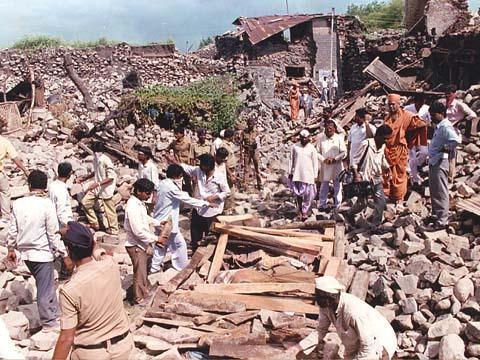
As the world woke to an unprecedented calamity that had engulfed Maharashtra, I was probably the first outstation journalist to reach Latur — barely 15 hours after the earthquake struck in the dead of night on September 29–30, 1993.
It was around 3:56 a.m. when the earth shook. Homes became graveyards as villagers slept, unaware of the catastrophe unfolding around them, and were mostly buried alive.
Rattled myself, I nevertheless managed to reach the Indian Express office earlier than usual, as the first reports of the devastation began trickling in. This was an India still largely unfamiliar with the cacophony of blaring private news channels. Information travelled through official channels, often staid or understated Doordarshan ‘khabrein’, news-agency tickers, landline calls to the administration, and a network of local journalists, activists and other contacts.
At barely 10 a.m., my then News Editor, the late Ervell Menezes, greeted me with a scowl.
“So late? There was an earthquake in Latur… Rush there. Coordinate with your Boss!”
Soon after, my then City Editor, the late D. K. Raikar, came huffing and puffing into the office. Since I was still the only person around, he ordered me to prepare for an immediate trip to Latur. He arranged a cash advance and telex cards, advised me to pack a change of clothes if possible, and get moving. I did exactly that.
As a train ticket or private taxi were being organised, a call came from Thakiyuddin Abdul Wahid, founder and managing director of the now-defunct East West Airlines. He informed us that the private carrier was operating a special relief flight to Solapur that evening.
Sensing an opportunity, my bosses asked whether they could send a reporter along. Wahid readily agreed. With barely enough time to grab some food and clothes from home, I was all set to fly to Ground Zero — Latur.
The large EWA aircraft landed at Solapur that evening. Even the autorickshaw ride into the city proved a grim curtain-raiser.
“Sir, entire villages are flattened. Thousands are dead,” the driver said sombrely, referring to the devastation across Latur and Osmanabad, the worst-hit areas.
Fortunately, through some helpful contacts, a local colleague and I managed to secure a room at the Circuit House and had supper there.
Late that night, the place suddenly came alive with a flurry of activity: scores of police and government vehicles, their red, yellow and blue beacons — still permitted in those days — flashing brightly in the darkness; many babus and officials of varying ranks, armed with files, facts and figures, moving around.
Amid the commotion, I noticed a grim but tall, familiar figure stepping out of a vehicle and briskly walking towards the VIP bungalow in the same complex.
It was Chief Minister Sharad Pawar, dressed in his trademark white shirt and trousers, heading into yet another major crisis-battle of his long political career.
Following the Chief Minister
The next morning, at around 8 a.m., the CM’s huge cavalcade was ready to leave for a tour of the regions ravaged by the earthquake across Latur and Osmanabad.
Spotting an opportunity, I sent word — along with my press card — to a senior official in Pawar’s team, seeking permission to accompany the Chief Minister.
The reply came promptly: “Join the convoy in 20 minutes near the gate…!”
And we did.
Pawar’s entourage sped along the surviving roads at dizzying speeds, eventually reaching some of the worst-hit villages. I followed Pawar’s footsteps wherever he went.

Small groups of farmers and villagers, their eyes moist with grief over the loss of loved ones, stood with folded hands, looking to him for help in rebuilding their shattered lives. The stoic CM met and comforted as many as he could, assuring them that the government would stand behind them. Around him, an alert officialdom hung on to every word and instruction.
We passed through village after village reduced to rubble. An unbearable stench of death and destruction hung in the air, made worse by the heavy rains that had fallen the previous day.
Pawar wore a pair of black gumboots. I sported my regular sneakers. In some places, bodies of victims lay in narrow alleys and muddy pathways, and officials leading the CM stepped on or through them; I kept in tow.
The entire day spent in Pawar’s shadow was, in its own way, a lesson in governance — a close-up demonstration of what happens when the machinery of government is forced to confront a catastrophe of such magnitude.
It showed me ‘what makes Pawar, Pawar’.
A remarkable night at the Circuit House
Late that evening, the weary travellers returned to the Circuit House.
Pawar immediately plunged into a series of quick meetings, firing off instructions, seeking different sets of details and coordinating with State and Central government officials, including then Prime Minister P. V. Narasimha Rao and Finance Minister Dr Manmohan Singh.
I had requested an official to arrange a possible tête-à-tête with Pawar that night.
Fortunately, sometime after midnight, we were summoned. We were shown into his room.
I was taken aback to find Pawar preparing to have a frugal meal of dal, rice, chapatis and a watery vegetable. He invited us to join him, but we politely declined.
During that audience, I gently put several questions to him about the earthquake, its aftermath, the casualties and fatalities, and the steps being taken by the government.
He appeared remarkably composed and in complete control despite the hazardous and exhausting day he had just endured.
Pawar patiently answered my questions between mouthfuls of simple food prepared by the Circuit House cook — and a barrage of telephone calls coming through a hotline.
For nearly two hours, I listened intently as he spoke to an extraordinary roll call of world and Indian leaders: the then Prince of Wales, Nepal’s Chief of Army Staff, kings, presidents and prime ministers from various countries, chief ministers of different States, and others.
I noted down everything.
When I finally sought Pawar’s permission to leave, he rose from the sofa, his ‘dinner’ cold and incomplete, and folded his hands in farewell.
He then returned to work.
I learnt later that he continued his meetings and calls with officials until nearly 5 a.m., before finally retiring for a couple of hours of rest.
Ground Zero
The next morning, still groggy, I managed to write and wire four dispatches through the local post office telex and called my boss, Raikar, to confirm that they had been received.
“Now, what?” I asked.
His reply came in his soft voice: “You have done a good job today… The interview with Sharad Pawar is a masterpiece scoop. You can return now. Others will take over…”
Meanwhile, most roads and highways leading to Latur were clogged with Army convoys, disaster-relief teams and vehicles carrying domestic and international aid. Hordes of Indian and foreign journalists were consequently forced to travel via Pune, Hyderabad, Bhopal, Bengaluru or Goa.
The first wave of the outside media brigade began reaching the disaster zone only around the morning of October 2.
By then, I had already completed my first round of ground reporting.
Relieved, I again coordinated with East West Airlines for its return relief flight from Solapur.
After conquering the maiden challenge, late on October 2, I returned to Mumbai.


Comments