

Lords of Kalinjar: The Chandellas and the Struggle for Central India

Long before Khajuraho became a shorthand for erotic sculpture, Sisir Kumar Mitra’s history reveals the formidable dynasty that made those temples possible.
The erotic sculptures at Khajuraho have become so inseparable from the place that the temples are often reduc

ed, in the popular imagination, to the sensual figures carved on their walls.
Yet the Chandellas, the powerful dynasty that built Khajuraho, were not simply patrons of an extraordinary sculpture. They were rulers of a formidable Central Indian kingdom, who emerged from obscurity, mastered the politics of a collapsing imperial order, captured the strategic fortresses of Kalinjar and Gwalior, resisted the Ghaznavid invasions and remained, for centuries, among the more persistent defenders of Hindu rule against the Turkish advance.
This larger history is recovered with unusual patience in Sisir Kumar Mitra’s The Early Rulers of Khajuraho, published in 1958. Mitra’s (not to be confused with his more famous pioneering physicist namesake) book deserves to be remembered not merely as a political study of the Chandellas but as an attempt to reconstruct a tangled political world from fragmentary inscriptions, bardic works, foreign chronicles and archaeological evidence of varying historical value.
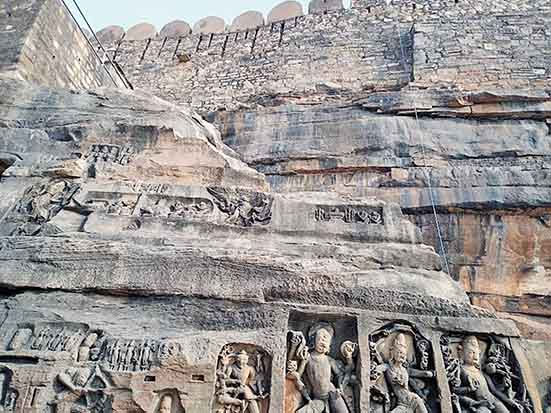
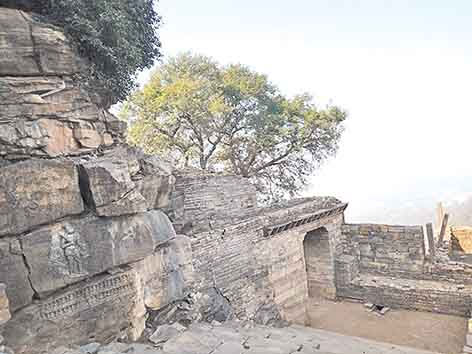
The Chandellas formed one of the most prominent dynasties that flourished in India in the centuries preceding the establishment of Islam as an imperial power in the subcontinent. Their importance lay partly in geography. The sturdy defences of the mighty Kalinjar fort and its twin mountain fastness of Ajaigarh provided the Chandellas with a comparative security against external enemies.
Historian Benoy Chandra Sen, in his foreword to Mitra’s book, writes that “in an age of strife and turmoil, they [the Chandellas] were to provide their people with a strong and stable government and prevent the disruption of the prevailing social and economic order over a fairly wide area.”
The Chandellas also preserved their independence longer than many rulers who quickly surrendered to Muslim aggression in the first onrush of the Turkish onslaught in northern India, which began with the Ghaznavid ruler Sabuktigin’s tangles with the Hindu Shahi dynasty that ruled over parts of Afghanistan (including Kabul) and the Punjab at the time.
As Mitra observes, the Chandellas had a humble beginning “which is almost lost in obscurity”. From that obscure beginning they gradually rose to feudatory status under the imperial Pratiharas. At a critical moment in the latter’s history, they distinguished themselves by rendering effective assistance to Ksitipaladeva, who had been humiliated by powerful antagonists. As the Pratihara empire approached its final disintegration in the 11th century CE, the Chandellas enlarged their dominion and, most importantly, secured the strategic fortresses of Kalinjar and Gwalior.
Geography is Destiny
Their rule lasted for more than three centuries, from the tenth to the beginning of the fourteenth century, when, after prolonged resistance, they were finally overwhelmed by the Turkish invasions.
The region – later known as Bundelkhand after the Bundelas - in which the Chandel rulers established their kingdom was known in their inscriptions as ‘Jejabhukti’, ‘Jejabhuktika’ or ‘Jejikabhukti.’ Earlier it had been called Jajhoti or Jajahuti. Mitra suggested that Jajhoti might be connected with the Chih-chi-to mentioned by the Chinese pilgrim Hiuen Tsang, who visited the region in 641–42 AD.
This geographical setting is important because the history of the Chandellas is, in large measure, the history of some of Central India’s (today’s Madhya and Uttar Pradesh) most strategic places.
The dynasty really shot to prominence under Yasovarman, who secured Kalinjar fort early in the tenth century. From then onward the Chandella rulers proudly bore the title of Kalanjaradhipati (or ‘Lord of Kalinjar’) down to Hammiravarman, the last known ruler of the family.

The twin Vindhyan fort of Ajaygarh (or Jayadurga) later acquired a similarly important position in the history of the dynasty. Situated on the fringe of the Panna hills, south-east of Mahoba and south-west of Kalinjar, it became another major Chandella stronghold as evinced after the capture of Kalinjar by Qutb-ud-din Aibak (Muhammad of Ghor’s lieutenant and founder of the Mamluk dynasty in Delhi) in 1203 CE. Vincent Arthur Smith believed that the Chandella chiefs ordinarily resided at Ajaygarh after the fall of Kalinjar and their capital, Mahoba.
Like many ruling houses of early medieval India, the Chandellas surrounded their beginnings with genealogy and myth.
\
The Chahamanas, Pratiharas, Chaulukyas and Paramaras were regarded as the four fire-born races, or agnikula, whose founders were said to have sprung from the fire-altar of the sage Vasistha on Mount Abu. Other dynasties traced their ancestry to figures of epic antiquity. The Kalachuris claimed descent from Yayati, the Kachhwahas from Kusa, son of Rama, and the Guhilots directly from Rama.
The Chandellas, Mitra notes, traced their descent from the Moon. Their inscriptions consistently used the clan-name “Chandratreya”, after the sage Chandratreya, who was claimed as the progenitor of the family. The Khajuraho inscription of Vikrama Samvat 1011 is the earliest available record to refer to this mythical origin.
The more elaborate tradition appears in the Mahoba Khand, generally treated as part of the medieval epic Prithviraj Raso of Chand Bardai.
But Shyamasundar Das, who edited the text as the Parmal Raso (the exploits of the last eminent Chandella ruler Parmardideva) argued that it could never have been part of the Prithviraj Raso and that its authorship could not be assigned to Chand Bardai, the court poet of Prithviraj Chauhan.
He believed the extant Mahoba Khand could not have been composed earlier than the seventeenth or eighteenth century of the Vikram era - long after Chand Bardai, the supposed contemporary of Prithviraj Chauhan.

But Mitra refused to regard the rich (but frequently absurd) bardic material as entirely useless.
The Mahoba Khand, though unacceptable as literal history, provides an insight into the way the Chandella legends coalesced to explain the origin and early history of a key ruling dynasty that played a vital role in a turbulent epoch.
The great chronicler of the dynastic history of Northern India H. C. Ray had argued that the early Chandellas could hardly have established a sovereign state while the imperial Gurjara-Pratiharas, who ruled from the magnificent city of Kannauj, were at the height of their power.
Ray suggested that Nannuka, the first Chandella ruler of note, was probably a feudatory of the Imperial Gurjara-Pratiharas, perhaps under Nagabhata II.
Mitra rejects this suggestion, questioning the theory that the Chandellas were feudatories to the Gurjara-Pratiharas.
This apparent historical hair-splitting is important because the political circumstances of ninth century northern India were considerably more fluid than the conventional picture suggests. R. C. Majumdar had questioned the reliability of the Jain Prabhavaka Carita as evidence for the Pratihara Nagabhata II’s control of Kannauj. The Palas of Bengal, too, remained a considerable power in northern India in the contest for Kannauj – which was the indisputable political heart of northern India since the time of the great Harshavardhana.
In such circumstances, Mitra argued, it was not possible to presume that the Chandellas could have existed only as Pratihara feudatories.
Nannuka may instead have been the leader of a local tribe who recognised an opportunity in the prevailing disorder and organised it on a military basis. “It was under his leadership,” Mitra suggested, “that the nucleus of the Candella State was founded” in the region later known as Jejabhukti.
The Chandellas may therefore have begun not as imperial nominees but as a local power learning to exploit the weakening of greater powers around them. It was Yasovarman, who carried that process decisively forward.
The Chandellas did eventually become feudatories of the Pratiharas, but the imperial power itself was increasingly weakened by repeated struggles with the Rashtrakutas of the Deccan. Such conflicts depleted the resources of the Gurjara-Pratiharas and increased its dependence upon feudatories such as the Guhilots (of Mewar) and the Chandellas. Those feudatories would soon seek the earliest opportunity to shake off their allegiance.
The Chandellas had already made their presence felt in the affairs of Kanauj. By the time Yasovarman came to the throne, succeeding his father Harsha (not to be confused with the great Harsha of the seventh century), the dynasty was positioned to exploit the weakening of the old imperial order.
By that time, the Rashtrakutas themselves were being enfeebled by internecine dynastic quarrels. The near-simultaneous dismemberment of two great imperial dynasties in the middle of the tenth century created, in Mitra’s phrase, a “golden opportunity” for subsidiary powers which was seized by the Chandella Yasovarman.
The consensus of scholars, Mitra noted, credited Yasovarman with military successes in at least Bihar and Bengal, where he exploited the weakness of the Pala rulers Rajyapala and Gopala II.
His career marked a decisive transformation. From “a petty subordinate ruler of Central India under the Pratiharas”, Yasovarman liberated himself, laid the foundations of an independent Chandella kingdom and made his influence felt among the major powers of northern and central India.
Apogee of Power
His son and successor, the great Dhanga consolidated the gains. By his reign, the Chandella kingdom included two of the most important strategic fortresses of northern India: Kalinjar and Gwalior. The capture of Gwalior was particularly significant. Situated on the principal route into the Central Indian valley, it strengthened the Chandella position enormously. Just as Yasovarman’s occupation of Kalinjar had given the dynasty a distinctive status, Dhanga’s conquest of Gwalior completed its transformation into an independent power. Thereafter, Chandella records contain no acknowledgement of Pratihara overlordship.

By then, a storm was gathering on India’s north-western frontier, where the Ghaznavids loomed as the new barbarians at the gates.
It was to be the beginning of a long night for northern India.
A fragmentary inscription discovered at Mahoba (in present-day Uttar Pradesh) offers an intriguing glimpse of Dhanga’s reputation. It describes him as a blessing to the earth who destroyed his enemies and whose strength equalled that of the powerful “Hamvira”.
Mitra examines the possibility that this term, derived from the Arabic Amir, referred to either Sabuktigin or his son, the fearsome iconoclast Mahmud of Ghazni.
It was Mahmud’s decimation of the Hindu Shahi of Kabul and the Punjab that rulers opened the road eastward for the Turks. The defeat of the Hindu Shahi army in 1008 AD brought the territories beyond the Sutlej increasingly within reach of Turkish raids.
In 1018, Mahmud reached Kanauj. The effete Pratihara ruler Rajyapala, (according to the contemporary chronicler al-Utbi, the author of the Tarikh-i-Yamini), was deserted by his allies and losing his nerve, retreated from the field, leaving Harshavardhana’s splendid city and its fortifications to be captured by the Turks in a single day, who later ravaged it.
As Mitra vividly shows, this defeat had lethal consequences beyond Kanauj. The fall of the Pratiharas was symbolic. Despite their political weakness, the imperial status of the Pratihara ruler, the master of north Indian politics, still carried enormous prestige.
Their collapse shattered the morale of the other Hindu princes with the result that chiefs and smaller states north of the Chambal began surrendering en masse to Mahmud of Ghazni, producing a situation “surcharged with grave consequences.”
It was at this point that the Vidyadhara (Dhanga’s grandson) emerged as the principal Chandella defender of the old Hindu political order that remained unbowed to Mahmud’s rampaging Turkish hordes.
Mitra credits with recognising that the danger would not end with the fall of Kanauj. Vidyadhara formed an alliance of Indian rulers prepared to meet further Ghaznavid attacks. The Shahi ruler Trilochanapala also sought his protection.

Mahmud eventually turned upon Kalinjar. This great fortress, “on the lofty crag of a precipitous rock of hard stone on an outlying branch of the Vindhyas,” was regarded as impregnable. Mahmud’s army laid siege to it, but the fort resisted.
The chronicler Nizamuddin records that the Chandella ruler reportedly offered 300 elephants to Mahmud as truce and sought safety. Yet, according to Mitra, neither Gwalior nor Kalinjar could be conquered by the Ghaznavids. In both cases, Mahmud was forced to raise the siege following formal submission and an exchange of gifts – a testament to Chandella resistance.
Thus, Vidyadhara was not merely surviving at the margins of a rapidly collapsing Ancient Indian order but was struggling admirably, at the same time, to preserve the strategic Chandella strongholds from which the dynasty could continue to operate.
But the Turks were not the only adversaries of the Chandella. In a sorry instance of Hindu disunity, a mortal blow to the Chandellas came from within.
Chauhan-Chandella Armageddon
By the twelfth century, their principal adversary was no longer the Ghaznavid but the Chauhan ruler Prithviraj. Paramardideva, grandson of Madanavarman and the last Chandella ruler of major eminence, became embroiled in prolonged conflict with the Chahamanas of Delhi.
According to bardic chronicles, the Chauhan-Chandella Armageddon ended with the defeat of Paramardi by Prithviraj and the plunder of Jejabhukti and the occupation of Mahoba by the Chauhan forces.
While the Chandella prashastikaras (court eulogists) are conspicuously silent on the defeat of their ruler, the famed epics - Prithviraj Raso, Mahoba Khand and the Alha Raso (after Alha and Udal, the heroic sibling duo who were Paramardi’s generals) – offer tantalizing clues of this key episode.
Mitra warns that much of their material from these epics was later fabrication intended to glorify either Prithviraj or Paramardi. But there was, he insisted, a “kernel of truth” in them.
A major set-piece in this struggle for supremacy between the Chandellas and the Chauhans is the elaborate story of the heroes of the Banaphar clan – the brothers Alha and Udal; of the intrigues of the wily Mahil Parmar, who poisons Paramardi’s mind against his two braves; and of the great battle before Mahoba, which saw the death of Udal, who fell fighting the hordes of Prithviraj (or Rai Pithora).
While much of the history in these chronicles is obscured by poetry and inflated rhetoric, behind the bardic accretions lies a genuine political catastrophe that was to prove a tragedy for the Hindu political order in early medieval north India. Mahoba fell to the Chauhans and was plundered in 1182 (the battle is attested by the Madanpur stone inscriptions).
While Prithviraj Chauhan was later defeated and killed by Muhammad of Ghor in the second Battle of Tarain in 1192 CE, Paramardi had scarcely recovered from the Chauhan blow when an even more formidable enemy appeared on the scene.
The fall of Prithviraj definitively opened the floodgates of northern India to Islamic invasions. Qutb-ud-din Aibak, Ghori’s slave, invaded Kalinjar in 1202. The fort once again offered stiff resistance. But drought dried its reservoirs, and the last resistance collapsed and the Chandella army capitulated.
However, the Chandella story did not end with the fall of Kalinjar. Under Trailokyavarman, the dynasty recovered some of its former eminence and reconquered the fortress. He assumed once again the title Kalanjaradhipati.
The fortunes of the Chandellas rose and fell with the great political transformations of northern India, but their strategic core repeatedly survived. Kalinjar was conquered, lost and recovered; Mahoba was sacked but the dynasty endured; and while imperial powers rose and disappeared around them while the Chandellas repeatedly reconstructed their authority.
This is the history that stands behind the magnificent temples of Khajuraho. Mitra’s book remains the most comprehensive account on the Chandellas as it draws upon a remarkably diverse body of material, indigenous and foreign, literary and archaeological, to reconstruct the political and cultural history of this great Hindu dynasty.
But Mitra is never over-zealous in estimating the reliability of his sources, examining inscriptional material as critically and discussing controversial questions without allowing the authority of tradition to settle them in advance.
The Early Rulers of Khajuraho restores political depth to a place that modern tourism has turned into a reductive visual idea. The Chandellas were state-builders and enlightened patrons of art who governed a substantial Central Indian territory and, in the generations after Kannauj fell, boldly confronted the expanding Turkish power.
All pics: Shoumojit Banerjee


Comments