

More Than a Sully Moment

From an unlikely start in aviation, Smit Machchhar’s story is about the making of a pilot who found himself tested in the most terrifying circumstances.
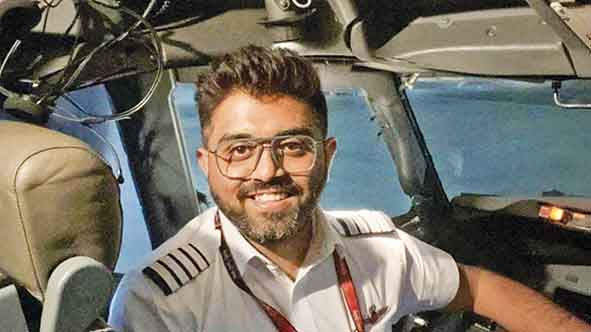
There are many ways to describe courage Captain Smit Machchar’s moment came with a knife at his throat and an aircraft plunging thousands of feet towards disaster.
Seriously wounded after being attacked by his co-pilot, Machchhar, disregarding the human instinct for self-preservation, fought back in a bid to save his aircraft and the 174 lives on it. When he realised that the plane was going down, he used what remained of his strength to open the cockpit door and summon help. Passengers and crew rushed in, overpowered the attacker and enabled other pilots aboard the aircraft to take control. The Boeing 737 was eventually diverted to Tabuk, Saudi Arabia and everyone survived.
This sequence deserves to be understood in its full horror. Machchhar was not a captain calmly responding to an engine failure but the victim of a violent attack inside the cockpit. His hands and neck were badly wounded (one medical witness said his left hand had almost been split apart). At one point, his pulse was dropping and he was losing consciousness. Yet he still managed to open the door that allowed others to enter the cockpit.
Machchhar’s heroic act has invited comparisons with American Captain Chesley “Sully” Sullenberger, who landed a disabled US Airways aircraft on the Hudson River in 2009. But Machchhar’s ordeal presented a different and uniquely terrifying challenge.
Never the stereotypical boy who spent his childhood dreaming of becoming a pilot, he was studying textile engineering because he expected to join his family’s textile business. He then enrolled in management studies at Mumbai’s Welingkar Institute. Aviation entered his life almost accidentally, at an aviation seminar he attended when he was about 19. That was when the aviation bug bit him.
He went to New Zealand for pilot training, returned to India and joined SpiceJet in 2011. Over more than a decade there, he rose to become a senior commander and line-training captain, flying and mentoring other pilots. He accumulated more than 9,500 hours with the airline, including thousands as pilot-in-command. In June 2022, he joined flydubai as a direct-entry captain. His professional profile lists nearly 9,750 flying hours and extensive experience on the Boeing 737, including the 737 MAX.
His friends describe him as calm, composed and down-to-earth. Colleagues remembered a captain who treated loaders, engineers, ground staff and catering workers with the same respect with which he treated fellow pilots. He was also a mentor to young aviators, having helped establish a flying school in Mumbai with three pilot friends in 2017.
There is a revealing detail in the way Machchhar spoke about his profession before the world knew his name. Asked what mattered more, a smooth landing or arriving on time, he reportedly answered: “None. Safe.”
It is tempting, after what happened, to read that sentence as prophecy. On September 30, Machchhar’s philosophy was tested in circumstances no training manual could make ordinary.
There is an almost paradoxical quality to his story. The man who once worried his mother by choosing such an unfamiliar profession became the person those strangers depended upon when the profession became a matter of life and death.
Today, recovering in an Abu Dhabi hospital, Machchhar has spoken less like a celebrity than like a pilot. In an emotional video call with Prime Minister Narendra Modi, he described the ordeal and spoke of fighting for his life. He also said that he recited a prayer to Lord Hanuman during the crisis.
There is something fitting about that mixture of the intensely personal and the intensely professional. The headlines have made Machchhar a hero. But the most revealing portrait of Smit Machchhar is that of a man who did not go looking for heroism, but as a professional who spent years preparing for responsibility. When responsibility finally arrived in its most terrible form, he did not look away.
The remarkable thing is how little of the mythology of heroism appears in the man himself. There is no grand declaration, and no attempt to turn an ordeal into legend. Machchhar’s modest account is that of a pilot who found himself in an impossible situation and did what he believed had to be done.
Smit Machchhar had entered aviation by accident. On September 30, he gave the word “pilot” its fullest meaning.


Comments