

Musk-like Tech-broism is a Tech Diplomacy Terminator

America’s pursuit of technological supremacy risks alienating strategic partners.

Last year, in the aftermath of the first kinetic phase of Operation Sindoor, in August 2025, when Pakistan’s Aseem Muneer visited the US, he threatened- something that comes naturally to the terror state- to attack India’s critical infrastructure. For India, critical infrastructure includes not only industrial installations, strategic terrestrial assets, cities, towns, and villages, but also its space programme. Like any other country, India's space programme is the jugular of technological sovereignty. India is a responsible space power, committed to sustainability and constructive, cooperative space diplomacy; India doesn’t go around asserting itself as a feisty superpower, but it fully understands the harsh realities of space realpolitik and acts when necessary.
While India’s Department of Space has reiterated its intention to expand its share of the global space economy from 2% to 15%, no one in India should presume that large, quick-tempered entities would permit such growth unimpeded. India-US space diplomacy exists, works well, and has an amicable history. It is particularly evident when India launches the Dove satellites of US geospatial firm Planet. This active cooperation also shows up in ISRO and NASA's joint NISAR mission, NASA's ground support for India’s Chandrayaan missions, and scientific exchanges, including astronaut Shubhanshu Shukla's flight on an Axiom orbital mission.
But beyond goodwill, mandates remain: US space companies must obtain their government’s approval to launch satellites on Indian launch vehicles, to ensure captive domestic business for SpaceX. While this is within the US's rights, our government has no such diktats. Our Pixxel, GalaxEye and other commercial space companies continue to launch from US launchers, particularly SpaceX. Indians have typically viewed this business only through a commercial lens, never as a strategic threat. India’s commercial space sector in its formative years has not built its business fundamentals on belligerence and outlandish, unsustainable pipe dreams, it is international yet pragmatic.
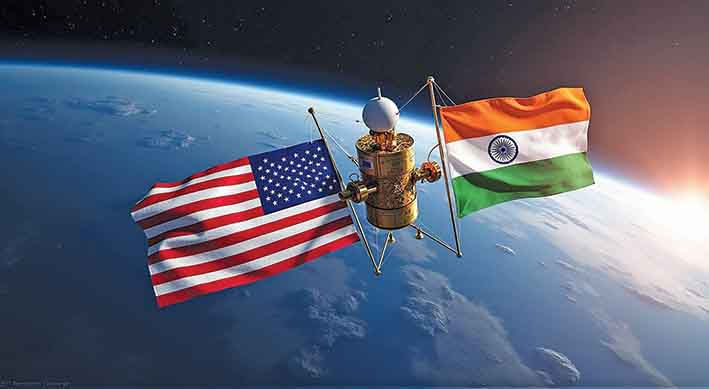
Absolute Dominance
Beyond the functioning of India-US space cooperation, the US space programme singularly works to achieve absolute dominance in outer space and let no other come close. China and Russia are engaged in a great-power contest with the US in the space domain because they acknowledge and challenge this doctrine. India has no reason to do so, as our polity, bureaucracy, and people assume the US is a fellow democracy, a rational business and academic partner. So much so that India has hardly any bilateral space diplomacy with China. With the Russians, it is strictly governmental, as India’s startups and established companies, to avoid the irritation of US sanctions, have found solace in the US space ecosystem. While Delhi and Washington have had plenty of hard talk and amicable resolutions in the past, a major space entity's nervous breakdown on a public platform has never affected their bilateral space diplomacy this much.
Internationally, India’s amicability has often been wrongly perceived as supplication. Indeed, there have been times when India roared and fought for its ‘strategic autonomy’ assertively. However, the default mode has been amicable, at times ‘hard bargaining’, celebrating but not pompous. There is no reason to believe India doesn’t see through any intent to exploit its amicability; it fully recognises when others try to take advantage of it. India’s heft is growing, naturally. Hence, its responses and retaliations are increasingly becoming powerful and unsettling. This is something the tech-bro Elon Musk must have felt when the Indian government failed to meet his persistent and assertive demands for monopolistic clearances.
Respectful Partners
India, since independence, has been at war with transnational terrorism, and so has the US. While superpowers’ achievements are proportional to their capabilities, they stand out more than those of an erstwhile middle power like India. But India has fought hard and surgically. It knows what aids this terrorism and what abets it. These include institutions, cartels, agencies, money flows, and technologies. Today’s confident India can now make punitive strikes against all of these, and do so solo. India does not need a military coalition; all that it needs is steadfast and respectful partners in its anti-terror operations.
Tech-bros of the US, have grown up in the secluded, innovation-friendly climes of the US West Coast, well-endowed by the financial might of the State and War Departments. For many in India, Elon Musk, the man behind SpaceX, has been viewed as a techno-optimist and go-getter with a strong skill set. India appreciates his techno-optimism, but it remembers his unempathetic, boorish nature, as evidenced by reprimands from UK Prime Minister Keir Starmer, French President Emmanuel Macron, German Chancellor Olaf Scholz, Australian Prime Minister Anthony Albanese and Polish Foreign Minister Radosław Sikorski. Musk, in many ways, from his public ill-wishing of coups and civil wars in other countries, has been responsible for Europe moving away from the US, protecting its collective tech sovereignty.
Not just Musk: in 2023, Sam Altman said it is "pretty hopeless" for India to build a foundational AI model like ChatGPT on a small budget (such as $10 million) and compete with companies like his, OpenAI. The infamous New York Times piece on India’s Mars Orbiter Mission is still remembered for the bad taste it left. India appreciates tech bros' achievements and supports whatever constructive comes of it, yet a thinking civilizational nation like India can see through much of their hyperbole and shenanigans. While all public bluster on social media or public platforms can be ignored, what cannot be ignored are threatening statements like what Muneer made from US soil, nor the threats that some of the tech-bro-built technologies bring by inadvertently or inadvertently aiding terrorists.
Starlink is dual-use and with a kill-switch in Musk and his investor’s control; On the peaceful side it could help with education, health, and last-mile connectivity, all of which are well taken. But so can Jio, OneWeb, Rassvett, Qianfan, or even Amazon Leo. Musk wants to hard-sell his pioneering Starlink; he doesn’t want to acknowledge what others are seeing: that Starlink is exploitable, and in various parts of the world it has been a harbinger of collateral threats exploited by malicious terror groups and criminal organisations- its biggest design flaw. India cannot and will not ignore these nefarious actors. India acknowledges the technological advantages; it is concerned that such actors already have access to this technology.
The international community is not getting swayed by ambitious promises of rapid progress compromising their comprehensive security. India aspires to reach Mars and the Moon and become an interplanetary nation; in line with this vision, it has signed the Artemis Accords in recognition of the US ecosystem’s space capabilities. None of this should undermine India’s interests and security. The Indian space sector seeks to collaborate constructively with its US counterparts, and such collaboration would serve well bilaterally when it is the product of mature and responsible engagement.
America’s space cooperation with many partner countries, especially those engaging in the Artemis Accords, has immense potential and will expand only through dedicated efforts by talented, committed, and rational individuals on all sides who will abide by a gentleman’s and lady’s code; they need not be as gifted, coup-wishers as Elon Musk or other ungentlemanly tech-bros like him. The more the US puts ahead such ‘tech diplomacy’ terminators at forefront, the more self-imposed diplomatic exile it will get into. India’s Foreign Minister S. Jaishankar has very dextrously articulated the US as a country deliberately intending to become a lonely superpower. Musk is one catalyst towards that US’ self-imposed friendlessness. India in that case would fight tech-enabled terrorism, against those threatening India, with other like-minded and truly committed partners.
(The writer is a Fellow at the Centre for Security, Strategy and Technology at the Observer Research Foundation and the author of The Long Siege: 500 Years of India’s Struggle for Technopolitical Freedom. Views personal)



Comments