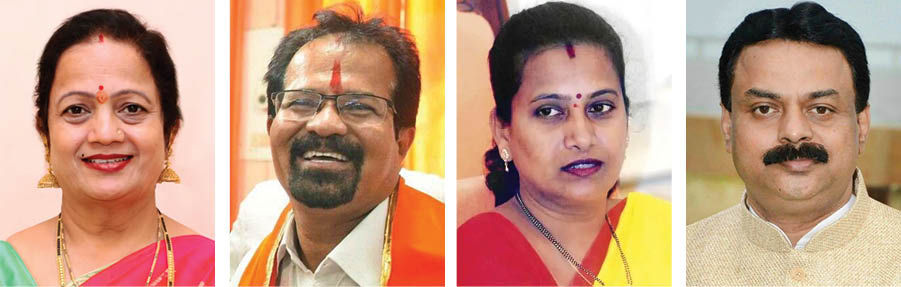
After four years, Mumbai to salute its first citizen Kishori Pednekar Vishwanath Mahadeshwar Snehal Ambekar Sunil Prabhu Mumbai: As the date for appointing Mumbai’s First Citizen looms closer, various political parties have adopted tough posturing to foist their own person for the coveted post of Mayor – the ‘face’ of the country’s commercial capital. Ruling Mahayuti allies Bharatiya Janata Party (BJP) and Shiv Sena have vowed that the city will get a ‘Hindu Marathi’ person to head India’s richest civic body, while the Opposition Shiv Sena (UBT)-Maharashtra Navnirman Sena also harbour fond hopes of a miracle that could ensure their own person for the post. The Maharashtra Vikas Aghadi (MVA) optimism stems from expectations of possible political permutations-combinations that could develop with a realignment of forces as the Supreme Court is hearing the cases involving the Shiv Sena-Nationalist Congress Party this week. Catapulted as the largest single party, the BJP hopes to install a first ever party-man as Mayor, but that may not create history. Way back in 1982-1983, a BJP leader Dr. Prabhakar Pai had served in the top post in Mumbai (then Bombay). Incidentally, Dr. Pai hailed from Udupi district of Karnataka, and his appointment came barely a couple of years after the BJP was formed (1980), capping a distinguished career as a city father, said experts. Originally a Congressman, Dr. Pai later shifted to the Bharatiya Janata Party, then back to Congress briefly, founded the Janata Seva Sangh before immersing himself in social activities. Second Administrator The 2026 Mayoral elections have evoked huge interest not only among Mumbaikars but across the country as it comes after nearly four years since the BMC was governed by an Administrator. This was only the second time in the BMC history that an Administrator was named after April 1984-May 1985. On both occasions, there were election-related issues, the first time the elections got delayed for certain reasons and the second time the polling was put off owing to Ward delimitations and OBC quotas as the matter was pending in the courts. From 1931 till 2022, Mumbai has been lorded over by 76 Mayors, men and women, hailing from various regions, backgrounds, castes and communities. They included Hindus, Muslims, Christians, Parsis, Sikhs, even a Jew, etc., truly reflecting the cosmopolitan personality of the coastal city and India’s financial powerhouse. In 1931-1932, the Mayor was a Parsi, J. B. Boman Behram, and others from his community followed like Khurshed Framji Nariman (after whom Nariman Point is named), E. A. Bandukwala, Minoo Masani, B. N. Karanjia and other bigwigs. There were Muslims like Hoosenally Rahimtoola, Sultan M. Chinoy, the legendary Yusuf Meherally, Dr. A. U. Memon and others. The Christian community got a fair share of Mayors with Joseph A. D’Souza – who was Member of Constituent Assembly representing Bombay Province for writing-approving the Constitution of India, M. U. Mascarenhas, P. A. Dias, Simon C. Fernandes, J. Leon D’Souza, et al. A Jew Elijah Moses (1937-1938) and a Sikh M. H. Bedi (1983-1984), served as Mayors, but post-1985, for the past 40 years, nobody from any minority community occupied the august post. During the silver jubilee year of the post, Sulochana M. Modi became the first woman Mayor of Mumbai (1956), and later with tweaks in the rules, many women ruled in this post – Nirmala Samant-Prabhavalkar (1994-1995), Vishakha Raut (997-1998), Dr. Shubha Raul (March 2007-Nov. 2009), Shraddha Jadhav (Dec. 2009-March 2012), Snehal Ambedkar (Sep. 2014-March 2017). The last incumbent (before the Administrator) was a government nurse, Kishori Pednekar (Nov. 2019-March 2022) - who earned the sobriquet of ‘Florence Nightingale’ of Mumbai - as she flitted around in her full white uniform at the height of the Covid-19 Pandemic, earning the admiration of the citizens. Mumbai Mayor – high-profile post The Mumbai Mayor’s post is considered a crucial step in the political ladder and many went on to become MLAs, MPs, state-central ministers, a Lok Sabha Speaker, Chief Ministers and union ministers. The formidable S. K. Patil was Mayor (1949-1952) and later served in the union cabinets of PMs Jawaharlal Nehru, Lah Bahadur Shastri and Indira Gandhi; Dahyabhai V. Patel (1954-1955) was the son of India’s first Home Minister Sardar Vallabhbhai Patel; Manohar Joshi (1976-1977) became the CM of Maharashtra, later union minister and Speaker of Lok Sabha; Chhagan Bhujbal (1985-1986 – 1990-1991) became a Deputy CM.



Comments