top of page

By:

Quaid Najmi

4 January 2025 at 3:26:24 pm

Thackerays’ ‘Taandav’ for trees, tigers

AI generated image Mumbai: Maharashtra Navnirman Sena (MNS) President Raj Thackeray launched a sharp attack on the government for the systematic degradation of the state’s environment under the garb of development, even as the climate change poses a direct threat to the environment, economy, agriculture, public health and the future of both rural and urban centres. Questioning the state government’s claims of having planted millions of trees, he rued how the World Environment Day has been...

Thackerays’ ‘Taandav’ for trees, tigers

AI generated image Mumbai: Maharashtra Navnirman Sena (MNS) President Raj Thackeray launched a sharp attack on the government for the systematic degradation of the state’s environment under the garb of development, even as the climate change poses a direct threat to the environment, economy, agriculture, public health and the future of both rural and urban centres. Questioning the state government’s claims of having planted millions of trees, he rued how the World Environment Day has been reduced to an annual ritual of tree-planting drives and clicking selfies for social media, though 90 pc of the saplings don’t survive even a day. “Only the government knows where those trees really are,” said Raj sternly. He recalled a "Blueprint of Maharashtra’s Development" he had proposed in 2015, in which he advocated how development without environmental sensitivity is hollow. Justifying, he said that the consequences are visible where roads, bridges and infrastructure projects are hailed as achievements, but even a short spell of rainfall can paralyze entire cities. Referring to recent reports on farmers returning from the fields after 10 am due to the scorching heat, Raj said that the worsening climate crisis has become an everyday reality. Citing official statistics, Raj claimed that extreme heat has caused productivity losses of nearly USD 159 billion and slashing of 160 billion work-hours annually in recent years. He mentioned the World Bank estimates that India’s GDP could plummet by 2.5-4.5 pc while 57 pc of the country’s districts sheltering 76 pc of the population stare at serious climate-related crises. Taking a swipe, he said while the governments boast about growth figures and economical rankings, they are silent on the staggering costs of environmental destruction. He questioned the development model “whether flooded cities, washed-away crops and unbearable summers” genuinely indicate progress. Claiming that Maharashtra was increasingly becoming unliveable for upto 8 months in a year, he said excessive monsoon rains disrupt rural life and urban floods cripple cities, while extreme heat make normal life a torture in summers in both urban-rural areas. Targeting the Centre, Raj alleged that nearly 173,984 hectares of forest lands were diverted in the past 11 years for mining and infrastructure projects to benefit the PM’s single favourite Adani Group. He said that these lands amount to 1,730 sqkm, or equivalent to the area of 16 Sanjay Gandhi National Park (SGNP) that is spread over barely 104 sqkm. Dissolve state wildlife board: Aaditya Shiv Sena (UBT) leader Aditya Thackeray has accused the Maharashtra government for issuing a permit to carry out mining activity in the sensitive tiger corridor between the Tadoba-Andhari and Indravati sanctuaries housing the big striped cats. In a strongly-worded letter to the National Tiger Conservation Authority (NTCA) Member-Secretary Sanjay Kumar, Thackeray sought his immediate personal intervention, sacking the Maharashtra State Board for Wild-Life (SBWL), revoking the permit, and probe against the Chief Wildlife Warden & Principal Chief Conservator of Forests (PCCF) M. Srinivasa Reddy for the alleged lacunae. Aditya’s two-pager says the permit has been granted for “scientific exploration and excavation/systematic recovery of low-grade iron ore in existing mines in villages Hedri, Bande, Parsalgondi and Round Parsalgondi, in the Etapalli taluka of Gadchiroli district”. Last January, Aditya – MLA from Worli – had first raised the issue saying that the proposed mine would create only 120 jobs, including 32 permanent, and the estimated output is pegged at 1.1 million tons in a year. Referring to two letters of Reddy – on April 28 and May 21 – the SS (UBT) leader claimed that in communications to the state government, the PCCF had changed his stance on the issue. Aditya said that in the first letter, Reddy had effectively opposed the government plans for mining activity but in the second letter, he took a somersault, ostensibly due to government pressures or some commercial interests, “the U-turn is disgraceful and detrimental to India’s national interest” – and this abrupt shift in stance must be investigated thoroughly. In view of the contrary stance of the PCCF Reddy, entrusted with protecting the wildlife but failing to defend the NTCA and NBWL, point to serious malfunctioning of the SBWL, and hence it must be dissolved, besides reviewing all its decisions in the past three years, particularly those pertaining to hazardous activities in sensitive areas, demanded Aditya. 444 tigers roam in 11,000 sq.km As per the Status of Tiger Report (2002), and the Maharashtra Economic Survey 2025-2026, the state boasts of 444 tigers prowling in the wild along with other menacing creatures. The state’s total protected wildlife network of 88 Notified Areas of National Parks, Sanctuaries, and Conservation Reserves - including 6 dedicated to the striped big cats – is spread over 11,092 sq. kms as per current data.

Nadda's strategic meet signals urgency for chemical sector

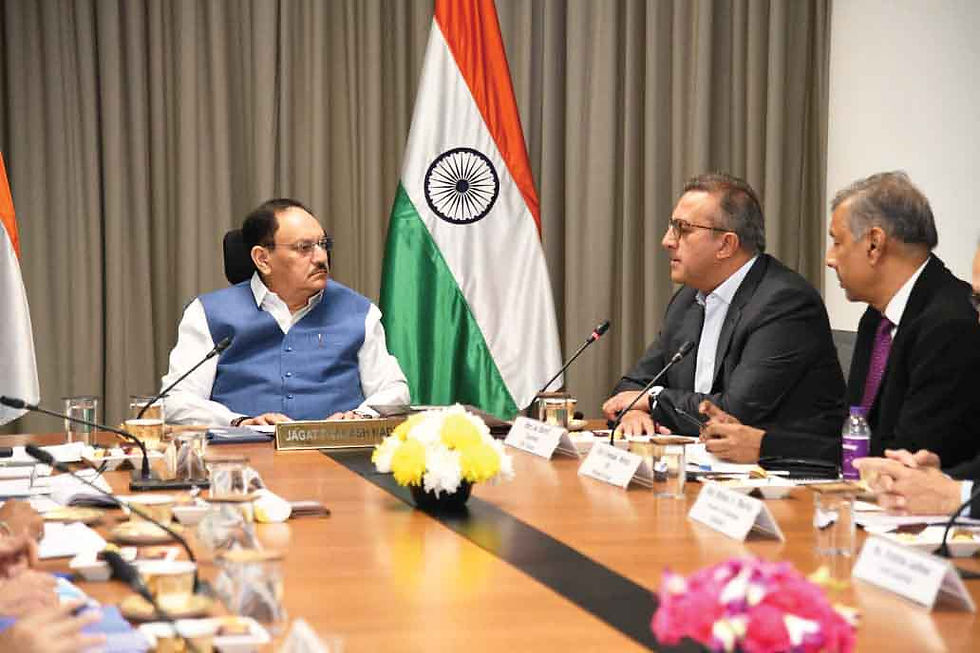
New Delhi: As war simmers across the volatile landscape of West Asia, whether in the form of a direct confrontation between Israel, United States and Iran, or through Iran's hybrid warfare involving groups like Hezbollah and the Houthis, the tremors are no longer confined to the region's borders. They are coursing through the arteries of the global economy. India's chemicals and petrochemicals sector, heavily dependent on this region for critical raw materials, finds itself among the earliest and hardest hit by this geopolitical turbulence.


It is in this backdrop that the recent meeting convened by Union Minister for Chemicals and Fertilisers J. P. Nadda at Kartavya Bhavan must be seen not as a routine consultation, but as a signal of strategic urgency. India's ambition to scale this sector from its current valuation of $220 billion to $1 trillion by 2040, and further to $1.5 trillion by 2047, will remain aspirational unless the country confronts its structural vulnerabilities with clarity and resolve.


India today ranks as the world's sixth-largest producer of chemicals and the third-largest in Asia. The sector contributes 6-7 percent to GDP and underpins a wide spectrum of industries, from agriculture and pharmaceuticals to automobiles, construction, and electronics. It would be no exaggeration to call it the backbone of modern industrial India.


Yet, embedded within this strength is a paradox. India's share in the global chemical value chain (GVC) stands at a modest 3.5 percent. A trade deficit of $31 billion in 2023 underscores a deeper issue: while India produces at scale, it remains marginal in high-value segments. This imbalance becomes starkly visible when disruptions in West Asia choke the supply of key feedstocks, shaking the very foundations of domestic industry.


Supply Disruption

The current crisis has laid this fragility bare. Disruptions in the supply of LNG, LPG, and sulfur have led to production cuts of 30-50 percent in several segments. With nearly 65 percent of sulfur imports sourced from the Middle East, the ripple effects have extended beyond chemicals to fertilisers, plastics, textiles, and other downstream industries. Strategic chokepoints such as the Strait of Hormuz have witnessed disruptions, pushing shipping costs up by 20-30 percent and adding further strain to cost structures.


This is precisely where Nadda's emphasis on supply chain diversification and resilience appears prescient. In today's world, self-reliance cannot mean isolation; it must translate into strategic flexibility. While India imports crude oil from as many as 41 countries, several critical inputs for the chemical industry remain concentrated in a handful of sources, arguably the sector's most significant vulnerability.


Opportunity Ahead

A recent report by NITI Aayog outlines a pathway to convert this vulnerability into opportunity. It envisions raising India's GVC share to 5-6 percent by 2030 and to 12 percent by 2040. If achieved, the sector could not only reach the $1 trillion mark but also generate over 700,000 jobs. However, this transformation will demand more than policy intent, it will require sustained investment and disciplined execution.


The most pressing challenge lies in research and innovation. India currently spends just 0.7 percent of industry revenue on R&D, compared to a global average of 2.3 percent. This gap explains why the country remains largely confined to basic chemicals, even as the world moves toward specialty and high-value products. Bridging this divide is essential if India is to climb the value chain.


Equally constraining is the fragmented nature of the industry. Dominated by MSMEs with limited access to capital and technology, the sector struggles to compete globally. Cluster-based development models offer a pragmatic way forward, such as PCPIRs and the proposed chemical parks.

Comments


bottom of page