top of page

By:

Abhijit Mulye

21 August 2024 at 11:29:11 am

NDA power matrix reshaped after success

AI generated image Mumbai: A quiet coup in the state has triggered a loud shift in the power dynamics of the nation’s capital. By engineering the defection of six additional MPs, Deputy Chief Minister Eknath Shinde has nearly doubled his parliamentary muscle, transforming his Shiv Sena faction from a junior regional partner into an indispensable pillar of the NDA. Now sitting on a commanding 13 seats, Shinde has dramatically increased his political leverage—leaving a cautious BJP to weigh the...

NDA power matrix reshaped after success

AI generated image Mumbai: A quiet coup in the state has triggered a loud shift in the power dynamics of the nation’s capital. By engineering the defection of six additional MPs, Deputy Chief Minister Eknath Shinde has nearly doubled his parliamentary muscle, transforming his Shiv Sena faction from a junior regional partner into an indispensable pillar of the NDA. Now sitting on a commanding 13 seats, Shinde has dramatically increased his political leverage—leaving a cautious BJP to weigh the cost of an emboldened ally demanding a bigger slice of the pie in both the Union and state cabinets. In a masterstroke of political engineering that has profoundly jolted political landscape, Shinde has once again demonstrated his formidable capacity for disruption. The rebellion of six out of nine Lok Sabha Members of Parliament from the Uddhav Thackeray-led Shiv Sena (UBT), ostensibly joining Shinde’s ranks under the banner of “Operation Tiger,” is not merely a regional skirmish. It is a calculated power play that reverberates through the highest corridors of power in New Delhi. By nearly doubling his party’s strength in the lower house from seven to thirteen MPs, Shinde has dramatically altered his own political trajectory, elevating his faction from a helpful regional ally to an indispensable pillar of the National Democratic Alliance (NDA). Shinde’s Stature The immediate consequence of this crossover is a massive surge in Shinde’s stature within the NDA hierarchy. With thirteen parliamentarians, his Shiv Sena is now poised to become the fourth-largest bloc in the ruling national coalition, sitting just behind the Bharatiya Janata Party, the Telugu Desam Party, and the newly formed Nationalist Citizens Party of India. This numerical leap is of immense strategic value to the BJP-led central government. In a parliamentary environment where the ruling coalition possesses only a modest majority, every single seat counts. The central leadership is acutely aware of upcoming legislative hurdles, particularly ambitious constitutional amendments like the proposed delimitation bill, which will require a formidable two-thirds majority. By acting as the architect of this crucial numerical boost, Shinde has cemented his reputation as a reliable and highly effective operator for the NDA, significantly increasing his bargaining power and political leverage. National Relief For the BJP, this development evokes a complex mixture of profound national relief and acute regional anxiety. From the vantage point of PM Narendra Modi and Union Home Minister Amit Shah, Shinde’s successful poaching operation is a clear windfall. It simultaneously fortifies the NDA’s numerical strength in New Delhi while severely crippling a vocal opposition force in Maharashtra. The central BJP leadership views Shinde as a vital asset capable of bridging the gap between their current numbers and the overwhelming mandates of the past. However, the perspective from the Maharashtra BJP headquarters is noticeably more apprehensive. State BJP leaders openly acknowledge Shinde’s soaring political equity, but they are increasingly wary of his expanding ambitions. They recognize that an emboldened Shinde, eager to fill the political vacuum left by Uddhav Thackeray and a fragmented Nationalist Congress Party, will aggressively attempt to expand his footprint across the state, potentially encroaching upon the BJP’s own traditional support bases. Power Sharing This dramatically enhanced political heft immediately raises pressing questions regarding power-sharing arrangements, both at the Centre and in the state. Armed with thirteen MPs, Shinde’s camp is undoubtedly preparing to seek greater political rewards. In the Union Cabinet, his demand for an additional, high-profile ministerial berth is now backed by solid arithmetic. Given his heightened utility to the national coalition, the BJP high command is highly likely to accommodate this request during the next cabinet reshuffle. However, the power struggle within the Maharashtra state cabinet promises to be far more contentious. Shinde, who had to settle for the Deputy Chief Ministership behind Devendra Fadnavis following the last assembly elections, may now feel emboldened to petition the BJP leadership for the top job. The BJP’s state unit is actively preparing to fiercely resist any such demand. Senior BJP leaders are quick to emphasize that despite his parliamentary gains, Shinde’s legislative strength in the state assembly hovers around 57 MLAs, dwarfed by the BJP’s commanding 132 legislators. Consequently, conceding the Chief Minister’s chair remains highly improbable. Instead, the BJP will be forced into a delicate balancing act, likely appeasing Shinde by granting his faction a larger share of influential, heavyweight portfolios within the state government to keep the alliance stable. Ultimately, through sheer political audacity, Eknath Shinde has ensured that neither New Delhi nor Mumbai can afford to govern without catering to his increasingly formidable political weight.

NDA power matrix reshaped after success

AI generated image
AI generated image

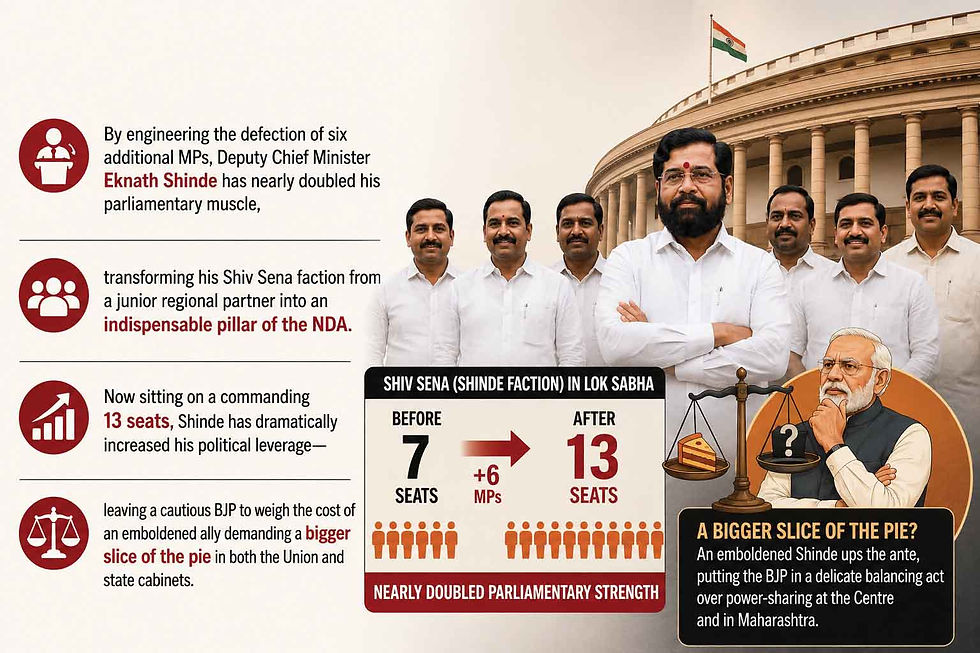
Mumbai: A quiet coup in the state has triggered a loud shift in the power dynamics of the nation’s capital. By engineering the defection of six additional MPs, Deputy Chief Minister Eknath Shinde has nearly doubled his parliamentary muscle, transforming his Shiv Sena faction from a junior regional partner into an indispensable pillar of the NDA.


Now sitting on a commanding 13 seats, Shinde has dramatically increased his political leverage—leaving a cautious BJP to weigh the cost of an emboldened ally demanding a bigger slice of the pie in both the Union and state cabinets.


In a masterstroke of political engineering that has profoundly jolted political landscape, Shinde has once again demonstrated his formidable capacity for disruption. The rebellion of six out of nine Lok Sabha Members of Parliament from the Uddhav Thackeray-led Shiv Sena (UBT), ostensibly joining Shinde’s ranks under the banner of “Operation Tiger,” is not merely a regional skirmish. It is a calculated power play that reverberates through the highest corridors of power in New Delhi. By nearly doubling his party’s strength in the lower house from seven to thirteen MPs, Shinde has dramatically altered his own political trajectory, elevating his faction from a helpful regional ally to an indispensable pillar of the National Democratic Alliance (NDA).


Shinde’s Stature

The immediate consequence of this crossover is a massive surge in Shinde’s stature within the NDA hierarchy. With thirteen parliamentarians, his Shiv Sena is now poised to become the fourth-largest bloc in the ruling national coalition, sitting just behind the Bharatiya Janata Party, the Telugu Desam Party, and the newly formed Nationalist Citizens Party of India. This numerical leap is of immense strategic value to the BJP-led central government.


In a parliamentary environment where the ruling coalition possesses only a modest majority, every single seat counts. The central leadership is acutely aware of upcoming legislative hurdles, particularly ambitious constitutional amendments like the proposed delimitation bill, which will require a formidable two-thirds majority. By acting as the architect of this crucial numerical boost, Shinde has cemented his reputation as a reliable and highly effective operator for the NDA, significantly increasing his bargaining power and political leverage.


National Relief

For the BJP, this development evokes a complex mixture of profound national relief and acute regional anxiety. From the vantage point of PM Narendra Modi and Union Home Minister Amit Shah, Shinde’s successful poaching operation is a clear windfall. It simultaneously fortifies the NDA’s numerical strength in New Delhi while severely crippling a vocal opposition force in Maharashtra. The central BJP leadership views Shinde as a vital asset capable of bridging the gap between their current numbers and the overwhelming mandates of the past.


However, the perspective from the Maharashtra BJP headquarters is noticeably more apprehensive. State BJP leaders openly acknowledge Shinde’s soaring political equity, but they are increasingly wary of his expanding ambitions. They recognize that an emboldened Shinde, eager to fill the political vacuum left by Uddhav Thackeray and a fragmented Nationalist Congress Party, will aggressively attempt to expand his footprint across the state, potentially encroaching upon the BJP’s own traditional support bases.


Power Sharing

This dramatically enhanced political heft immediately raises pressing questions regarding power-sharing arrangements, both at the Centre and in the state. Armed with thirteen MPs, Shinde’s camp is undoubtedly preparing to seek greater political rewards. In the Union Cabinet, his demand for an additional, high-profile ministerial berth is now backed by solid arithmetic. Given his heightened utility to the national coalition, the BJP high command is highly likely to accommodate this request during the next cabinet reshuffle.


However, the power struggle within the Maharashtra state cabinet promises to be far more contentious. Shinde, who had to settle for the Deputy Chief Ministership behind Devendra Fadnavis following the last assembly elections, may now feel emboldened to petition the BJP leadership for the top job. The BJP’s state unit is actively preparing to fiercely resist any such demand. Senior BJP leaders are quick to emphasize that despite his parliamentary gains, Shinde’s legislative strength in the state assembly hovers around 57 MLAs, dwarfed by the BJP’s commanding 132 legislators. Consequently, conceding the Chief Minister’s chair remains highly improbable. Instead, the BJP will be forced into a delicate balancing act, likely appeasing Shinde by granting his faction a larger share of influential, heavyweight portfolios within the state government to keep the alliance stable. Ultimately, through sheer political audacity, Eknath Shinde has ensured that neither New Delhi nor Mumbai can afford to govern without catering to his increasingly formidable political weight.

Comments


bottom of page