
Pawar vs Pawar: A Dynasty Divided


In Maharashtra’s long and complicated history of politics, very few stories are as fascinating or as layered as the silent but very real tug-of-war happening inside the Pawar family. On one side stands the patriarch, 85-year-old Sharad Pawar, one of India’s sharp political minds who has been Chief Minister of Maharashtra four times.
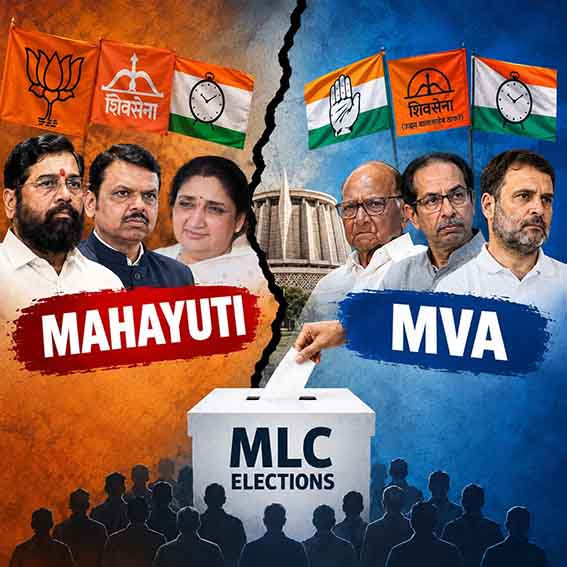
On the other stands Parth Pawar, his grandnephew and son of the deceased Ajit Pawar, who has just been sworn in as a Rajya Sabha MP. While Sharad Pawar, as the chief of NCP (SP), was fielded by the opposition alliance Maha Vikas Aghadi (MVA), Parth was fielded by the NCP aligned with the ruling Mahayuti alliance led by Chief Minister Devendra Fadnavis.
To understand why Sharad Pawar is unhappy with Parth, one must understand why the octogenarian is miffed with Fadnavis. In 2014, when Fadnavis first became the Chief Minister of Maharashtra, Pawar Sr. had quietly hoped that Eknath Khadse, then a senior BJP leader from north Maharashtra, who was known to be friendly with the undivided NCP, would get the top job. If Khadse became CM, Sharad Pawar believed he could control the State government’s decisions from behind the scenes.
But the smart and careful Fadnavis got the job instead, throwing cold water over Pawar’s plans. Still, Maharashtra’s Machiavelli tried to adjust. He gave indirect support to the BJP government during a difficult period when the BJP and Shiv Sena were quarrelling with each other.
But Fadnavis was always one step ahead. He outplayed his intra-party BJP rivals like Khadse, Vinod Tawde and Pankaja Munde.
Byzantine Intrigue
In July 2023, Ajit Pawar’s defection to the Mahayuti and splitting of the NCP was a major blow for Sharad Pawar. While some claim Pawar had fought hard to stop this from happening, other ‘conspiracy theorists’ believe that it was actually Sharad Pawar’s own strategy to align with the ruling BJP and return to power.
After all, a similar move had occurred in 2019, when Fadnavis and Ajit Pawar startled Maharashtra with their infamous early morning oath-taking ceremony. However, that arrangement collapsed soon after, reportedly due to Sharad Pawar’s intervention.
It is said that this incident deeply upset both Ajit Pawar and Devendra Fadnavis, who, since then developed a strong tacit understanding. Many feel that it was this growing closeness that has also strengthened the position of Parth Pawar and Sunetra Pawar today. Some political observers believe that this entire chain of events has quietly reshaped the balance of power within the Pawar family and Maharashtra politics.
First, Eknath Shinde’s revolt in 2022 had rent the Shiv Sena asunder and triggered the collapse of Uddhav Thackeray’s MVA government – whose architect was Sharad Pawar. Then, Ajit Pawar’s defection further limited his room for manoeuvre.
Parth Pawar is young, clipped in speech, and (say those who watch him closely) more calculating than his occasional bursts of bluntness suggest. He first drew wider notice during the Sushant Singh Rajput case, when, despite being a part of the ruling MVA government (as the undivided NCP was allied to the MVA coalition), he demanded a Central Bureau of Investigation probe - an intervention that irked Sharad Pawar, who brusquely dismissed his grandson’s views in public.
Now, Parth has taken the oath as a member of the Rajya Sabha. The ceremony signalled that the next generation of Nationalist Congress Party leadership from Ajit Pawar’s branch has arrived on the national stage.
Chief Ministerial Ambition
For Sharad Pawar, two figures complicate his long-cherished ambition of seeing his daughter, Supriya Sule, ascend to Maharashtra’s Chief Ministership: Parth and Devendra Fadnavis.
Sule is an established parliamentarian, having repeatedly won Baramati and, in 2024, defeating her sister-in-law Sunetra Pawar in a bruising and emotive contest. Yet, success in national politics does not easily translate into dominance at the state level. To become CM, she would need to pivot decisively to Maharashtra’s rough-and-tumble assembly politics by winning over legislators, cadre and voters in a far more fragmented arena. Sharad Pawar knows the climb will be steep.
He also knows that Parth’s steady rise, especially if coupled with closer ties to Fadnavis and the BJP’s central leadership, could recreate a familiar problem. For years, Ajit Pawar’s proximity to the BJP and his command over the state apparatus had constrained Sule’s ascent. In Parth, some see the outline of a similar dynamic taking shape.
This outline has become sharper after Ajit Pawar’s tragic death in a plane crash near Baramati in January. Within days, Sunetra Pawar was elevated - first as leader of the NCP legislature party, then sworn in as Deputy Chief Minister. The speed of her ascent has discomfited Sharad Pawar.
She has begun, quietly but firmly, to consolidate control over her faction. A recent visit to Delhi - noticeably without senior leaders such as Praful Patel and Sunil Tatkare - hinted at a deliberate centralisation of authority, with Parth positioned as the key interlocutor with the BJP’s high command.
The generational shift is broader still. Sunetra’s younger son, Jay Pawar, has been inducted into the party’s top decision-making body. And when Parth took a swipe at the Congress during the Baramati bypoll by calling its decision to field a candidate the start of its “downfall,” Sharad Pawar issued a pointed rebuke, stressing the need for “maturity” in political commentary. It was a rare public dressing-down within a family accustomed to managing its differences behind closed doors. Sule, for her part, responded more gently, invoking the Congress’s long national role.
Even so, Sharad Pawar is hedging. He has been nurturing Rohit Pawar, a younger MLA who has consistently taken a hard line against Fadnavis, as a potential organisational counterweight - someone who could anchor Sule’s prospects within the state.
The result is a family divided by political strategy. On one side stand Sharad Pawar and Sule, aligned with the Opposition. On the other, Sunetra and Parth Pawar, embedded within the ruling establishment and building bridges with the BJP. For now, civility prevails.
But beneath it lies a contest that is at once personal and political: a struggle over succession, influence and Maharashtra’s most coveted office. With the patriarch ageing, time is not on anyone’s side.
(The writer is a political observer. Views personal.)

Comments