

Plastic Bags: A Bad Habit We Don’t Question
- Dr. Sanjay Joshi

- Jan 9
- 3 min read
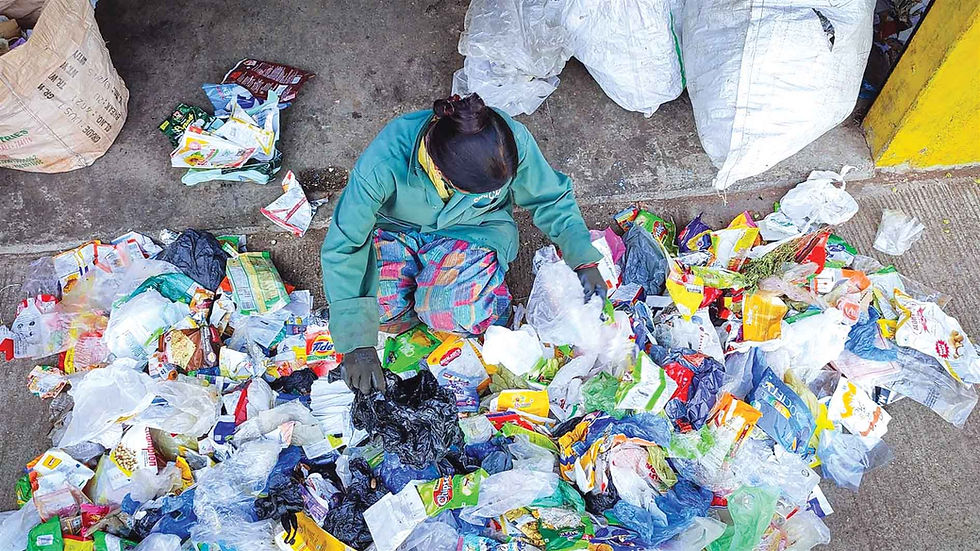
Convenient as they are, one-time plastic shopping bags eventually land in garbage dumps and become pollution.

Welcome to 2026, dear reader!
Before I continue, let me briefly recall where the seminar discussion had paused. I had shared a simple incident from a vegetable market to explain that plastic by itself does not create pollution. It was at this point that one of the attendees remarked how most of us reuse plastic carry bags to collect household garbage, only to discard them later in dustbins or roadside heaps. That observation struck a chord and prompted quiet reflection across the room.
I left my narration at that point and looked at the audience. Most of them were deep in thought, perhaps trying to connect the incident with their own daily experiences. The hall was unusually quiet, as if everyone was replaying familiar scenes in their minds.
After a brief pause, one of the participants raised his hand and sought permission to speak. “Sir, I remember a similar incident,” he began. “The other day, I went to buy a couple of tender coconuts from a roadside vendor.”
He described how several customers were waiting for their turn. The vendor was working swiftly—cutting open the coconut shell, exposing the tender portion, and then, as per the customer’s demand, placing the coconut into a plastic carry bag. Along with it, he would add a couple of plastic straws, which were handed over without a second thought.
Some customers drank the coconut water right there, using the plastic straws provided. After finishing, the straw was either thrown into a nearby dustbin or stuffed back into a plastic bag and casually discarded somewhere around the vendor’s cart.
“One gentleman”, the participant continued, “asked the vendor to empty the coconut water into a small plastic pouch, put that pouch into another plastic bag, and then happily walked away, carrying the bag as if it were something precious.” Another customer bought only the ‘malai’—the fresh pulp scooped out from the coconut. The vendor repeated the same process again, using plastic bags as before. This cycle went on continuously.
The participant then admitted something important. He said he, too, had taken coconuts in the plastic bag provided by the vendor. At that moment, he did not find anything odd about it. It felt completely normal. In fact, not taking things in plastic carry bags seemed unusual, even inconvenient.
Then came his realisation. “Now I am slowly beginning to understand what you are trying to highlight,” he said. “Once we take home different products in plastic carry bags, we don’t store those bags carefully. Most of the time, they are treated as waste. Eventually, they end up either in landfills or, more commonly, in roadside garbage heaps.”
He paused and added, “In countries like India, as we all know, the final destination of such plastic bags is usually the open garbage dump.” With that, he ended his narration.
The forum was then opened for discussion. As expected, many others joined in. Almost everyone had a similar story to share. By the end of the discussion, there was broad agreement that the root cause of plastic pollution is not plastic itself, but our lack of discipline—our behaviour, carelessness, and attitude.
We never think twice before discarding a plastic bag, whether into a dustbin or an open garbage heap. One participant summed it up rather wittily by saying that plastic bags do not walk out and land in garbage dumps on their own. It is we, the users, who put them there.
Still, one person remained unconvinced. He wanted to understand why plastic bags and other items cause pollution even after being discarded. I asked him to hold on to his curiosity until next week.
I request you, dear readers, to do the same. Until then, have a great weekend and a very happy and prosperous New Year.
(The author is an environmentalist. Views personal.)


Comments